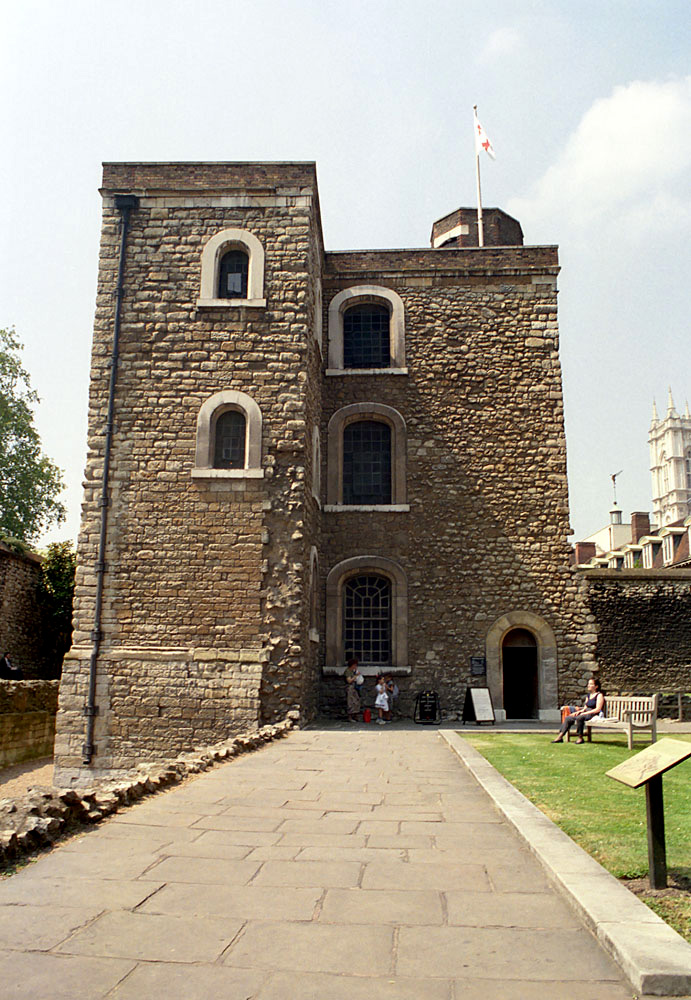
The Jewel Tower of the remains of the medieval Palace of Westminster. Photo May 1998.
The Jewel Tower of the remains of the medieval Palace of Westminster. Photo May 1998.
If you’ve got about US$68,000 to spare.
From the New York Times:
The Vatican has opened its Secret Archives, the repository of centuries worth of documents pertaining to the Holy See, to let the world get a closer look at a document presaging England
I’ve been seeing various short articles coming through my news alerts saying that Joss Stone will be back as Anne of Cleves during the 4th season of “The Tudors”. I haven’t seen any information on how many episodes she’ll be in though.
I’ve been seeing a few interesting reviews about “Wolf Hall”, a novel about Thomas Cromwell, coming through on my Google news alerts and I also received a recommendation from Foose, so I thought it was time to look into this book some more! Here’s the product description from Amazon, as well as an order link for Amazon UK (where the book is already out) and a pre-order link for the US Amazon, where it will be out in October. I’m personally hoping it is eventually at Audible, since that’s how I “read” a lot of books these days!
In the ruthless arena of King Henry VIII
There is a post up at the British Library’s blog for the Henry VIII: Man & Monarch exhibition about the location for the famous Field of Cloth of Gold, including a photo of the current marker. Check it out!

Wooden tankard recovered from the wreck of The Mary Rose. Photo June 2000.

In addition to being the anniversary of Henry VII’s death and Henry VIII’s accession to the throne (and his marriage to Catherine of Aragon), it is also the 500th anniversary of the death of Lady Margaret Beaufort, mother of Henry VII. Christ’s College, Cambridge was founded by Margaret and they will be holding an event on June 27 in her honor including talks, evensong, a banquet and more.

(Picture taken with my laptop’s built-in webcam in my office at work)
I haven’t had a chance to do a thorough flip-through yet, but I can’t wait to dig in!
Andrea was kind enough to put together this timeline of Anne Boleyn’s fall, so you can following along in “real time” as we go through the month of May. If I was more organized and had more time, I’d set these up as individual posts to come on the appropriate days!
Late January 1536 – Anne Boleyn miscarries for second time
February – Anne Boleyn recovering
4 February – Henry busy with Parliament
Mid-March – Henry has become serious about Jane Seymour (the purse of soveriegns incident)
Lent – Henry facilitates Chapuys’ snub of
Although I’ve linked to the exhibition stuff already, I wanted to point out this link to some key documents related to Henry VIII that the British Library has in their online galleries. They also have clips from Starkey’s “Henry: The Mind of a Tyrant” series.
BBC News video:
Additional articles:
The Guardian: Kenilworth Castle garden reopens
The Independent: Recreated, the Tudor garden where an ambitious earl wooed the Virgin Queen

Leeds Castle. May 2003
If ever there was a place I need to go back and visit on a nicer day, it’s Leeds Castle! It’s such a beautiful castle and setting, it’s really a shame it was such so damp and dreary when we were there. Still, a lovely place to visit!
From The Telegraph:
Queen thanks Yeomen of the Guard on 500th anniversary of Henry VII’s death
The Queen expressed her thanks to the Yeomen of the Guard as she honoured the founder of the famous royal bodyguards.
More than 70 Yeomen – resplendent in their distinctive red and gold tunics, large white ruffled collars, scarlet stockings and flat brimmed black Tudor hats – gathered in Westminster Abbey in tribute to King Henry VII.
Henry VII created the Queen’s Body Guard of the Yeomen of the Guard in 1485 at the Battle of Bosworth.
To mark the 500th anniversary of his death, the Queen placed a posy at his tomb in the Abbey’s Lady Chapel.
And you could win a
Here it is, finally!
Henry VIII 500th Anniversary events page
August 2007 podcast that included Empson and Dudley: http://tudorhistory.org/podcast/08-2007.html
[Comments are closed on older posts. If you wish to make a comment, please contact Lara via the link in the sidebar.]
Just wanted to let everyone know that the answers from Leanda de Lisle Q&A have now been posted over at the Lady Jane Grey Reference site!
From the Channel 4 website
I got this fun press release from the British Library in conjunction with the opening of the Henry VIII – Man and Monarch exhibition
They’ve also started a Henry VIII exhibition blog and a podcast!
And here is my previous post about the exhibition catalogue. I ordered mine yesterday and it has already shipped. Can’t wait to see it!
THE CREDIT CRUNCH KING
HOW HENRY VIII DIED IN DEBT AND OTHER THINGS YOU DIDN
If you’ve ever wondered what goes in to researching portrait identification, head on over to Stephan Edwards’ (a.k.a PhD Historian) website to see some fascinating work that he recently did.
Here’s the abstract:
In mid February 2009, I was contacted by a private collector in regard to a painting he had recently purchased from an estate. The painting, seen above, bears the label Princess Elizabeth (afterwards Queen) , “The Harington Portrait” and has been attributed in the past to the artist Antonio Mor (d. ca. 1578). The collector questioned the identification and requested my opinion on it. I was able to determine at first glance that it was not, in fact, an authentic portrait of Elizabeth Tudor, so the owner asked for my assistance in determining who the sitter may have actually been. Thus began a two-month period of intensive research, and the results of that investigation are now presented here for the first time.

Armor for man and horse of Henry VIII from about 1515, on display at the White Tower in the Tower of London. Photo May 2003.
In celebration of the 500th anniversary of Henry VIII’s accession to the throne this week, I went with this picture of armor from early in Henry’s reign. The gold-colored (it’s actually brass) border of the skirt on the human armor are the letters H and K (for Henry and Katherine). This armor is currently part of the Dressed to Kill exhibition at the Tower of London.

