Sunday Short Takes

* The October edition of History Today features Elizabeth I on the cover and you can read the article Elizabeth I: Exception to the Rule free on the site.

* The Vivat Rex! exhibition that was at the Grolier Club in New York last year celebrating the 500th anniversary of Henry VIII’s accession to the throne is now on at the Folger Shakespeare Library in Washington DC. Click the link for an online exhibition.

* The Harry Ransom Center (at the University of Texas – my alma mater and employer) has published a three-part series on Books of Hours, from medieval times to the post-Reformation period. The first part is here, with links to the second and third parts at the bottom of that page.

* The always entertaining Cracked.com posted 5 Fictional Stories You Were Taught in History Class and readers of this site might be interested to see what the number 1 entry is!

* The Tudors Complete Series DVD set will be coming out in the US on November 23 (just in time for the holidays!). Amazon pre-order link below:

See the Phoenix and Pelican portraits together this week only

Oh boy do I wish I was in London!

From the BBC:

Art historians are one step closer to discovering the identity of a royal painter thanks to scientific research.

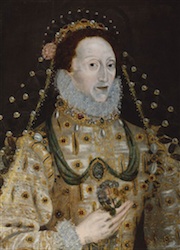
Analysis by the National Portrait Gallery of two renowned portraits of Elizabeth I has shown they were painted on wood from the same two trees.

The 16th century paintings have been associated with artist Nicholas Hilliard for many years.

Curator Tarnya Cooper said the research meant the work is probably that of Hilliard or someone working with him.

Full article

More from The Guardian

And more from the National Portrait Gallery website, including a really interesting infrared image of the Phoenix portrait.

Round-up of links about Lady Jane Grey

Two of these come from the very excellent Lady Jane Grey Reference Guide Blog which I’m sure most of you also read, but just in case you don’t I’d like to highlight some recent posts.

In a previous post reminding people about the Delaroche exhibition and Leanda de Lisle’s talk there, I asked for anyone to let me know if they got a chance to go. Here’s a write-up from the Lady Jane Grey blog: Death Becomes Her: The Life and Afterlife of Lady Jane Grey – Lecture by Leanda de Lisle

And on a related note, here is a link to a guest post by Ms. de Lisle: DEATH BECOMES HER – BY LEANDA DE LISLE And similarly related, here is an article from The Express also by Ms. de Lisle: THE TRUTH ABOUT THE QUEEN FOR NINE DAYS

Imagined Lives: Mystery Portraits 1520-1640

From a National Portrait Gallery press release:

IMAGINED LIVES: MYSTERY PORTRAITS 1520-1640
17 March 2010-October 2011
The National Trust’s Montacute House, near Yeovil, Somerset

A new National Portrait Gallery display of unseen paintings of 16th and 17th-century mystery figures opens at one of its regional partners, the National Trust’s Montacute House, on 17 March 2010. Over the last 450 years, the identities of the sitters featured in the portraits on display have been either lost or mistaken. This will be the first opportunity to see these portraits, which have either been recently restored or not exhibited for over half a century.

Inspired by the mystery that surrounds the unknown sitters, the Gallery has invited writers John Banville, Tracy Chevalier, Julian Fellowes, Sir Terry Pratchett, Sarah Singleton, Joanna Trollope and Minette Walters to contribute short imaginative stories on what their lives might have been like. These fantasy character sketches and fictional biographies accompany the portraits in the display and help bring the sitters to life.

New research undertaken by History of Art MA students at the University of Bristol, working with Dr Tatiana String – and supervised by the Gallery’s 16th Century Curator Dr Tarnya Cooper – has meant that they can now be brought back into full view with a clearer understanding of their past.

The display features portraits of men and women whose identities are no longer known. They appear to depict courtiers, musicians, writers, soldiers and others who hoped to preserve their memory by sitting for a portrait. They were purchased by the National Portrait Gallery from 1858 to 1971. When the identity of these portraits was disproved or disputed, the paintings were often removed from display or lent to other collections. Recent conservation work and new research has meant that some portraits can now be re-identified.

Link to full text of press release

Excerpts from the stories published by the Times Online

Update: I meant to add a link about the work done to identify one of these previously un-or-mis-identified portraits. The portrait subject of the story written by Tracy Chevalier is now thought to be Sir Robert Dudley, the illegitimate son of Robert Dudley, Earl of Leicester. Here is a news release from the University of Bristol about the students who made the identification.
Secret snake on portrait of Elizabeth I

I know I’m way late with this, but better late than never!

News release from The National Portrait Gallery:

MYSTERY SNAKE REVEALED IN ELIZABETH I PORTRAIT. NEW RESEARCH SHOWS CHANGING FACES OF THE TUDOR QUEEN

Scientific detective work has revealed a mysterious coiled serpent in the hands of Queen Elizabeth I, which was painted out by the artist shortly afterwards, in a portrait at the National Portrait Gallery. It has also been revealed that this portrait of the queen, which has not been on display at the Gallery since 1921, was painted over an unfinished portrait of an unknown sitter. The revelations about this painting and three others of the Tudor queen will form a new display, Concealed and Revealed: The Changing Faces of Elizabeth I, from 13 March at the National Portrait Gallery as part of the Making Art in Tudor Britain project led by Dr Tarnya Cooper.

Concealed and Revealed: The Changing Faces of Elizabeth I runs from 13 March – 26 September 2010 in Room 2 of the National Portrait Gallery.

Full text of news release

Additional articles:

Art Daily: New Research: Mystery Snake Revealed in Elizabeth I Portrait

BBC: Portrait of Queen Elizabeth I reveals secret snake

The Daily Mail Online: The Queen’s loyal serpent: 400 years on, a painted-over snake reappears on portrait of Elizabeth I

The Guardian: Portrait of Elizabeth I reveals she held serpent where a posy now appears

The Independent: The Virgin Queen, the serpent and the doctored portrait

Delaroche exhibition at the National Gallery opens next week

Now that we’re getting closer to the opening, I thought it was a good time to post a reminder that the exhibition Painting History: Delaroche and Lady Jane Grey opens next week. Be sure to click on the “Related Events” tab for more events, including information on Leanda de Lisle’s lecture “Death Becomes Her:
The Life and Afterlife of Lady Jane Grey” on March 5
.

Here’s a PDF of the full press release for the exhibition.

And if anyone gets a chance to see the exhibition or attend some of the events, I’d love to hear from you!

Another round-up post

Sorry to do another “link dump” post so close on the heels of the last one but it’s just a lot quicker this way (and I’m sure you all don’t want to be bombarded with a bunch of posts at once).

* National Portrait Gallery on the Iconography of Lady Jane Grey

Here’s the article from Art Daily about it and here’s a little information from the National Portrait Gallery’s website. And just a reminder that Painting History – Delaroche and Lady Jane Grey will be opening at the National Gallery (around the corner from the NPG) at the end of February.

* Large medieval waterwheel uncovered at Greenwich

It’s a little before the Tudors, but I’m a sucker for medieval archaeological finds. Here’s an article (with a few pictures) from Medieval News.

* Showtime picks up a series on The Borgias

According to Variety Showtime is looking to continue playing in the Renaissance with a new series about The Borgias. Jeremy Irons will be starring so I’ll probably be watching!

Several stories of interest

Instead of bombarding everyone with a bunch of individual posts, here are three links that caught my eye in the past few days that I didn’t get a chance to post.

* From The Telegraph:
Rags to riches as tapestry masterpiece is restored to its former glory

A tapestry that has survived against the odds since the fifteenth century is to go on display for the first time in 20 years, following five years of restoration returning the masterpiece to its former glory.

* From The Guardian:
David Starkey on Henry VIII: Famous for 500 years

In this podcast, David Starkey asks why Henry continues to fascinate us in the 21st century, and how did a boy with such a conventional upbringing become such an unconventional king?

* From The BBC:
The map that changed the world

Almost exactly 500 years ago, in 1507, Martin Waldseemuller and Matthias Ringmann, two obscure Germanic scholars based in the mountains of eastern France, made one of the boldest leaps in the history of geographical thought – and indeed in the larger history of ideas.

Near the end of an otherwise plodding treatise titled Introduction to Cosmography, they announced to their readers the astonishing news that the world did not just consist of Asia, Africa, and Europe, the three parts of the world known since antiquity. A previously unknown fourth part of the world had recently been discovered, they declared, by the Italian merchant Amerigo Vespucci, and in his honour they had decided to give it a name: America.

Holbein painting of Henry VIII featured in The Bulletin

The headline made me do a double-take:

Henry VIII In Wedding Dress (1540) By Hans?Holbein The Younger

I know what they meant, but of course my brain instantly jumped to a vision of Henry VIII in white satin and lace with a bridal veil.

The article is an informational one about Holbein, his painting in general and specifically his portrayal of Henry VIII. Read it here

(And while I’m on a kick of being pedantic and talking about some of my reporting pet peeves, there is one in this article. Holbein was not at the British court, he was at the English court!)

Musical discovery in the Stirling Castle carvings

From The Daily Mail:

Scotland’s earliest harp music was encrypted in an unknown binary code in a ceilings at Stirling Castle.

Wood carver John Donaldson discovered the mysterious code around the head of a woman in a wood panel that adorned the bed chamber of King James V of Scotland.

And now, for the first time in almost 500 years, the historic music has been brought to life on harps played by pupils at Allan

Stirling Castle carvings update

In a follow-up to a post from last year, here is an update on the Stirling Heads. The replica set mentioned in the previous article have now been unveiled.

From the BBC:

A hand-carved replica set of 41 giant medallions that once covered the ceilings of Stirling Castle’s Royal Palace have been unveiled.

It took expert wood carver John Donaldson five years to reproduce the oak heads, which each measure a metre.

The original 16-century medallions feature vivid depictions of medieval kings and queens as well as mythological heroes.

Full article – including small set of images with a carving of Henry VIII and another possibly of Margaret Tudor.

What goes in to researching a portrait

If you’ve ever wondered what goes in to researching portrait identification, head on over to Stephan Edwards’ (a.k.a PhD Historian) website to see some fascinating work that he recently did.

Here’s the abstract:

In mid February 2009, I was contacted by a private collector in regard to a painting he had recently purchased from an estate. The painting, seen above, bears the label Princess Elizabeth (afterwards Queen) , “The Harington Portrait” and has been attributed in the past to the artist Antonio Mor (d. ca. 1578). The collector questioned the identification and requested my opinion on it. I was able to determine at first glance that it was not, in fact, an authentic portrait of Elizabeth Tudor, so the owner asked for my assistance in determining who the sitter may have actually been. Thus began a two-month period of intensive research, and the results of that investigation are now presented here for the first time.

“Virtual restoration” of Henry VIII tapestry


AP photo

This is pretty cool… I can have both a history and tech geek-out!

From The Telegraph:

Scientists have managed to “virtually restore” the faded hues of his 28ft long tapestry using coloured light beams.

The Manchester University researchers looked at the back of the heavy wool and silk tapestry, which has been less affected by sunlight, to gauge what the original colours might have been.

They then measured the colour of every yarn on the front and used computer software to calculate how much of the original pigments of woad (blue), weld (yellow) and madder (red) had been lost.

High-definition projectors have now been used to beam two million pixels of different coloured light on to the tapestry.

Full article

Also check out the BBC story, with videos

Rediscovered drawing at British Library exhibition

This just goes to show you how many things may still be hiding in archives, libraries, attics, etc.

From The Guardian:

A drawing of Henry VIII’s famous victory over the French at the “Siege of Boulogne” in 1544 is to go on public display for the first time in more than 400 years after lying undiscovered and mislabelled in the British Library archives.

The image, drawn by a “war artist” commissioned to record the Tudor king’s military achievements, dates to 1545 and is one of four “views” documenting Henry’s second invasion of France.

For centuries art historians have pondered why there was never a final picture showing the surrender of the city. Just three drawings survived, one showing Henry landing in Calais, another of him on the way to Boulogne, and a third of the siege in progress.

“Everybody just assumed that the end of the siege had not been done,” Peter Barber, head of map collections at the British Library, told the Observer. But due to a cataloguing error the existence of a fourth drawing had gone unnoticed. It only came to light when Barber began re-cataloguing the manuscripts of Sir Robert Cotton, which had been left to the nation by his grandson, Sir John Cotton, in 1702 and passed to the British Museum on its founding in 1753.

Full article

The drawing will be on display at the British Library’s “Henry VIII: Man and Monarch” exhibition