Sunday short takes

* Bess of Hardwick’s life of letters to go on display – Related: Hardwick Hall at the National Trust website

* Dr. Stephan Edwards has updated his Lady Jane Grey website Some Grey Matter with a new design and new information, including research on The Syon Portrait

* The Folger Shakespeare Library’s exhibit Manifold Greatness for the 400th anniversary of the King James Bible has a nice online companion site and there is some Tudor history content in the section on the lead-up to James’ reign and creation of the Bible. I was also thrilled to see that the only other US venue for the original version of the exhibition after its run at the Folger will be at the Harry Ransom Center at the University of Texas at Austin!

(Updated 04-19-11: I should mention that the exhibition is currently at the Bodleian Library at Oxford until September before it goes to the Folger in Washington D.C. and finally comes to the Harry Ransom Center here in Austin)

* For my fellow needleworkers, a CBS story visiting the Royal School of Needlework at Hampton Court Palace (Hopefully this video will work outside the US. If not, I apologize in advance!)

* There was a neat article with lots of images in the Daily Mail about a new reprint of Braun and Hogenberg’s Cities of the World, an atlas from the 16th century. Amazon links below, along with a couple of books that I have with Tudor-era maps that some of you may be interested in:

The Counties of Britain – A Tudor atlas by John Speed

Maps in Tudor England by P.D.A. Harvey

Sunday Short Takes

* A couple of portraits of Tudor interest are up for auction at Sotheby’s next week, including this copy of a portrait of Jane Seymour. More interestingly, spotted on Hope Walker’s twitter @HansEworth, is this portrait of Edward Seymour Earl of Hertford, attributed to Eworth.

* Dig For Shakespeare is back and starting their new field season tomorrow (April 11). If you happen to be in the Stratford-upon-Avon area in the next few months, you can see the dig live.

* Margaret George has ventured back in to Tudor fiction with her new book Elizabeth I. I read The Autobiography of Henry VIII in high school and loved it, but I haven’t read any of her books since (although I have Mary Queen of Scotland and the Isles on my shelf). I might have to pick this one up though since I haven’t read as much fiction on the later part of Elizabeth I’s life.

Amazon affiliate links below:

Sunday Short Takes

* Dr. Susan Bordo is writing at new book called “The Creation of Anne Boleyn” and wants to hear from Anne Boleyn fans, particularly women 20 years old and younger. She and her research assistant Natalie have started a Facebook group for discussion: The Creation of Anne Boleyn

* Dame Elizabeth Taylor (1932-2011) – Elizabeth Taylor, Mary I and Hans Eworth

* Lucy Worsley: ‘Lots of historians are sniffy about re-enactors’ – Interview with Lucy Worsley including information about her new series If Walls Could Talk

* Spotted at The Lady Jane Grey Reference Guide Blog – Lecture by Anna Whitelock “Woman, Warrior, Queen

Sunday Short Takes

* All the world’s a stage: British Museum to hold blockbuster Shakespeare show ahead of London Olympics

* Mary Rose treasures to go on show – Video story from the BBC. They talk longbows with Robert Hardy, whom some will recognize as Robert Dudley from “Elizabeth R” with Glenda Jackson, and others will recognize as Cornelius Fudge from the Harry Potter movies (and of course, many, many other things). I always forget that he is an expert on longbows until something like this comes along to remind me!

* David Starkey and Jennifer Scott discuss the Royal Portrait

Sunday Short Takes

Not quite as large a link-dump as last week. 🙂

* The Blood of Henry VIII – Site for the research into the possibility that Henry VIII had McLeod Syndrome and was positive for the Kell blood group. The researchers are also seeking permission to exhume Henry VIII for testing, although it doesn’t seem likely the Crown will approve it.

* A neat timeline of the English language from the British Library. Lots of neat documents there, including some from the Tudor period.

* A little more on the restoration work beginning at Chichester Cathedral that I mentioned last week

* And, in honor of the anniversary of the execution of Jane Parker Boleyn in 1542, The Accidental Thespian has written up her research into Lady Rochford for portraying her at the Maryland Renaissance Festival.

Update on the Anne Boleyn portrait conservation

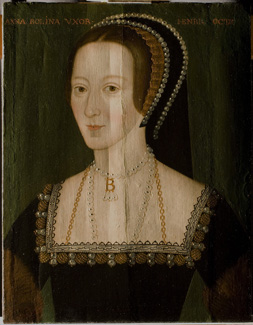
Here’s an update on the fundraising efforts for much-needed conservation work on the National Portrait Gallery’s iconic image of Anne Boleyn that I posted about last month.

Natalie from On the Tudor Trail has started a Facebook page to raise awareness on the effort. If you’re on Facebook, head on over and “like” the page and share it with your friends! Even if you aren’t able to donate, it helps to spread the word. And as added incentive, when the page reaches 500 fans, there will be a give-away of an autographed copy of The Lady in the Tower: The Fall of Anne Boleyn by Alison Weir. You can read Ms. Weir’s comments on the portrait and the conservation effort at Natalie’s site.

Google Art Project

I’m sure a lot of you have already heard about the new Google Art Project, which gives you a street-view-like experience of 17 great art galleries (and with more to come, I’m sure). And while you’re “walking” around, you can stop and zoom in on some of the paintings and see them in great detail. When I noticed The Frick Collection in New York was one of the galleries, I’ll bet most of you knew what the first painting was that I looked for. Sure enough, Hans Holbein’s “Sir Thomas More” is one of the paintings that you can view in detail, right down to the salt-and-pepper beard stubble on his chin!

Other Holbein paintings I found: “The Ambassadors”, “A Lady with a Squirrel and a Starling” and “Christina of Denmark, Duchess of Milan” from the National Gallery in London and “Henry VIII” in the Museo Thyssen-Bornemisza in Madrid.

Just glancing around, I saw several English renaissance paintings close-ups in the Tate Britain collection as well, and I’m sure there are more to find in some of the other museums.

Of course this isn’t a substitute for visiting the museums and seeing the paintings in person, but it’s a nice way to lose a few hours of your day.

Sunday Short Takes

Actually, not so short this week since I have quite a few stories with multiple links!

One of the big stories to make the Tudor news rounds this week was the discovery of a mural of Henry VIII on the wall of a house while the owners were doing renovations. The house was once the summer home of the Archdeacons of Taunton, including Thomas Cranmer before he became Archbishop of Canterbury. I noticed that pretty much every article, including the three I linked to below, called it a “medieval” mural. I’m assuming they are referring to the technique or style of the mural, since I’m pretty sure anything produced in the 1530s (as this has been dated to) would stretch the definition of the medieval time period.

* A medieval mural depicting Henry VIII has been uncovered by a couple renovating their home – The Telegraph

* Out with his head! DIY couple uncover medieval mural of King Henry VIII – The Daily Mail (including images)

* Medieval mural of King Henry VIII uncovered in Somerset – Article with video from the BBC

(Quick update – check out the comments thread at The Anne Boleyn Files’ post on this for some info from one of the homeowners! They plan to put up a website at http://milvertonmural.com/, although it isn’t up yet.)

New archaeological work is beginning at Sheffield Manor Lodge, once owned by the Earls of Shrewsbury and where Mary Queen of Scots was imprisoned, that will remove the soil above the kitchen quarters of the house. Previous archaeological work on the house was done in 2010 by students from the University of Sheffield, who kept a blog about the project.

* Project set to reveal secrets of ancient manor – The Star

* Fresh light on manor where Mary Queen of Scots held – Yorkshire Post

More articles have come out about research in to the tombs of Henry Fitzroy and Thomas Howard 3rd Duke of Norfolk that I linked to in a previous Sunday Short Takes

* Research uses space-age technology on 16th-century history – The Guardian

* The truth behind Tudor tombs is out there – PhysOrg

And finally, a new work on Mary Tudor Brandon is due out in April in the US and May in the UK. Unfortunately it looks like it will have academic pricing (hopefully my university’s library will get it, although with the budget crunch we’re facing, who knows), but here are the Amazon links if anyone is looking to pre-order:

Stirling Castle carvings finished


The Stirling Heads in place with some of the palace painters. Image from the Stirling Castle blog.

I’ve been linking to stories about the restoration of Stirling Castle’s Royal Palace to its 16th century appearance, including the recreation of the Stirling Heads for several years (see here, here and here), and I’m pleased to now link to several stories about the completion of the project!

Renaissance heads of Caesar and Henry VIII to return to Stirling Castle Royal Palace of James V – Culture 24

Kings and queens and classical heroes return to Stirling Castle – The Scotsman

Meticulous work comes to a head – The Edinburgh Evening News

Castle masterpiece work unveiled – The Galloway Gazette

Anne Boleyn portrait needs conservation work

I know most of you have probably already seen this through other sites since I’m a little late posting it. (It’s been a rough week packing up my office and lab at work to move before some renovations… the upshot is that I’ll finally get a window office!)

From the National Portrait Gallery:

This important portrait of Anne Boleyn is in urgent need of conservation treatment. It is in a particularly vulnerable and unstable condition as a result of structural problems with the wooden panel. Vertical cracking has occurred across the picture causing minor paint loss where the wood has split (see the photograph taken in raking light alongside). We need to act now as the damage is being caused by the long term effects of an unsuitable cradle (an applied wooden panel support) which must be removed. Therefore this important and much loved painting needs urgent conservation treatment to ensure it can be put back on public display.

The Gallery hopes to raise

Academic research in to portraits of Lady Jane Grey

Update November 17 – I added in a couple of new links to the post and here’s a link to a new article about the The van de Passe Engraved Portrait

Some of you might recall a post from last year highlighting some of the research work that goes in to researching Tudor-era portrait identification by Dr. J. Stephan Edwards of Some Grey Matter. Now here’s a follow-up with some of the work he’s done in his search for an authentic image of Lady Jane Grey. Here’s a summary his work so far and a tease about some work that he recently completed:

As part of my ongoing research on Lady Jane Grey, I have for the past five years been attempting to identify and locate every portrait of Jane Grey mentioned in the historical record that might potentially have been created in the sixteenth century. The project started in September 2005 with the Fitzwilliam portrait, which I thought at that time might be a portrait of Jane. I have since reversed that opinion and am convinced that it is not.

Thus far, I have located over a dozen portraits that were each at one point called “Lady Jane Grey.” Many of them, like the Althorp and Madresfield portraits, were easily shown to have been painted outside England by artists who were dead before Jane was even ten years old. Others, like the Melton Constable portrait, can be identified as some other known person. Another larger group, including the Bodleian and Somerley portraits and the National Portrait Gallery’s painting accession number 764, have no surviving documentation or image content that allows them to be properly identified. Still others, such as the Houghton, Northwick, and Portland portraits, have yet to be located and studied.

The process has generated one or two small controversies, the most prominent of which involved the Yale Miniature. It was put forward by renowned celebrity-historian David Starkey in 2007 as a possible portrait of Jane Grey, but I and others subsequently disputed his findings. That dispute was described in an article in The New Yorker magazine in mid October 2007.

To date, only one portrait has been generally accepted by art historians as a potentially authentic likeness. The Streatham Portrait was acquired by the National Portrait Gallery (as NPG 6804) in 2006 and displayed briefly in the Tudor Gallery. It has since been determined that the painting was created more than forty years after Jane Grey’s death. Curators have suggested it might be a copy of a lost original, though I am suspicious that it is simply the product of some artist’s imagination. The NPG has now removed it from display and has no plans to re-exhibit it, perhaps because of the questionable identification.

In August 2010, I did finally locate what I believe may be a previously ‘lost’ authentic likeness of Jane Grey mentioned in a document from the 1560s. I

Sunday Short Takes

* I meant to post this a few weeks ago – The November issue of BBC History Magazine has a cover article titled The Secret War Against the Tudors about the various plots against Henry VII and Henry VIII

* And because I thought it was really interesting – Heavenly illumination: The science and magic of stained glass (from The Guardian’s science blog)

* Was Henry Vlll’s first wife anorexic? Catherine of Aragon’s secret problem (I have no idea why they have a portrait of Charles V labeled as Prince Arthur)

The author of the above article also has a new book on Catherine (as far as I know, the first dedicated biography of Catherine since Garrett Mattingly’s) which just came out in the UK and will be out in a few weeks in the US. Usual Amazon links below: