The theme of this week’s round-up inadvertently ended up being archaeological and forensic in nature!
A little on the on-going research into the potential Richard III find:


Carew Castle, Wales. Photo May 2003.
I know regular readers are probably sick of seeing views of these arms at Carew Castle, but I had to post at least one more since today is the anniversary of the wedding of Catherine of Aragon and Prince Arthur in 1501. For close-ups and more info, just search through the site archives on “Carew” and you’ll find all of the previous posts and pictures.
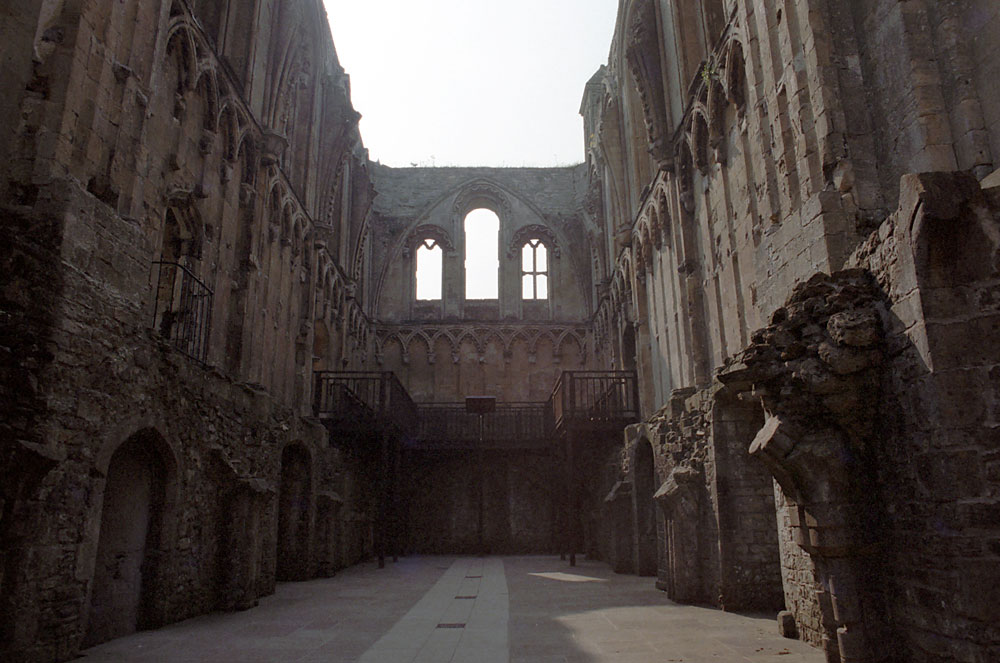
In the ruins of Glastonbury Abbey. Photo May 1998.
Two more obituaries for Eric Ives were published over the past week:
* The Guardian: Eric Ives obituary – Leading Tudor historian and university administrator known for his books on Anne Boleyn and Lady Jane Grey
* Sydney Morning Hearald: Historian of Tudor treachery – Eric Ives, 1931-2012
Another interesting obituary was caught by my Google news alerts, that of Lady Kinloss, the senior descendant of Lady Catherine Grey.
And the rest of this week’s links:
* Would you have been accused of witchcraft? – Fun quiz from BBC History Extra
* A book I missed in last week’s round-up post: Claire Ridgway of The Anne Boleyn Files has launched her third book, On This Day in Tudor History! (Links go to the paperback versions, but there are also inexpensive Kindle versions you can get to from the links below)
And a few videos for your enjoyment:
More on the re-creation of Henry VIII’s crown for Hampton Court Palace. This has some of the same footage from the news video I posted last month, but has some additional information:
Next up is a lecture at the Stanford National Accelerator Laboratory about their work on the wreck of the Mary Rose. I love it when science and history come together!
And finally, Tudor Kickz – An educational video which advertises the Tudor attractions within Southampton through rap:

The White Tower of the Tower of London. Photo May 2003.
I didn’t realize until today that the Picture of the Week #200 milestone would fall on Halloween. Considering I didn’t really have anything great for either (the axe and block would have been good, but I’ve already used it!) – here’s an imposing view of the White Tower on a stormy day.
If you want something more Halloween-ish, here’s a previous post for you: http://tudorhistory.org/blog/2011/09/16/elizabeths-haunted-portrait/
Books
A couple of books already out in the UK will be out later this month in the US:
Tarnya Coopers Citizen Portrait: Portrait Painting and the Urban Elite of Tudor and Jacobean England and Wales is due out on November 27th, although according to the Amazon.com page it is already in stock. Previous entry here.
And The Watchers: A Secret History of the Reign of Elizabeth I by Stephen Alford is due out on November 13 in the US. Previous entry here.
Also out this month –
The Tudors on Film and Television by Sue Parrill and William B. Robison is due November 3rd in the US (although I’m not 100% on that date) and December 31st in the UK. You can learn more about the book at their website.
Exhibitions
Just a reminder that the Shakespeare: Staging the World exhibition at the British Museum closes November 25th, so if you were planning to see it, don’t wait. I’ve heard some great things about it!
And finally, The Queen’s Gallery at Buckingham Palace will be hosting the exhibit The Northern Renaissance: D
The Telegraph has posted its obituary for Eric Ives:
* Professor Eric Ives – Professor Eric Ives, who has died aged 81, was the author of the definitive biography of Anne Boleyn and a much-loved figure at the University of Birmingham, where he served as head of the Modern History faculty and pro-vice-chancellor.
And in other news:
Another thing that I’m still catching up on from the summer….
I received two copies of Carol Wolper’s Anne of Hollywood to give away, so I thought this would be a great chance to run another survey! (If you want to see the one I did a few years back, you can read about it here.)
You can go to the survey here and you’ll be directed back to the main page once you’re finished (and you won’t be able to see the results until I post them, sorry!). You can take the survey without being entered in the contest, just leave the space for your email address blank. I’ll leave the survey open through November 30, 2012 and contact the winners shortly after and post the survey results here on the blog!
A little about the book:

Skirts are shorter now, and messages sent by iPhone, but passion, intrigue, and a lust for power don

Hampton Court Palace. Photo May 1998.
Since today is the 475th anniversary of the death of Jane Seymour at Hampton Court Palace, I thought it was a fitting place to feature for this week’s picture. This is a view of the the Base Court before it was paved over with cobblestones to restore it to what it would have looked like in Henry VIII’s time (at least that’s my recollection of why it was done – please correct me in the comments if I’m wrong!).
I can’t believe that I’m still catching up on things from the summer! Over on my personal blog I just posted about the trip I took for work out to McDonald Observatory in July and here is my write-up of an exhibit that I visited in June.
Regular readers of the blog will remember that I was pretty excited to see that the King James Bible exhibition previously at the Folger Shakespeare Library and the Bodleian at Oxford would be coming to the Harry Ransom Center at my university. You can see the Harry Ransom Center’s page for the exhibition here. I took a few photos with my cell phone camera and I decided to go ahead and post some even though they aren’t very good. Most of these are the pre-KJB items they had on display, since those are most related to Tudor history, although I included one neat English-made medieval Bible as well. I did include one photo of an original King James although there were many versions I didn’t photograph (including one of the infamous “Wicked Bible”). It was an amazing collection!
The captions below each photo are primarily taken from the information cards with each item, so I didn’t write them. I *hope* I managed to get the right info matched to the correct photo here, but there is a chance I didn’t. But given how cruddy the photos are I’m sure no one would be able to tell!

Banner outside the HRC. You can see the great fossiliferous limestone on the front of the building here too.

An English thirteenth-century manuscript Bible in Latin.

Champions of the English Bible: This was a large display board showing three excerpts from Foxe’s Book of Martyrs of persecution of three previous advocates of translating the Bible into English.

“The New Testament in English after the Greeke translation annexed wyth the translation of Erasmus in Latin” (Londini: Offincina Thomas Gaultieri, 1550)
William Tyndale (ca. 1494-1536) attended Oxford and Cambridge as a young man. He wanted to translate the Bible into English using Hebrew and Greek source texts, rather than the Latin Vulgate. When the bishop of London rebuffed Tyndate, he moved to Germany and proceeded on his own.
The first edition for Tyndale’s New Testament appeared in 1525. Tyndale introduced a number of phrases that the King James translators retained in the 1611 edition, including Matthew 9:2 “be of good cheer.”

“(Biblia?) the Byble: that is, the holy Scrypture of the Olde and New Testament, faythfully translated in Englyshe, and newly oversene & corrected” (Southwark: James Nycolson, 1537)
In 1535, shortly before William Tyndale’s death, his associate Miles Coverdale (ca. 1488-1569) completed and printed a translation of the Bible whlie exiled in Antwerp. A second edition was printed that same year in Southwark, England.
Coverdale relied heavily on Tyndale’s translation, but worked primarily from the Vulgate and from Martin Luther’s German translation. The King James translators retained many phrases from Coverdale includin “the valley of the shadowe of death” and “thou enoyntest my heade with oyle”.


Two volumes of the “Biblia Sacra Hebraice, Chaldaice, Graece, & Latine [known as the Polyglot Bible] (Antwerp: Christopher Plantin, 1569-1573)
Plantin’s Polyglot Bible is considered the most important typographical enterprise of the sixteenth century. The printer had to obtain permission form Philip II, the Holy Roman Emperor, which was a delicate matter in the midst of the Reformation. Plantin then had to create a brilliantly functional typographical design to incorporate the five languages.

“The Bible that is, the Holy Scriptures conteined in the Olde and Newe Testament. Translated according to the Ebrewe and Greeke, and conferred with the best translations in diuers languages. With most profitable annotations vpon all the hard places, and other things of great importance as may appeare in the epistle to the reader. (London: Christopher Barker, 1576)
Protestant scholars fled to Geneva after Mary I’s ascendance to the throne in 1553. There they undertook a new English translation of the Bible, complete with extensive, heavily Calvinist interpretive notes.
The Geneva Bible (1560) introduced a number of features that would soon become standard in English printed Bibles, including the use of Roman type, numbered verses, and italics for English words not represented in the original texts. The Geneva Bible became incredibly popular among English speakers, as this 1576 English reprint attests, and is the translation most frequently quoted and paraphrased by William Shakespeare.

“The Bible. Translated according to the Ebrew and Greeke, and confermed with the best translations in diuers languages. With most profitable annotations vpon all the hard places, and other things of great importance, as may appeare in the epistle to the reader. And also a most profitable concordance for the readie finding out of any thing in the same conteined” (London: Deputies of Christopher Barker, 1588) also a “Geneva Bible”

“The New Testament of Jesus Christ, translated faithfully into English, out of the authentical Latin, according to the best corrected copies of the same, diligently conferred with the Greeke and other editions in diuers languages; with arguments of bookes and chapters, annotations, and other necessarie helpes, for the better vnderstanding of the text, and specially for the discouerie of the corruptions of divers late transtlations, and for cleering the controversies in religion, of these daies; in the English College of Rhemes” (Rheimes: John Fogny, 1582)
In 1559, when the Protestant Elizabeth I (1533-1603) succeeded Mary, Catholic scholars went into exile in Flanders. The translators used the Latin Vulgate as their source text, rather than relying on previous English translations. Named for the two cities in which it was completed, the Douay-Rheims Bible (1582/1610) also contained extensive annotations, many rebutting those of the Geneva Bible.
Additional notes on these two bibles:
Geneva and Douay-Rheimes: A Battle of Annotations
The most populdar English Bible to precede the King James Bible was the Geneva Bible, prepared by English Protestant exiles during the reign of Catholic Queen Mary I. IN 1582, the Catholic Church published its first portion of an English Bible translation, the Rheims New Testament. Comparing annotations found in Revelation 17:1-6 shows how these Protestant and Catholic translations engaged each other. The Geneva Bible contends that the figure of the Whore of Babylon represents “the Antichrist, that is, the Pope”. The Rheims New Testament responds, “The Pope can not be Antichrist.”

Hugh Broughton’s “An epistle to the learned nobilitie of England”
(Middleburgh: Richard Schilders, 1597)
Hugh Broughton (1549-1612) was as famous for his intellect, particularly as a Hebrew scholar, as he was infamous for his cantakerous personality. In this book, he argues for a new translation of the Bible, given the inadequacy of the Bishops’ Bible, and claims to have the support of Queen Elizabeth. Although he wanted a new translation, when King James was finally publshed, Broughton wrote another tract strongly criticizing it.

“The Holy Bible: conteyning the Old Testament and the Newe. Authorised and appoynted to be read in churches” (Imprinted in London: By Robert Barker, 1602) a.k.a. “The Bishops’ Bible”
King James translators were given an unbound 1602 edition of the Bishops’ Bible as a base text. The Bishop’s Bible translators had used the Great Bible as the basis for their translation, but had also taken some non-canonical material including maps, woodcuts, and annotations from the more popular Geneva Bible. Though the Bishops’ Bible was the official starting text of the King James translators, only about four percent of the King James translation comes directly from content original to the Bishops’ Bible (as opposed to earlier English translations).

The First Edition of the King James Bible
“The Holy Bible, conteyning the Old Testament, and the New: newly translated out of originall tongues (London: Robert Barker, 1611)
Although I posted about it shortly after the announcement, here are a few more articles about Hilary Mantel’s second Man Booker prize:
* Hilary Mantel wins Man Booker prize for second time
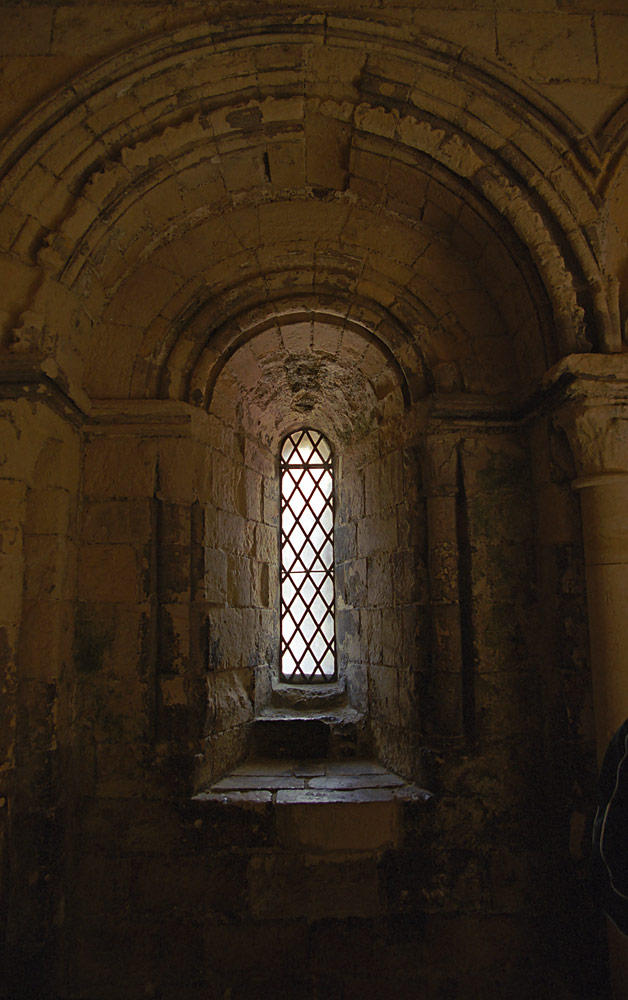
Deep-set medieval window in the great keep of Dover Castle. Photo May 2003.
I just wanted to dash off a quick post with the news that Hilary Mantel has snagged her second Man Booker Prize, this time for Bring Up the Bodies, the sequel to Wolf Hall (which won the prize in 2009). The Mirror and the Light will finish the trilogy in the next few years. Congrats to Ms. Mantel!
You can read more about it here at the Man Booker Prize website.
Sadly, not a visit that I was able to make myself! Debbie sent in this wonderful photo of one of Katherine Parr’s books on display at Sudeley Castle‘s exhibition celebrating the 500th anniversary of the birth of Katherine Parr:
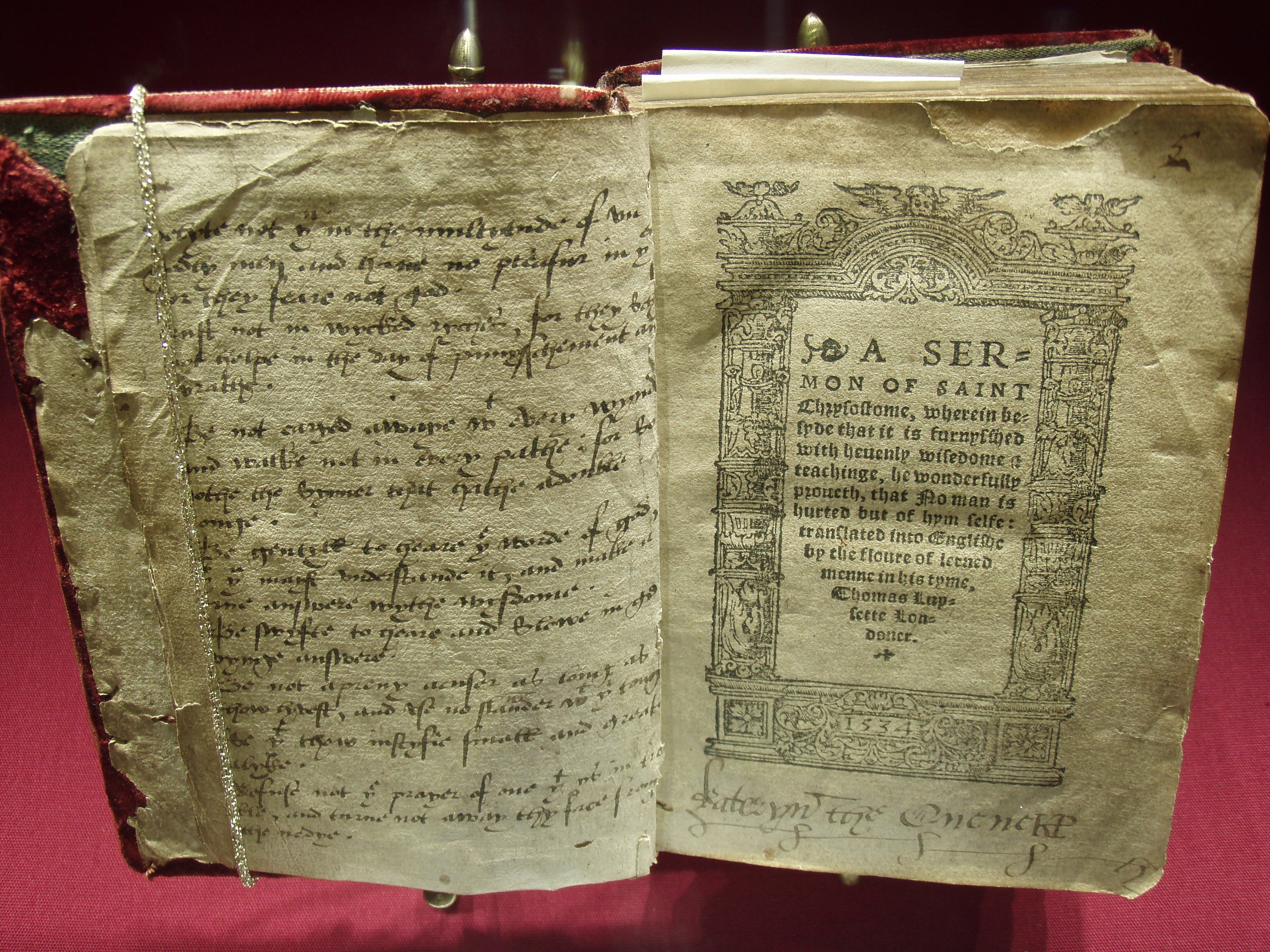
Click for a great full-sized view! Note Katherine’s signature at the bottom right.
You can read more about Debbie’s visit at her website:
http://thetudorkey.blogspot.de/2012/05/sudeley-castle-visit.html
And if you want to catch the exhibition yourself, you’d better hurry since the castle’s open season ends on October 28th!
Quite a few more news items this week than last!
* In a follow-up to last week’s video about the recreation of Henry VIII’s crown, here’s more about it from the Historic Royal Palaces website
* And for anyone with a little cash to spare: Henry VIII home goes on sale for
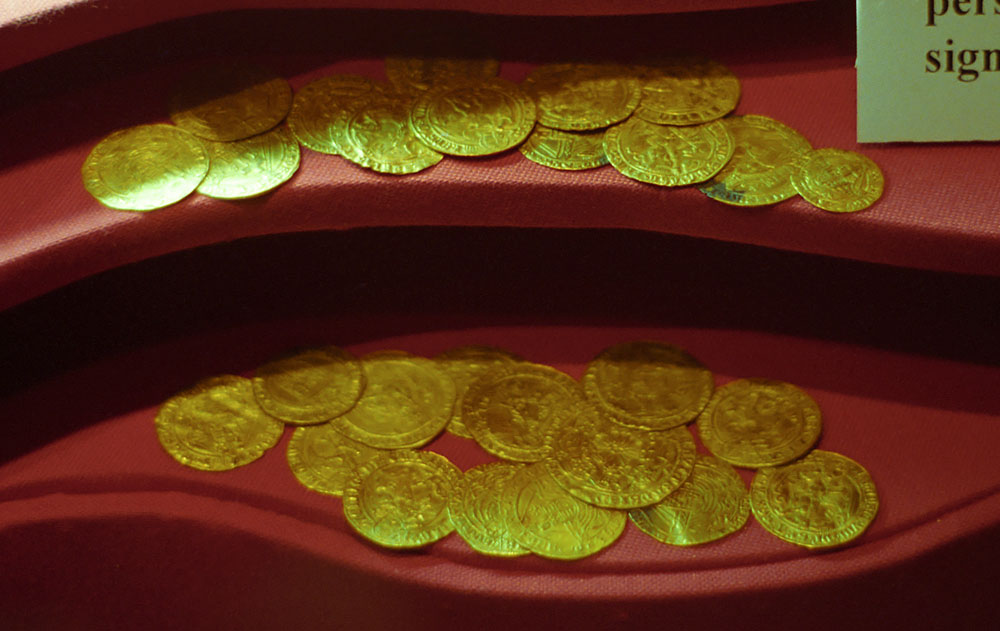
Gold coins from the Mary Rose. Photo June 2000.
In honor of tomorrow’s 30th anniversary of the raising of the Mary Rose!
Just one story this week, but I hope you will find it as interesting as I did!
* Henry VIII’s lost crown recreated nearly 400 years on – article and video from the Guardian

Gold coin from the first half of the reign of Elizabeth I on display in the British Museum. Photo May 2003.
Just a few books this for this month’s round-up:
* Alison Weir’s latest novel A Dangerous Inheritance about Katherine Grey will be released in the US on October 2. The UK release info and ordering links are back in the June round-up.
* David Loades’ latest Tudor biography, Catherine Howard: The Adultress Wife of Henry VIII is due out on October 28 in both the US and the UK
Events and Exhibitions
Just a reminder that the Katherine Parr Quincentenary Exhibition at Sudeley Castle will be closing on October 28 when the castle’s open season ends. Also continuing are the Tudor Revels events in Southampton which run through November 1 and the Shakespeare: Staging the World exhibit at the British Museum continues to November 25.
Just one new event for this month’s round-up: October 11 will mark the 30th anniversary of the raising of Henry VIII’s ship the Mary Rose and there will be a boat trip and talk in Portsmouth to mark the day. More information is available at the Mary Rose website.
Sad news came this week of the death of Tudor historian Eric Ives. Here are two short obituaries, but I’ll post any others that I find in future news round-ups.
* From BBC History Extra – Eric Ives obituary
* From History Today – Obituary: Eric Ives
And the rest of this week’s news:

