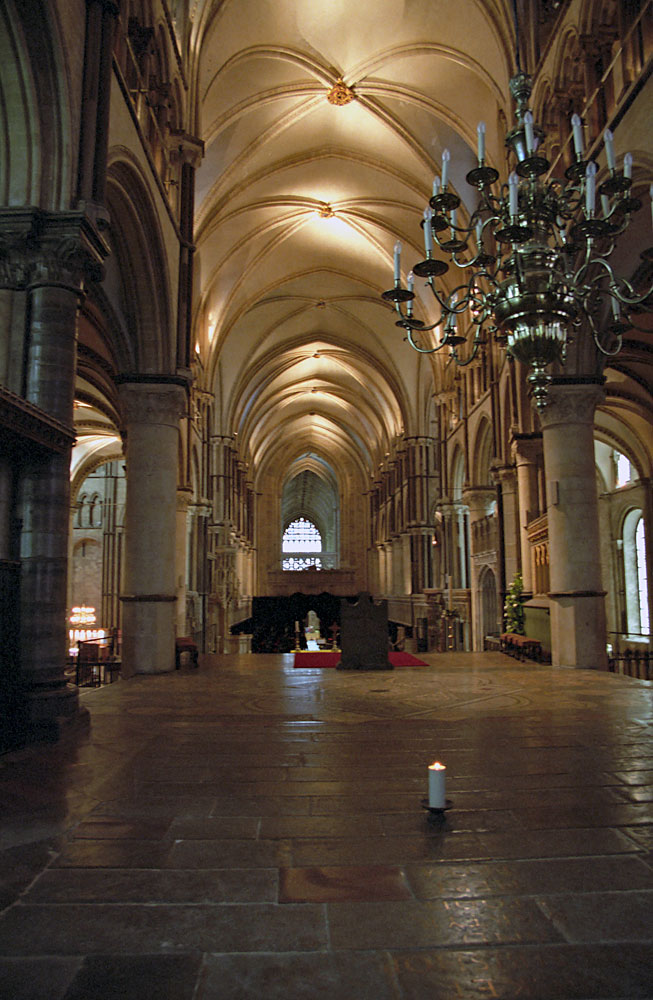
Looking down the length of Canterbury Cathedral. Photo May 2003.
The candle in the foreground is the one in Picture of the Week #104 that marks the former location of the Shrine of Thomas Becket that was demolished in 1538.

Looking down the length of Canterbury Cathedral. Photo May 2003.
The candle in the foreground is the one in Picture of the Week #104 that marks the former location of the Shrine of Thomas Becket that was demolished in 1538.
The Divorce of Henry VIII: The Untold Story from Inside the Vatican
(UK Title: Our Man in Rome)
by Catherine Fletcher
With so many books out on Tudor history it is always nice to see someone fill in a gap that has been neglected. Such is the case in Catherine Fletcher’s debut work The Divorce of Henry VIII: The Untold Story form Inside the Vatican. Fletcher’s book focuses on Gregorio Casali, Henry VIII’s ambassador to Rome, and rescues him from being consigned to the footnotes of other works on The Divorce and fleshes him out. In the process we get a view that had been too long overlooked.
The story of the divorce is one that is well-covered in general works on Tudor history, specific books on the English Reformation, and biographies of Henry VIII, Catherine of Aragon, Anne Boleyn (and often at least in summary in books on Mary I and Elizabeth I). Anyone who has devled into the subject is familar with the happenings in England – Henry VIII’s desire for a male heir, Catherine’s resistance to the annulment and Anne Boleyn’s long wait to become Henry’s queen. When the events on the Continent are covered, it is usually in passing discussion of the Sack of Rome in 1527 by Holy Roman Emperor Charles V – nephew of Catherine of Aragon – and how that complicated matters. But what of the actual men who worked on Henry’s behalf in Italy? That’s where Gregorio Casali and his family come in.
By following Gregorio’s career, Fletcher brings us an insight in to the complicated world of a Renaissance ambassador. Besides having to communicate back to and receive funds from a king over a thousand miles away in a day before telephones or the internet, he had to keep up appearances and dress and live in a certain style. There was also the matter of money for well-placed and well-timed bribes, a staple of the trade. Casali solved the problem in part by marrying an heiress, although there were legal issues that prevented her (and by extension her husband) from receiving the full amount of money she was due. And in addition to troubles negotiating with the Papacy, Casali sometimes faced difficulty with his own English delegation and unofficial agents.
I wouldn’t suggest this book as an introduction to the Divorce (and I don’t think it is meant to be one) and having a familiarity with the issues, the important players, and the legal and ecclesiastical arguments is helpful before reading this work. But for those seeking a fresh and different perspective on Henry VIII’s “Great Matter” I highly recommend The Divorce of Henry VIII.

Chirk Castle in northeast Wales. Photo May 2000.
Chirk was one of the lordships given to Robert Dudley by Elizabeth I.
As most of you know by now, there were some exciting developments last week in the search for the grave of Richard III! When I last wrote about it on the Sunday news round-up of September 9, the archaeological team had confirmed that they had received an additional week to dig in light of their discoveries.
Here’s a timeline of relevant events prior to the 21st century [Source]:
* Richard III was buried in the church in 1485 after the defeat at Bosworth and a tomb was erected over the grave ten years later.
* In 1538, Greyfriars was closed during the Dissolution and by the early 17th century the church had fallen into ruin.
* In 1600 the Mayor of Leicester, Robert Herrick, bought the site and had a house built, with a memorial pillar of Richard III’s grave erected in the garden.
* The land was sold in the early 18th century to Thomas Novle and then is sold to the Leicester city council in 1914, who paved over the land for a car park in 1940.
Archaeologists confirmed that they had found the remains of the Greyfriars Church and the 17th century garden that contained the memorial pillar. They then extended the three trenches in hopes of finding the choir area of the church which is thought to be where Richard was buried. (I once again recommend this BBC article for a background on the historical detective work that lead to the dig and, now very importantly, the genealogy work that found a descendant of Richard III’s sister Anne of York for DNA testing.)
Unbeknownst to the public at the time, human remains had been found at the site and on September 4th exhumation began. On September 11 (in my time zone) news had leaked about the remains and that there would be a press conference at 11 a.m. UK time on Wednesday September 12th with details. At the time I was excited by the possibilities, but I knew that finding human remains while digging in a church site wasn’t that unexpected. But I was very curious to hear what they had to say. Given that they were putting together a press conference, I was thinking that they might have some additional evidence that they might have actually found Richard III – and that turned out to be the case!
Here’s a summary of the findings that point to the potential of this being Richard III’s skeleton [Source]:
1. The remains
All the exciting news from the Richard III dig will be in a separate post!
The rest of the news that caught my eye this week:
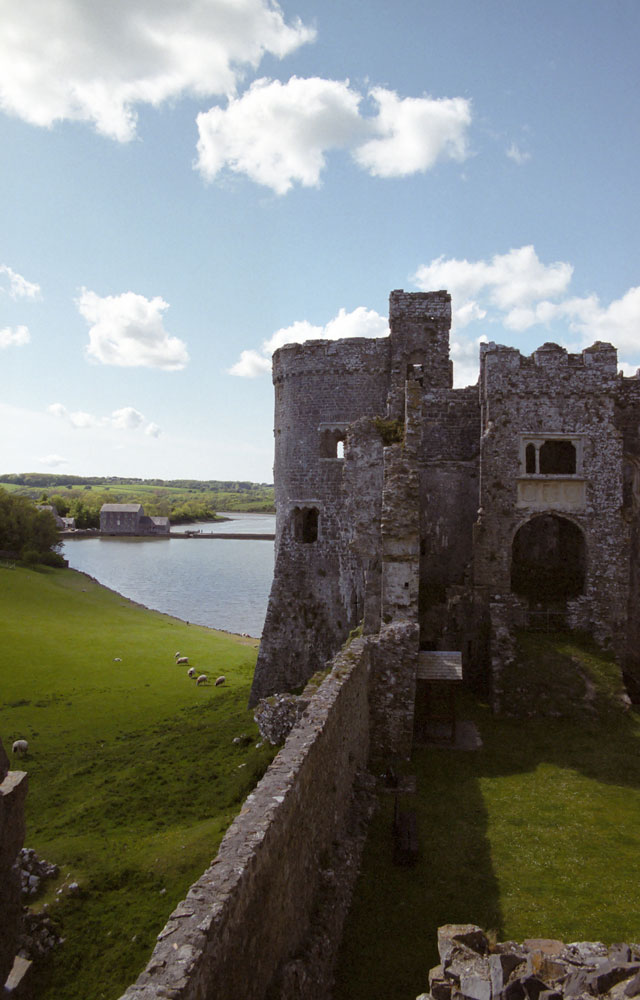
Carew Castle, Wales. Photo May 2003.
In the middle-right of the photo you can see the context for the arms of Prince Arthur, Henry VII, and Catherine of Aragon that I’ve had up-close photos of before.
The Tudor Ghost Story contest is on again! Head over to On the Tudor Trail for more information on this year’s contest.
And for some follow-up on a couple of previous stories:
The re-enactment of the funeral of Katherine Parr at Sudeley Castle was held today. See a gallery of photos from the event on the Sudeley Castle Facebook page.
And more news has come from the dig in search of the grave of Richard III! From the University of Leicester blog –
* Search for Richard III confirms that remains are the long-lost Church of the Grey Friars
And here’s an interesting article from the BBC on the background research:
* Richard III dig: How search reached Leicester car park
The initial run of the project was due to wrap up this weekend, with the possibility that it would be extended if significant progress has been made. And I saw on the University Leicester twitter account that is has been confirmed that they will get a third week!

Closer view of the tomb of Katherine Parr. Photo May 1998.
Today is the anniversary of Katherine’s death in 1548.
Hi everyone! It
In a follow-up to last Sunday’s news about the dig to find Greyfriars Church in Leicester and the possible resting place of Richard III, archaeologists have already found strong evidence that they’re digging in the right place.
To keep up with all of the news, check the official site from the University of Leicester’s Greyfriars Project site news section.
Additional news on the most recent finds from the dig – just a few selected from many:
* Richard III dig in Leicester car park ‘is definitely on the right track’
And another couple of 16th century properties have come on the market (I keep posting these in hopes that someone who reads this blog will buy one and invite me to visit!):
* Live like Henry VIII in your own Tudor mansion complete with pool and 300 acres (but at
And here are the events and exhibitions for September (book info is in a previous post since there were so many of them).
Just a reminder that both The National Maritime Museum‘s Royal River: Power, Pageantry and the Thames and the National Portrait Gallery‘s Double Take: Versions and Copies of Tudor Portraits exhibitions end September 9, 2012.

I should also mention that the re-enactment of Katherine Parr’s funeral that I slipped in to a Sunday Short Takes since I figured it would sell out before I got it into this round-up has indeed sold out. But you can still enjoy Sudeley’s exhibition celebrating the 500th anniversary of Katherine Parr’s birth until the end of October.
Also at Sudeley, Alison Sim (author of Food and Feast in Tudor England and The Tudor Housewife, etc.) will be joining Lady Ashcombe for a lunchtime event on September 3rd. See Alison Sim’s website for more information.

On September 13, Maria Hayward (author and editor of several works on the inventories and clothing of the Tudors) will be giving a talk at the National Archives entitled “Henry VIII and Anne Boleyn: clothing, courtship and consequences”. Check the National Archives site for more information. They often have free podcasts of their talks so if they post this one I’ll put it in a future blog entry.

Closer to my neck of the woods, Texas Early Music Project‘s next concert will be “The Tudors: From Henry To Elizabeth” on September 15 & 16 in Austin. I’m not 100% sure if I can make it to the concert but I’m going to try!
Description of the concert:
Popular culture has been interested in all things Tudor in recent years, so more people than ever are interested in the very important courts of Henry VIII and Elizabeth I. We will perform lovely works written by Henry VIII as well as masterpieces from the court composers from both rulers. Our renowned singers will present solo and small ensemble vocal works and viola da gamba superstar, Mary Springfels, will lead our consort of viols.
And finally…
There have been and will be a bunch of events in Southampton’s Tudor Revels but I wanted to point specifically to their Michaelmas Faire on September 29 and 30 that will have a lot of events over those two days. From the press release:
On Saturday 29th and Sunday 30th September the Michaelmas Fair in Southampton sees the oldest part of the city transformed in to a Tudor festival of workshops, living fair, historical re-enactments, storytelling, townsfolk and walks.
The Michaelmas Fair is the busiest weekend of the Tudor Revels project – An exciting programme of events and activities based on the heritage, archives and real lives of Southampton’s Tudor period.
Bugle Street, St Michael
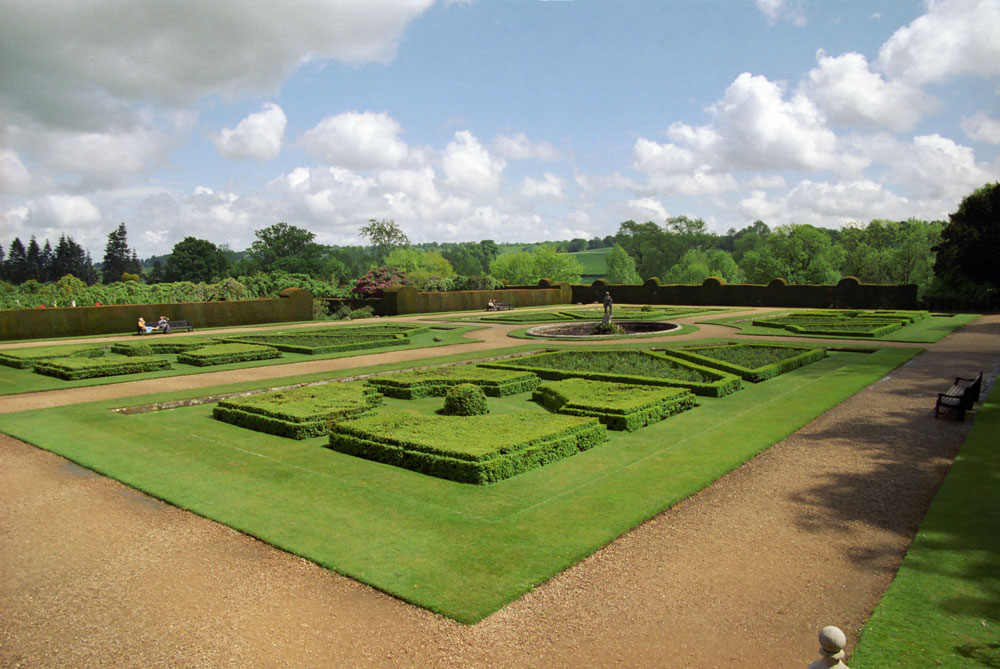
Gardens at Penshurt Place. Photo May 2003.
[I’m going to split the upcoming books, exhibitions, and events into two posts this month since there are SO many this time!]
Some of these are already out since they were August (or earlier) releases that I just found out about. These first four are already out in both the US and UK and I believe all are available as print and ebooks. (I’ll be linking to the print version, but if you click through you can also see the Kindle versions listed.) I have or will have copies of several of these that I hope to review in the next few months. Of course I have to finally finish writing the three reviews I already have in the queue first!
First up is The Sultan’s Organ: The Diary of Thomas Dallam 1599, put into modern spelling by John Mole. I’ve wanted to learn more about the Tudors’ interactions with cultures beyond Europe and the New World and this looks to be an interesting insight. You can also learn more about the book at the author’s website.
Next up is Henry VIII: His Life and Legacy by Kristin A. Sinclair which is meant to be an introduction to Henry VIII and his successors.
Next is Blood Will Tell: A Medical Explanation for the Tyranny of Henry VIII by Kyra Cornelius Kramer. This work further expands on the theory of Henry VIII having a Kell positive blood type and the possibility he had McLeod syndrome. I will have a guest post on the topic from the author soon!
And finally in the “already out” category – The Merry Wives of Henry VIII: A Tudor Spoof Collection by Ann Nonny and launched by the Anne Boleyn Files (you can learn more about the book here at the site).
And now to the books released in either the US or UK (or both) in September:
Nancy Bilyeau’s debut novel The Crown will be coming out in paperback in the US on September 4 and February 21, 2013 in the UK. Her follow-up The Chalice will be coming next year as well!
Peter Ackroyd is working on an epic History of England series and the second volume, focussing on the Tudors, is out on September 13 in the UK. (The US market seems to be lagging way behind on this series… if I’m reading it right, the print edition of the first volume isn’t even due out until October of this year).
Next is Sarah Gristwood’s Blood Sisters: The Hidden Lives of the Women Behind the Wars of the Roses – technically not Tudor, but of course many women important to the Tudor dynasty are covered! It is also out on September 13 in the UK and will be out next February in the US.
Susan Brigden has a work on Thomas Wyatt coming out on September 20 in both the US and UK entitled Thomas Wyatt: The Heart’s Forest.
And finally…
Tarnya Cooper, the Chief Curator and 16th Century Curator for the National Portrait Gallery in London, has a new book called Citizen Portrait: Portrait Painting and the Urban Elite of Tudor and Jacobean England and Wales out on September 30 in the UK and November 27 in the US.
The last few days have been abuzz with the start of an archaeological dig at a carpark in Leicester in search of the remains of Richard III. In the back of my mind I recalled a previous news article related to the topic and it turns out it was a news article that I linked to back in 2007 (the original news link is no longer active, but this 2012 dig appears to be the one archaeologists were hoping to do back then). There was also a story in 2008 about Richard III’s possible coffin, although I don’t know if further research has been done on that. I’m hoping to be in the area next year so I really hope they find something!
This whole thing reminds me of research I did in to trying to find the modern location of Jasper Tudor’s burial. He was laid to rest at Keynsham Abbey, but the abbey was dissolved in 1539 and now the A4 runs over part of the site. Depending on where within the building Jasper was buried, there is a chance he’s under the Keynsham By-Pass!
Here are just a few of the articles about the dig from the past few days:
* Richard III’s remains: Leicester car park dug up (BBC)
* Is this the lost grave of King Richard III? Archaeologists dig under council car park for monarch killed in Battle of Bosworth (Daily Mail)
* Is Richard III ‘buried under council car park’? (The Telegraph – this one has an informative interview with one of the archaeologists)
Another story that got a lot of coverage last week was the announcement that the BBC will be developing Hilary Mantel’s “Wolf Hall” into a six part mini-series. Like the story above, this rang some bells for me, and sure enough, I posted about it last year (although it doesn’t appear that HBO is involved now).
* Wolf Hall adaptation planned for BBC Two (BBC)
* BBC turns best-selling Henry VIII novel and Booker Prize winner ‘Wolf Hall’ into a mini-series (Mail Online)
And here are a few other interesting things that caught my eye over the past week:

Wider view of the gatehouse in the remaining parts of Richmond Palace. Photo May 2000.
Since I still haven’t made it up to the Bosworth Battlefield (although it is high on the list of places for the trip I’m planning for next year), I didn’t have a photo directly related to today’s anniversary of the battle. So instead I chose a photo of part of the Richmond Palace remains, built by Henry VII and named for his title of Earl of Richmond which he held at the time of the decisive battle that ultimately made him king.
Lots of interesting links this week!
* Hilary Mantel discusses Thomas Cromwell’s past, presence and future – The Wolf Hall author tells the Edinburgh book festival of her plans for the conclusion of her Tudor trilogy
* Sudeley Castle: the curious life and death of Katherine Parr – Sudeley Castle commemorates 500 years since the birth of Katherine Parr, the last of Henry VIII’s wives.
* Lambert Simnel, a counterfeit king – Once upon a time a good-looking Oxford youth, the son of a carpenter, was taken away from his home city and crowned King of England by an archbishop

Fantastic old, gnarled tree in the park around Hatfield. Photo May 1998.
Short round-up this week. I’m sure there were some things that got past me during the ridiculously busy week I just had, but here are a couple of things I managed to catch:
* Cromwell and royal letters to stay in Northamptonshire – Letters signed by Queen Elizabeth I and Oliver Cromwell are to stay in Northamptonshire thanks to a

Glastonbury Abbey. Photo May 1998.

