Happy New Year!
We still have 5 hours to go here in Texas, but most of the world has already started 2009. Here’s hoping for a good year to come!
Since someone asked about this a while back, I thought I would post an update now that it is available. And Season 1 and Season 2 are available in both HD (and standard definition) for any of you who got fancy new TVs or computer monitors for Christmas.
From The BBC:
Researchers are working to uncover the mysteries of 33 wood carved medallions which would have decorated the Royal Palace at Stirling Castle.
Historic Scotland is trying to find out why the works, known as the Stirling Heads and carved between 1530 and 1544, were created and whom they depict.
The carvings are thought to feature monarchs such as James V and England’s Henry VIII.
The research is part of £12m plans to refurbish Stirling’s Royal Palace.
Historians are in the process of restoring the palace to how it would have looked in the 1540s and creating a new gallery where a replica set of heads will go on display.
…
The palace was begun by James V in about 1538 as a home for his new French bride Mary de Guise.
From The Telegraph:
Rare Holbein work bought for a few thousand could fetch millions
An art collector who bought a painting for less than £2,000 is celebrating after experts declared it a genuine Holbein worth millions.
The painting was thought to be a reproduction of the Renaissance artist’s work and bought for just £1,900 at an auction in France.
But, after cleaning and expert analysis, it emerged the work is a genuine Holbein and as such is worth millions.
The unnamed Swiss collector, who owns the work, discovered the painting at a sale of heirlooms and bric-a-brac. The sale was linked to the once-stately Lamoignon family, who had connections to Holbein through another painting, The Ambassadors, which now hangs in the National Portrait Gallery in London.
However the portrait was thought to be by one of the great man’s imitators when the painting of Erasmus, the Dutch scholar, came up for sale as the family sold off the last of the heirlooms in 2000.
Marco Grassi, a New York conservator who was at the auction, said he advised the Swiss collector to make the purchase, which cost 2,000 euros.
When the crude background had been removed a painting created by Holbein emerged. The hands, book and fur had been painted in the style of the artist and infrared photography showed that the underdrawing for the hands also resembled Holbein’s methods.
And another article (from the The Independent) with an image of the painting
After changing release dates a few times, it is finally due out on January 27, 2009 here in the US. And of course, it has a different title…
Amazon pre-order link below:
Check out the Historic Royal Palaces’ YouTube Channel for more videos
(Tip of the Tudor flat cap to Tim for the link)
And from me, a repeat of last year’s Christmas image (sorry, I didn’t get a chance to make a new one this year!). I’m not traveling this year so I won’t be taking any lengthy breaks from the site or blogs during my time off.
No matter what you celebrate at this time of year, all the best from me to you!
I’ve been compiling a “master list” of events, exhibitions, conferences, etc. taking place to celebrate the 500th anniversary of Henry VIII’s accession. I’m going to put a permanent link to it over on the side bar and I’ll update it as new information comes in. Please email me (lara [at] tudorhistory.org) or post a comment if you know of things that I don’t have listed. I haven’t gone looking for stuff yet (just posting what people have emailed to me) so I’m sure there are things out there I’m missing.
And… If anyone gets a chance to attend any of these, I’d some write-ups to post here on the blog. I seriously doubt I’m going to get to any of these so I’ll have to live vicariously though all of you who do get to them!
It’s later than our period, but I have to agree with Kathy (who sent this in) that it is fascinating.
From The Daily Mail:
It has been sung at carol services across the country but a centuries-old secret political code has been found in a popular Christmas song.
According to one musical expert, O Come All Ye Faithful, also called Adeste Fideles, is actually a birth ode to Jacobite pretender Bonnie Prince Charlie.
Born on December 20 1720, Bonnie Prince Charlie was the grandson of England’s last Catholic monarch, James II.
…
‘Fideles is Faithful Catholic Jacobites. Bethlehem is a common Jacobite cipher for England, and Regem Angelorum is a well-known pun on Angelorum, angels, and Anglorum, English.‘The meaning of the Christmas carol is clear: ‘Come and Behold Him, Born the King of Angels’ really means, ‘Come and Behold Him, Born the King of the English’ – Bonnie Prince Charlie!’
Professor Zon said there were other clues to the subversive political message contained in the carol.
I’ve started making a page to keep track of all of these events and exhibitions. I’ll upload it over the holidays and update it as more news comes in.
From the BBC:
A special exhibition to mark the 500th anniversary of Henry VIII’s accession to the throne is launching at Windsor Castle, the monarch’s one-time home and final resting place.
Henry VIII was proclaimed king on 23 April 1509, just before his 18th birthday, and reigned for almost 38 years until his death in 1547.
The exhibition explores the life of one of the most significant figures in the history of the English monarchy, bringing together treasures from the Royal Collection and the archives of St George’s Chapel, Windsor Castle.
Leanda de Lisle’s new work The Sisters Who Would Be Queen: The Tragedy of Mary, Katherine and Lady Jane Grey will be coming out January 19, 2009 in the UK and is expected in September 2009 in the US. PhD Historian has offered to blog his reading of the book over on the Q&A blog. He and I both received advance copies, but I’m already in the middle of reading a couple of other books so I don’t think I’ll be getting to this one for a while!
Here’s the Amazon UK pre-order link. I don’t have one for the US release yet, but I’ll post it when it comes along.
Thanks to kb for alerting me to this sale from TannerRitchie Publishing! If you aren’t familiar with them, they publish hundreds of rare and out of print historical sources as ebooks and specialize in British History, especially Tudor and Stuart England, British Colonial history (especially in North America and the Carribean), Medieval history and Scottish medieval and early modern history.
TANNERRITCHIE’S AMAZING YEAR END SALE!!
* ALL DOWNLOADS $10 (CAD)
* 50% off all CD-ROMsBeat the credit crunch blues with TannerRitchie Publishing! All eBook downloads are an incredible $10 each, and all CD-ROMs are half price. Build up your personal library or treat yourself to an entire series of eBooks. Don’t miss out on this limited time offer. Buy now – this sale will end on 1 January 2009!
The winner and an honorable mention for this year’s ghost story contest have been selected!
Here’s the report from the judge, Sandra Worth:
So nice to see so much talent! The stories were an amazingly good crop of entries and it was difficult to choose from amongst them, especially for Honorable Mention. I feel they were so good, they all deserved that. The winner of the contest wrote a story that was gripping the first time I read it, and also when I re-read it and knew what to expect. The winner also displayed a flawless grasp of fundamentals such as dialogue, structure, word choices, characters, point of view, all of which were expertly handled in a complex and tense story of time travel.
The winner is Innocent Ghost
I have also chosen Why, This is Hell for Honorable Mention.
You can read the stories at the links above on Wendy’s site or here on this site:
Innocent Ghost by Madeline Martin
Why, This is Hell by Kathy Marcella
Congrats to the winners and thanks to Wendy for organizing the contest and to Sandra for judging!
Yet another celebration of Henry VIII’s 500th!
From the British Library website:
Henry VIII: Man and Monarch
22 April – 6 September 2009
2009 marks the 500th anniversary of Henry VIII’s accession to the throne.
In celebration of this landmark, the historian and broadcaster Dr David Starkey will guest-curate the major new exhibition at the British Library Henry VIII: Man and Monarch.
This unique exhibition looks beyond the myths and stereotypes surrounding Henry VIII, to address the inner intellectual journey of Henry’s monarchy and re-examine the perceptions of the great Tudor monarch.
Through fresh interpretation of rich source material the exhibition will examine the extraordinary transformations – personal and political, intellectual and religious, literary, aesthetic, linguistic – of Henry’s reign.
Books, manuscripts and letters written or annotated by Henry will offer an unprecedented insight into the mind of the king, revealing the driving forces behind his actions, and telling the story of his reign from his own perspective.
And Nikki sent in a link about the exhibition from The Guardian:
An exhibition that seeks to blow away the preconceptions surrounding arguably England’s most important monarch was yesterday announced by the British Library to mark the 500th anniversary of Henry VIII’s accession to the throne.
…
The exhibition next April will include rarely displayed treasures drawn from the British Library’s collections, including important documents, maps and books, and loans from other collections including portraits, tapestry, armour and jewellery. The aim is to build a fuller picture of Henry the man and Henry the monarch.A key feature will be a 1513 portrait of the king, the earliest surviving painting in which he appears as a good-looking, fanciable youth rather than the fat, bearded monster he became. This is on loan from Denver in the US and goes on display for the first time in the UK.
…
Of course, the six wives have their place in the exhibition. On display will be the marriage contract between the king and his first wife, Katherine. She had been married to Henry’s brother, Prince Arthur, who died of sweating sickness and so paved the way for a young Henry to become England’s king. Katherine was offered as a bride to Henry by Spain in an attempt to maintain the Anglo-Spanish alliance. The marriage treaty appears for the first time in a UK exhibition, sent from Archivo General de Simancas, at Valladolid in Spain.
Thanks to Sandra for answering the questions and for getting back to me so quickly!

Kathy said:
What is your background? — more specifically, how did you get
interested in this area of English history?
I grew up on English history because I grew up in Canada, and my step-mother who raised me was English. As a child I loved fairy tales, and when I ran out of Grimms and Anderson, I wrote my own. One day someone gave me Anya Seton’s KATHERINE, and from that moment on I was hooked on the medieval era. To me, the period was one long fairy tale about real princes and princesses. From the fourteenth century, I moved into the fifteenth and discovered Richard III, and the Wars of the Roses when Malory wrote his tales of King Arthur’s court. This became my passion, and friends encouraged me to write on Richard III. That’s how I started, and I’ve been moving forward from there.

Bladerunner said:
What was your main source materials?
Did you use new source material?
Do you feel there is more material out there about Elizabeth
of York, that has been overlooked? Yet to be found?
When I first began researching the Wars of the Roses, I relied solely on secondary sources. But even academics disagree with one another on the interpretation of the facts, so I soon found I had to go deeper in order to decide for myself. I read primary documents — family letters, accounts of the chroniclers of the time, and obtained privileges at the British Museum to peruse original documents. I also became friends with a medievalist. We researched together at our local university libraries, and discussed our discoveries.
The text I found most valuable to me with my novel on Elizabeth of York was Anne Wroe’s recent biography of Perkin Warbeck, THE PERFECT PRINCE. In the main, though, I’d say that my medievalist friend and I came up with a new way of looking at the facts surrounding Elizabeth, rather than new facts per se. I explain more about this in my author’s note. My friend feels there’s enough for an academic paper and is planning to make a presentation at a future academic conference.
If our theory about Elizabeth of York is correct, the new material that might still come to light about her exists not so much in England, as in the observations of visiting dignitaries. These would be found in the archives of foreign countries. Presently, just about everything we know of Elizabeh after her marriage to Henry VII comes to us from letter the Spanish ambassador wrote back to Isabella and Ferdidnand. There could well be others awaiting for discovery in the archives of France, Portugal, Belgium, and Austria.
when you are writing, do you ever get
discouraged? What advice would you give to a person who is
trying to write but sometimes has a really bad case of writer’s block?
One of the advantages of writing historical fiction is that you already have the framework for your story given to you. It’s also one of the disadvantages because you can’t change anything if you want to stay true to the way things happened. But for writers block– which happens to everyone, by the way — I take a long break. Sometimes it’s a clean break for a day or two, where I just have fun and forget about the book. Sometimes it’s listening to music of the period. I sit in the garden, watch the birds, and the changing sky, and after a while, scenes come to me. When they do, I grab that pen and jot them down, even if it’s just a skeleton. That has worked for me, but there’s also a good book out there you might read entitled “Writing Down the Bones”. It gives all kinds of ways writers can break the creative block.

Tracey said:
What is your style? Embarrassingly, I have never read any of your
novels, so I’m not familiar with how you write.
(Lara, I’m assuming this is part of the next question, so I just answered that. Hope I guessed right)
[From Lara - I think so, but if we're not correct, Tracey can clarify in the comments.]
Do you use a lot of description? Is there minute detail, for instance
of fabric, or just enough to get the gist of what the apparel looks like?
Well, reader tell me I put them “there” (one reviewer called my books “a time machine”) but I’m not wordy. My books seem to be shorter than most others on a simlar topic.
Your cast of characters…do they focus more on people who actually
lived the events or the people were around them who’s lives could
be fictionalized? Yep…I know that Elizabeth of York was a real person
I know it’s not fashionable, but I like accuracy and try to stay as close to the true historical record as possible, so I focus on the real historical figures who lived the events. I have one fictional character in my five books, and that’s because very little has survived on my heroine in LADY OF THE ROSES. This fictional character is the daughter of Sir Thomas Malory, and becomes a lady-in-waiting to my heroine Isobel, who is Warwick the Kingmaker’s sister-in-law. Not much is known about Malory except that he lived and wrote his tales of King Arthur’s court during the Wars of the Roses, and probably died fighting for Warwick at the Battle of Barnet.
Are you affiliated with The Richard III Society? And if so (and even if
the answer is no!), in your opinion, who helped the Little Princes’ to
their disappearance?
I was a member of the Richard III Society, but my membership has lapsed.
As far as the Princes are concerned, I don’t believe Richard III killed them. Henry VII was as plagued by rumors that the princes were alive as Richard III was that they were dead. My most compelling reason for acquitting Richard of these murders is a fact I have never heard mentioned. Richard III had three little nephews legally barred from the throne. History would have us believe that he murdered two of them, but not the third. It’s unreasonable.

Carlyn Beccia said,
Fun! looking forward to hearing from Sandra. I have your book on
my christmas wishlist. It was recommend to me by several people.
I know everyone always asks this but – how long does it take for
you to complete a novel? What is your best marketing advice for
promoting a new book? And lastly, did you have any say in the
cover design? What is Eleanora di Toledo doing on the cover?
And why is she missing her head. ouch
You’re so funny!
The length of time it takes me to finish a book depends on the book. I’ve spent as long as five years on one, and as short as five months on another. As for marketing, I’ve tried everything–print and online ads– and I just don’t have the answer to that–I wish I did. Ads are expensive, and I’m not sure they work. Word of mouth isn’t the answer either, because that usually takes a very long time. They say a book has its own “magic quotient.” They also say reviews sell books, but it’s not so easy to get a newspaper review these days. My best marketing advice is to enter contests. It gets you critiques and also gets your name out there. I heard back from a couple of judges in the contests I entered who said they were buying my book as gifts for friends, because they enjoyed it so much. One of them was a person of some influence. I figure that had to help. I know someone who sells her books by going online into forums and volunteering for organizations like the Historical Novel Review, where she makes good contacts. I never did that, but it seems to have worked for her.
The answer to the last part of your question is that with small publishers, you pretty much tell them what you’d like on the cover, and they go along with it. With large publishers, it’s a different story. They may ask you, but it’s really a formality. In the case of the cover for THE KING’S DAUGHTER, the original cover they showed me was of Elizabeth’s grandaughter, Elizabeth I. When I pointed that out, they showed me this cover of Eleanor of Toledo.
Why Eleanor of Toedo? No one has explained it to me, but I’m guessing that the publisher figures very few are as knowledgeable as you are, and they are geared to marketing. They want something that will sell the book. Eleanor’s dress is gorgeous and makes an appealing cover and her well-shaped lips and line of chin give the suggestion of beauty. The reason her head is cut off (”ouch”– as you so accurately declare!) is that she’s not Elizabeth of York.
Thank you for putting my novel on your wish list! .
From Historic Royal Palaces:
In 1972, Rick Wakeman, the keyboard player with the supergroup Yes, released one of the most iconic albums of all time, The Six Wives of Henry VIII.
The album was a massive success all over the world and to date has sold more than 15,000,000 copies on both vinyl and CD.
Amazingly, the music has never been performed in its entirety but all that is about to change. On 1 and 2 May, The Six Wives of Henry VIII will be performed in spectacular style on Hampton Court Palace’s West Front, to a limited audience of 5000 for each performance.
You can find out more about the event here
And just for the heck of it, here are Amazon links to the CDs:

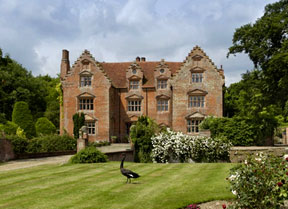
You can have this one for about £2.65 million (about $4 million US).
From EDP24:
The property is a Grade I listed late 16th-century manor house set in a spectacular secluded position on a garden island of just over half an acre surrounded by a moat filled with water and located at the end of a three-quarters of a mile drive. Built of red sand-faced bricks under a tiled roof over three storeys, the hall has stone mullioned windows. The principal reception room, formerly known as the Great Chamber, has marvellous views down the drive and over the gardens on both sides with a magnificent fireplace. The dining hall has a large Tudor-style fireplace and polished flagstone floor and there is a kitchen/breakfast room with exposed timbers.
On the estate are three renovated cottages, barns and stabling, garaging, paddocks and woodland.
Update:
Here’s an article from the Daily Mail about the house and the current owners who did important restoration work on it, including the moat.
Another event next year to mark the big Tudor anniversaries of 2009:
Tudor power, pageantry and propaganda
A one-day conference to celebrate the 500th anniversary of Henry VIII’s coronation and the 450th anniversary of Elizabeth I’s coronation
Saturday 21 March 2009
This one-day conference celebrates the 500th anniversary of Henry VIII’s coronation in 1509 and the 450th anniversary of Elizabeth’s coronation in 1559. The Tudor age has long been considered one of special splendour and the day will look at ways in which England’s most famous and easily recognisable royal dynasty used ceremonial, chivalric values, royal magnificence and propaganda to establish its position and power. The conference will also look at how the individual monarchs projected their own self-image to reinforce their personal and political power. What was reality and what was image? What effect, if any, did changes in religion, for example, have on the religious orders of the coronations?
There will be a display of documents from The National Archives on the day, focusing on the royal imagery and ceremony of the period. This will highlight how the symbolic significance of the royal coronations and the dramatic and lavish funerals were used to affirm the legitimacy of the Tudor dynasty.
Full details at the National Archives page for the event
I’d love a report from anyone who gets to go!
If I remember correctly, this portrait had been on loan to the gallery from the private owner for sometime, but now the gallery permanently owns it.
From the BBC:
Lady Dacre, and her son, Gregory Baron Dacre, by Hans Eworth, is described as “one of the finest works to be painted in Britain in the mid-16th century”.
The gallery paid just under £1m to secure the painting, following a public appeal for donations.
Sandy Nairne, director of the National Portrait Gallery, said: “It is a great acquisition for the nation.”Painted in 1559, the portrait is widely acknowledged as one of the great gems of Tudor portraiture.
Full article (with image)
In the vein of the 450th anniversary Elizabeth I coin, the Royal Mint is producing a £5 coin and illustrated folder to commemorate the 500th anniversary of Henry VIII’s accession to the throne.