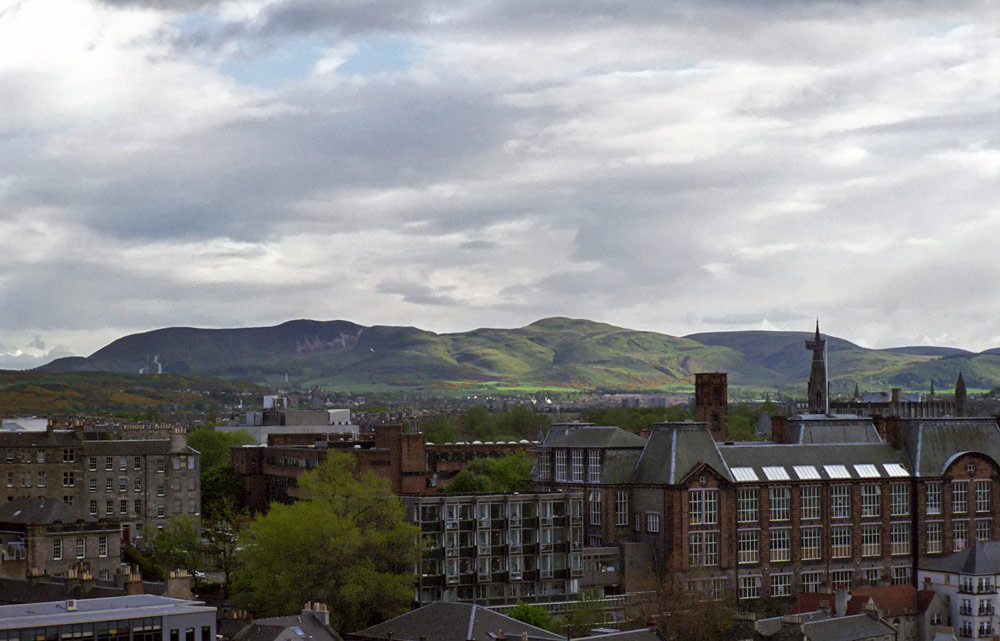
View from Edinburgh Castle. Photo May 2000.
Nothing specifically Tudor-related in this, just a view that I like. 🙂
View from Edinburgh Castle. Photo May 2000.
Nothing specifically Tudor-related in this, just a view that I like. 🙂
For those of you in the area (and how I wish that *I* was!) – Leanda de Lisle will be giving a free lunchtime lecture on Thursday at 1:15 p.m. at the National Portrait Gallery in London.
The talk is titled: A Picture of Innocence: Lady Jane Grey and Her Sisters
More information from the NPG website
(Thanks to Leanda for sending the info so I could pass it on to all of you!)
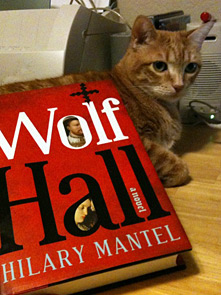
Since my cat keeps insisting that she must be on my desk while I’m working, I put her to work as a book stand.
I say “finally” since I actually finished reading the book last fall and mentioned a few months ago that I was working on a review. I’ve had some notes sitting around for a while but I’m just now getting around to trying to put those notes into a coherent commentary (albeit a short one). I’ve purposely not read any other reviews of the book beyond the headlines and snippet that show up in my Google news alerts, but even from the little bit I’ve seen I don’t think I will be adding much to the discussion that hasn’t already been said.
When I first heard about “Wolf Hall” and the author’s choice of Thomas Cromwell as the central figure my first reaction was surprise. But, after I thought about it for a while, I decided it was a refreshing choice. I don’t read a whole lot of Tudor history fiction any more for a variety of reasons, so a book that takes a person who is often portrayed as a two-dimensional villain and gives him a humanizing third dimension was a welcome change. Cromwell received a similar treatment in “The Tudors” television series.
I’m sure other reviewers have remarked on Mantel’s decision to write the book in the present tense, something I thought at first would bother me. But, between the tense (which reads as almost stream-of-consciousness at times) and the atmospheric descriptions, I found myself quickly sucked in to the story. I have never read much on Cromwell’s life outside of his role at court, so the backstory of his youth and the inclusion of his family life was all new ground for me. I know that there are some gaps in our knowledge of Cromwell’s life, so now I’m curious as to what is history and what was filled in by the author’s imagination.
Perhaps the biggest surprise of the book though was the wry humor throughout, the running joke of Thomas “Call Me” Wriothesley being just one example. When Thomas first comes in to the story he introduces himself: “My name is Wri-oth-es-ley, but wish to spare you the effort, you can call me Risley.” And pretty much every time after this he is referred to as “Call Me” or “Call Me Risley” (and I admit, I chuckled just about every time.)
If there is a negative to the book, I would say that it is not a “beginner” Tudor novel. A familiarity with the people and events of the period is helpful. (The book includes a five page cast of characters at the beginning, which is a good reference for those who don’t know the court of Henry VIII as well as most readers of this site probably do.) The only other negative that comes to mind – having to wait for the sequel!

Stained glass window in St. Gredifael’s Church, near Penmynydd, Wales. Photo May 2000.
Penmynydd is on the Isle of Anglesey, off the northwest coast of Wales. The area is ancenstral land of the Tudors and the great-great aunt and uncle of Henry VII are buried at the church.
The lettering around the window translates from the Welsh to “Unity is like a rose on a river bank, and like a House of Steel on the top of a mountain”. The Welsh of “House of Steel” is Ty Dur, or Tudor.
The top part of the window are parts of the royal regalia of England, the middle is a cluster of Tudor roses and the bottom part is a portcullis, which was the symbol of the Beaufort family.
This was the window that I mentioned back in 2007 had been smashed by vandals. If I remember correctly, it has since been restored, and I think they were able to incorporate some fragments of the original back in to the new window.
* The dig at Shakespeare’s New Place that I’ve mentioned previously has a website where you can follow the excavation and see what they’ve been finding: http://www.digforshakespeare.com/
* Little Miss Sunnydale has posted photos from a visit to Ludlow Castle, along with information on Princess Mary’s time there.
* Gareth Russell has been blogging the fall of Anne Boleyn as it happened in 1536.
The posts so far:
May 1st, 1536: May Day and May 2nd, 1536: The Queen’s Arrest


(Images from the Hampton Court Facebook fan page. See the gallery for larger versions.)
And yes, you can sample it (in both red and white) for
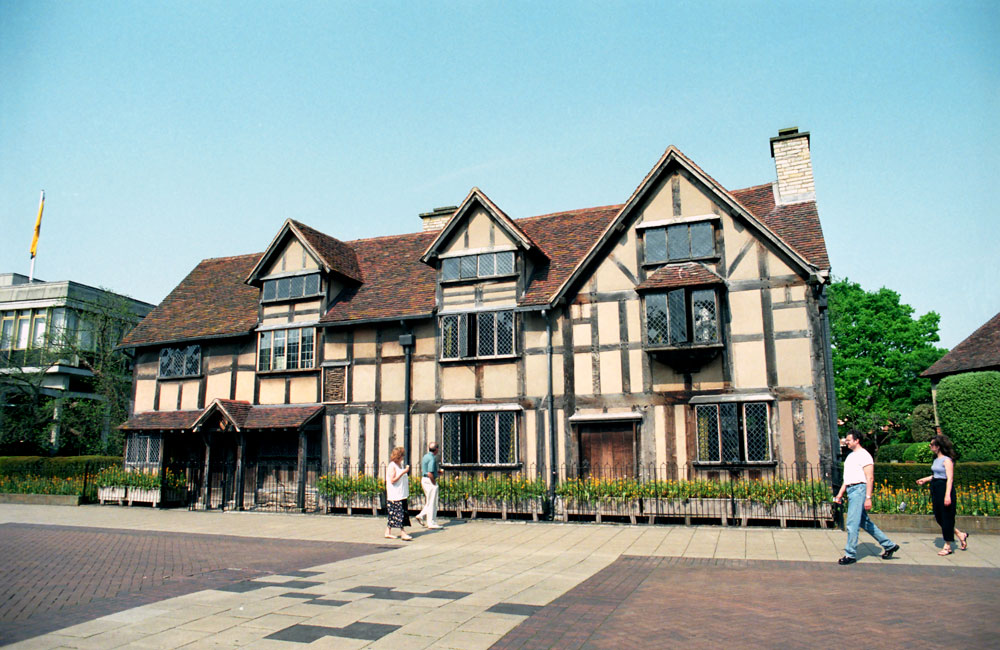
Shakespeare’s birthplace, Stratford-upon-Avon. Photo May 1998.
Short round-up this week!
* Follow-up to the story from the Sunday short takes two weeks ago – Design for statue of Cardinal Wolsey revealed
* Conservation work beginning on the Coronation Chair at Westminster Abbey – There is an interesting short video story linked at the bottom of the page.

Looking across the Avon at Holy Trinity Church, Stratford-upon-Avon. Photo May 1998.
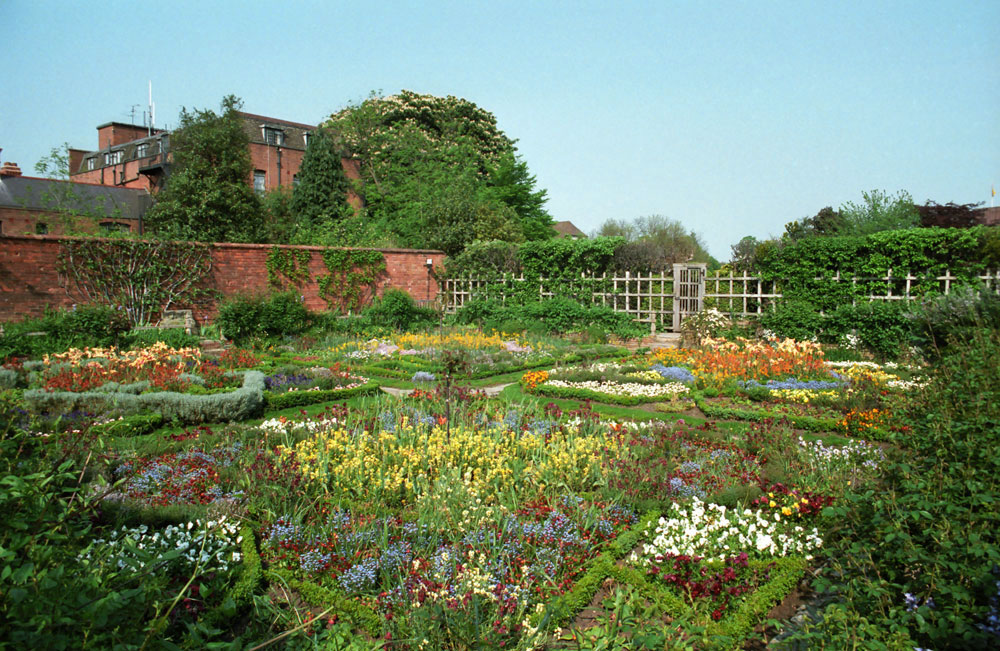
Gardens at New Place, Stratford-upon-Avon. Photo May 1998.
And to complete the catch-up on stuff, a Sunday short takes!
* BBC History Magazine offers a digital sample from their March 2010 issue (which has two Tudor history related articles)
* Spectator article about Mary Grey by Leanda de Lisle
* Little Miss Sunnydale’s Flickr set retracing Anne Boleyn’s coronation procession through modern London
* An article on the enduring popularity of the Tudors
The dig at New Place that I posted about last November has begun! Here are some articles about the early finds:
From The Guardian:
Dig seeks William Shakespeare’s shards for ale in his Stratford back garden
Pottery scraps and other finds unearthed on site of New Place mansion may help to rewrite playwright’s story
Archaeologists in Stratford-upon-Avon have made a sensational discovery: Shakespeare’s broken beer jug. Possibly.
Scraps of pottery, broken clay pipe and a 19th century penny have emerged from a muddy hole in what was a garden until a week ago. But this is the most extensive hunt for Shakespeare in his own backyard in 150 years, and every scrap is precious.
In 1597 the playwright returned from London a rich and famous man and bought New Place, the second best house in his home town. He had a fair copy made of his title deeds, now in the archives of the Shakespeare Birthplace Trust, owner of the site and a string of other properties linked with the most famous playwright in the world. The house vanished centuries ago but Birmingham Archaeology and volunteers are joining forces to recover any evidence left in the ground.
And another from The Telegraph:
Archaeologists dig up Shakespeare’s ‘cesspit’
Archaeologists believe they are on the cusp of shedding new light on the life of William Shakespeare
I totally forgot about several posts in my “draft” folder! So this article is a couple of weeks old – sorry!
Here’s an article by the author of “Death and the Virgin”, Chris Skidmore, from The Express:
A TUDOR MURDER MYSTERY
Was Elizabeth I implicated in the death of Amy Robsart, neglected wife of dashing Lord Robert Dudley, widely believed to have been the Queen’s lover? The author of a new book, Chris Skidmore, has fresh evidence.
It is a 450-year-old mystery that has baffled generations of historians.
One September afternoon in 1560, Amy Robsart, the wife of Lord Robert Dudley, Queen Elizabeth I
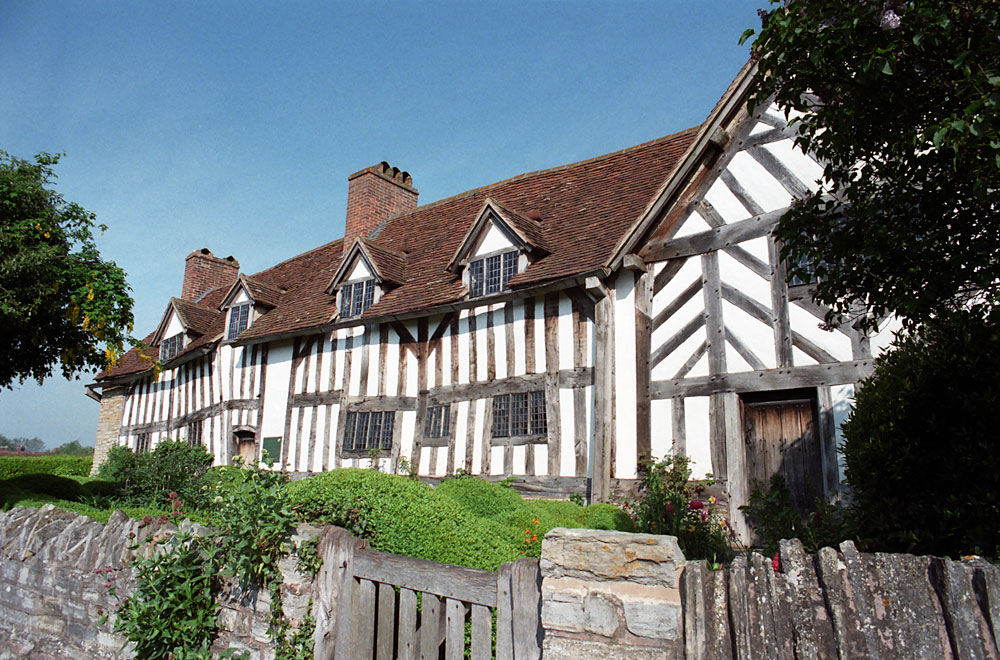
Mary Arden’s Farm. Photo May 1998.
This is another place on my list of places to revisit on a future trip to England. I spent the previous day in Stratford, but only stopped briefly at Anne Hathaway’s Cottage and Mary Arden’s Farm and didn’t actually go in to either property. But I was happy with the few photos I got on my way up to Warwick.
[Update: As Marilyn pointed out in the comments – I totally forgot that this property was re-identified as Palmer’s Farm in 2000, even though I posted about it on the old News Page (the pre-blog blog) and changed it on my personal homepage travel section. Age is catching up to me!]
I received an email from a documentary researcher looking for Tudor scholars in New York or London. If you fit that requirement and are interested, let me know and I’ll put you in touch!

Carving in the gardens at Hatfield, next to the Old Palace.
You can watch the tiny embedded version here, or click over to You Tube directly to see it bigger. You can also see it on Showtime’s website (including an HD option).
I don’t know if these will work outside of the US though – would someone please try it and post in the comments?
I mentioned this book in a “Sunday Short Takes”, but it was kind of buried so I thought I would move it to its own post and update the info now that it is available at the US Amazon.
This is the article that I linked to in the previous post – from the Times Online:
FOR more than four centuries it has been one of the great unsolved deaths of the Tudor age. Did Amy, wife of Elizabeth I
This sounds pretty cool –
From the BBC:
Search engine collects historical resources
A search engine is being created to help historians find useful sources.
The Connected History project will link up currently separate databases of source materials.
Once complete, it will give academics or members of the public a single site that lets them search all the collections.Once completed the search engine will index digitised books, newspapers, manuscripts, genealogical records, maps and images that date from 1500-1900.
“There are a number of electronic resources that have been created by universities and by commercial providers,” said Professor Robert Shoemaker from the University of Sheffield which is heading the project. “They are all available, and all separate and some require subscriptions.”
“What we are trying to do is join them up to create an integrated search facility so you do not have to conduct more searches than necessary,” Professor Shoemaker told BBC News.
Here’s the project page from the Institute for Historical Research:
http://www.history.ac.uk/connectedhistories
And their blog:
http://connectedhistories.wordpress.com/
I never got around to posting an update, but it looks like all of the comments did eventually find their way over to the proper places, this blog included.
And anyone who has seen the old blog will probably note that I updated the design to a new Blogger template. I may change it more in the future, but I kind of like this one. 🙂
[Comments are closed on older posts. If you wish to make a comment, please contact Lara via the link in the sidebar.]

