Upcoming books and events for December 2012

A pretty light month this time around!

Books

The Tudors on Film book that I posted about last month has had the US release date moved back to December 31 (which is what I originally had), which is also the UK release date. Here are the links again:

You can learn more about the book at their website.

Events

Henry VIII: The Musical, which I first mentioned a couple of months ago in a Sunday Short Takes, will have its London debut on December 21 and 22. Below is a new promo video, which you can also see at their website along with photos, songs and more videos from the production. You can also purchase tickets at the website.

Sunday Short Takes

Two more obituaries for Eric Ives were published over the past week:

* The Guardian: Eric Ives obituaryLeading Tudor historian and university administrator known for his books on Anne Boleyn and Lady Jane Grey

* Sydney Morning Hearald: Historian of Tudor treacheryEric Ives, 1931-2012

Another interesting obituary was caught by my Google news alerts, that of Lady Kinloss, the senior descendant of Lady Catherine Grey.

And the rest of this week’s links:

* Would you have been accused of witchcraft? – Fun quiz from BBC History Extra

* A book I missed in last week’s round-up post: Claire Ridgway of The Anne Boleyn Files has launched her third book, On This Day in Tudor History! (Links go to the paperback versions, but there are also inexpensive Kindle versions you can get to from the links below)

And a few videos for your enjoyment:

More on the re-creation of Henry VIII’s crown for Hampton Court Palace. This has some of the same footage from the news video I posted last month, but has some additional information:

Next up is a lecture at the Stanford National Accelerator Laboratory about their work on the wreck of the Mary Rose. I love it when science and history come together!

And finally, Tudor Kickz – An educational video which advertises the Tudor attractions within Southampton through rap:

Upcoming books and exhibitions in November

Books

A couple of books already out in the UK will be out later this month in the US:

Tarnya Coopers Citizen Portrait: Portrait Painting and the Urban Elite of Tudor and Jacobean England and Wales is due out on November 27th, although according to the Amazon.com page it is already in stock. Previous entry here.

And The Watchers: A Secret History of the Reign of Elizabeth I by Stephen Alford is due out on November 13 in the US. Previous entry here.

Also out this month –

The Tudors on Film and Television by Sue Parrill and William B. Robison is due November 3rd in the US (although I’m not 100% on that date) and December 31st in the UK. You can learn more about the book at their website.

Exhibitions

Just a reminder that the Shakespeare: Staging the World exhibition at the British Museum closes November 25th, so if you were planning to see it, don’t wait. I’ve heard some great things about it!

And finally, The Queen’s Gallery at Buckingham Palace will be hosting the exhibit The Northern Renaissance: D

Sunday Short Takes

The Telegraph has posted its obituary for Eric Ives:

* Professor Eric IvesProfessor Eric Ives, who has died aged 81, was the author of the definitive biography of Anne Boleyn and a much-loved figure at the University of Birmingham, where he served as head of the Modern History faculty and pro-vice-chancellor.

And in other news:

* Morning glory: England

The King James Bible exhibit at the University of Texas at Austin

I can’t believe that I’m still catching up on things from the summer! Over on my personal blog I just posted about the trip I took for work out to McDonald Observatory in July and here is my write-up of an exhibit that I visited in June.

Regular readers of the blog will remember that I was pretty excited to see that the King James Bible exhibition previously at the Folger Shakespeare Library and the Bodleian at Oxford would be coming to the Harry Ransom Center at my university. You can see the Harry Ransom Center’s page for the exhibition here. I took a few photos with my cell phone camera and I decided to go ahead and post some even though they aren’t very good. Most of these are the pre-KJB items they had on display, since those are most related to Tudor history, although I included one neat English-made medieval Bible as well. I did include one photo of an original King James although there were many versions I didn’t photograph (including one of the infamous “Wicked Bible”). It was an amazing collection!

The captions below each photo are primarily taken from the information cards with each item, so I didn’t write them. I *hope* I managed to get the right info matched to the correct photo here, but there is a chance I didn’t. But given how cruddy the photos are I’m sure no one would be able to tell!

Banner outside the HRC. You can see the great fossiliferous limestone on the front of the building here too.

An English thirteenth-century manuscript Bible in Latin.

Champions of the English Bible: This was a large display board showing three excerpts from Foxe’s Book of Martyrs of persecution of three previous advocates of translating the Bible into English.

“The New Testament in English after the Greeke translation annexed wyth the translation of Erasmus in Latin” (Londini: Offincina Thomas Gaultieri, 1550)

William Tyndale (ca. 1494-1536) attended Oxford and Cambridge as a young man. He wanted to translate the Bible into English using Hebrew and Greek source texts, rather than the Latin Vulgate. When the bishop of London rebuffed Tyndate, he moved to Germany and proceeded on his own.

The first edition for Tyndale’s New Testament appeared in 1525. Tyndale introduced a number of phrases that the King James translators retained in the 1611 edition, including Matthew 9:2 “be of good cheer.”

“(Biblia?) the Byble: that is, the holy Scrypture of the Olde and New Testament, faythfully translated in Englyshe, and newly oversene & corrected” (Southwark: James Nycolson, 1537)

In 1535, shortly before William Tyndale’s death, his associate Miles Coverdale (ca. 1488-1569) completed and printed a translation of the Bible whlie exiled in Antwerp. A second edition was printed that same year in Southwark, England.

Coverdale relied heavily on Tyndale’s translation, but worked primarily from the Vulgate and from Martin Luther’s German translation. The King James translators retained many phrases from Coverdale includin “the valley of the shadowe of death” and “thou enoyntest my heade with oyle”.


Two volumes of the “Biblia Sacra Hebraice, Chaldaice, Graece, & Latine [known as the Polyglot Bible] (Antwerp: Christopher Plantin, 1569-1573)

Plantin’s Polyglot Bible is considered the most important typographical enterprise of the sixteenth century. The printer had to obtain permission form Philip II, the Holy Roman Emperor, which was a delicate matter in the midst of the Reformation. Plantin then had to create a brilliantly functional typographical design to incorporate the five languages.

“The Bible that is, the Holy Scriptures conteined in the Olde and Newe Testament. Translated according to the Ebrewe and Greeke, and conferred with the best translations in diuers languages. With most profitable annotations vpon all the hard places, and other things of great importance as may appeare in the epistle to the reader. (London: Christopher Barker, 1576)

Protestant scholars fled to Geneva after Mary I’s ascendance to the throne in 1553. There they undertook a new English translation of the Bible, complete with extensive, heavily Calvinist interpretive notes.

The Geneva Bible (1560) introduced a number of features that would soon become standard in English printed Bibles, including the use of Roman type, numbered verses, and italics for English words not represented in the original texts. The Geneva Bible became incredibly popular among English speakers, as this 1576 English reprint attests, and is the translation most frequently quoted and paraphrased by William Shakespeare.

“The Bible. Translated according to the Ebrew and Greeke, and confermed with the best translations in diuers languages. With most profitable annotations vpon all the hard places, and other things of great importance, as may appeare in the epistle to the reader. And also a most profitable concordance for the readie finding out of any thing in the same conteined” (London: Deputies of Christopher Barker, 1588) also a “Geneva Bible”

“The New Testament of Jesus Christ, translated faithfully into English, out of the authentical Latin, according to the best corrected copies of the same, diligently conferred with the Greeke and other editions in diuers languages; with arguments of bookes and chapters, annotations, and other necessarie helpes, for the better vnderstanding of the text, and specially for the discouerie of the corruptions of divers late transtlations, and for cleering the controversies in religion, of these daies; in the English College of Rhemes” (Rheimes: John Fogny, 1582)

In 1559, when the Protestant Elizabeth I (1533-1603) succeeded Mary, Catholic scholars went into exile in Flanders. The translators used the Latin Vulgate as their source text, rather than relying on previous English translations. Named for the two cities in which it was completed, the Douay-Rheims Bible (1582/1610) also contained extensive annotations, many rebutting those of the Geneva Bible.

Additional notes on these two bibles:

Geneva and Douay-Rheimes: A Battle of Annotations

The most populdar English Bible to precede the King James Bible was the Geneva Bible, prepared by English Protestant exiles during the reign of Catholic Queen Mary I. IN 1582, the Catholic Church published its first portion of an English Bible translation, the Rheims New Testament. Comparing annotations found in Revelation 17:1-6 shows how these Protestant and Catholic translations engaged each other. The Geneva Bible contends that the figure of the Whore of Babylon represents “the Antichrist, that is, the Pope”. The Rheims New Testament responds, “The Pope can not be Antichrist.”

Hugh Broughton’s “An epistle to the learned nobilitie of England”
(Middleburgh: Richard Schilders, 1597)

Hugh Broughton (1549-1612) was as famous for his intellect, particularly as a Hebrew scholar, as he was infamous for his cantakerous personality. In this book, he argues for a new translation of the Bible, given the inadequacy of the Bishops’ Bible, and claims to have the support of Queen Elizabeth. Although he wanted a new translation, when King James was finally publshed, Broughton wrote another tract strongly criticizing it.

“The Holy Bible: conteyning the Old Testament and the Newe. Authorised and appoynted to be read in churches” (Imprinted in London: By Robert Barker, 1602) a.k.a. “The Bishops’ Bible”

King James translators were given an unbound 1602 edition of the Bishops’ Bible as a base text. The Bishop’s Bible translators had used the Great Bible as the basis for their translation, but had also taken some non-canonical material including maps, woodcuts, and annotations from the more popular Geneva Bible. Though the Bishops’ Bible was the official starting text of the King James translators, only about four percent of the King James translation comes directly from content original to the Bishops’ Bible (as opposed to earlier English translations).

The First Edition of the King James Bible

“The Holy Bible, conteyning the Old Testament, and the New: newly translated out of originall tongues (London: Robert Barker, 1611)
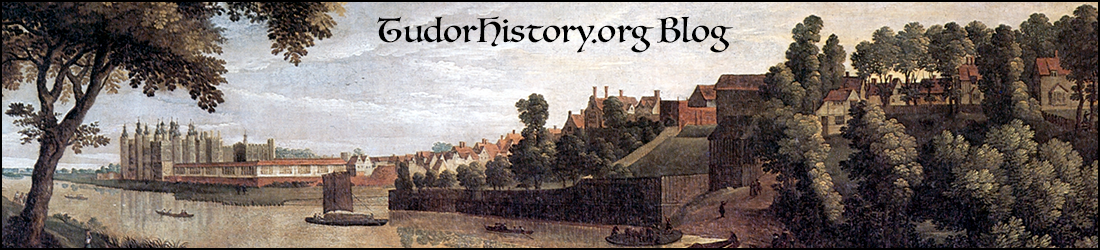
Visit to the Katherine Parr exhibit at Sudeley Castle

Sadly, not a visit that I was able to make myself! Debbie sent in this wonderful photo of one of Katherine Parr’s books on display at Sudeley Castle‘s exhibition celebrating the 500th anniversary of the birth of Katherine Parr:


Click for a great full-sized view! Note Katherine’s signature at the bottom right.

You can read more about Debbie’s visit at her website:
http://thetudorkey.blogspot.de/2012/05/sudeley-castle-visit.html

And if you want to catch the exhibition yourself, you’d better hurry since the castle’s open season ends on October 28th!

Upcoming books and events

Just a few books this for this month’s round-up:

* Alison Weir’s latest novel A Dangerous Inheritance about Katherine Grey will be released in the US on October 2. The UK release info and ordering links are back in the June round-up.

* David Loades’ latest Tudor biography, Catherine Howard: The Adultress Wife of Henry VIII is due out on October 28 in both the US and the UK

Events and Exhibitions

Just a reminder that the Katherine Parr Quincentenary Exhibition at Sudeley Castle will be closing on October 28 when the castle’s open season ends. Also continuing are the Tudor Revels events in Southampton which run through November 1 and the Shakespeare: Staging the World exhibit at the British Museum continues to November 25.

Just one new event for this month’s round-up: October 11 will mark the 30th anniversary of the raising of Henry VIII’s ship the Mary Rose and there will be a boat trip and talk in Portsmouth to mark the day. More information is available at the Mary Rose website.

Richard III dig news round-up

As most of you know by now, there were some exciting developments last week in the search for the grave of Richard III! When I last wrote about it on the Sunday news round-up of September 9, the archaeological team had confirmed that they had received an additional week to dig in light of their discoveries.

Here’s a timeline of relevant events prior to the 21st century [Source]:

* Richard III was buried in the church in 1485 after the defeat at Bosworth and a tomb was erected over the grave ten years later.

* In 1538, Greyfriars was closed during the Dissolution and by the early 17th century the church had fallen into ruin.

* In 1600 the Mayor of Leicester, Robert Herrick, bought the site and had a house built, with a memorial pillar of Richard III’s grave erected in the garden.

* The land was sold in the early 18th century to Thomas Novle and then is sold to the Leicester city council in 1914, who paved over the land for a car park in 1940.

Archaeologists confirmed that they had found the remains of the Greyfriars Church and the 17th century garden that contained the memorial pillar. They then extended the three trenches in hopes of finding the choir area of the church which is thought to be where Richard was buried. (I once again recommend this BBC article for a background on the historical detective work that lead to the dig and, now very importantly, the genealogy work that found a descendant of Richard III’s sister Anne of York for DNA testing.)

Unbeknownst to the public at the time, human remains had been found at the site and on September 4th exhumation began. On September 11 (in my time zone) news had leaked about the remains and that there would be a press conference at 11 a.m. UK time on Wednesday September 12th with details. At the time I was excited by the possibilities, but I knew that finding human remains while digging in a church site wasn’t that unexpected. But I was very curious to hear what they had to say. Given that they were putting together a press conference, I was thinking that they might have some additional evidence that they might have actually found Richard III – and that turned out to be the case!

Here’s a summary of the findings that point to the potential of this being Richard III’s skeleton [Source]:

1. The remains

Sunday Short Takes

The Tudor Ghost Story contest is on again! Head over to On the Tudor Trail for more information on this year’s contest.

And for some follow-up on a couple of previous stories:

The re-enactment of the funeral of Katherine Parr at Sudeley Castle was held today. See a gallery of photos from the event on the Sudeley Castle Facebook page.

And more news has come from the dig in search of the grave of Richard III! From the University of Leicester blog –

* Search for Richard III confirms that remains are the long-lost Church of the Grey Friars

* September 7 update: Archaeologists uncover remains of 17th century garden where memorial pillar once stood.

And here’s an interesting article from the BBC on the background research:

* Richard III dig: How search reached Leicester car park

The initial run of the project was due to wrap up this weekend, with the possibility that it would be extended if significant progress has been made. And I saw on the University Leicester twitter account that is has been confirmed that they will get a third week!

Sunday Short Takes

In a follow-up to last Sunday’s news about the dig to find Greyfriars Church in Leicester and the possible resting place of Richard III, archaeologists have already found strong evidence that they’re digging in the right place.

To keep up with all of the news, check the official site from the University of Leicester’s Greyfriars Project site news section.

Additional news on the most recent finds from the dig – just a few selected from many:

* Richard III dig in Leicester car park ‘is definitely on the right track’

* Breakthrough in the search for King Richard III as archaeologists find ‘tantalising clues’ to the location of his body (and it really could be under a council car park in Leicester)

And another couple of 16th century properties have come on the market (I keep posting these in hopes that someone who reads this blog will buy one and invite me to visit!):

* Live like Henry VIII in your own Tudor mansion complete with pool and 300 acres (but at

Upcoming events and exhibitions

And here are the events and exhibitions for September (book info is in a previous post since there were so many of them).

Just a reminder that both The National Maritime Museum‘s Royal River: Power, Pageantry and the Thames and the National Portrait Gallery‘s Double Take: Versions and Copies of Tudor Portraits exhibitions end September 9, 2012.

I should also mention that the re-enactment of Katherine Parr’s funeral that I slipped in to a Sunday Short Takes since I figured it would sell out before I got it into this round-up has indeed sold out. But you can still enjoy Sudeley’s exhibition celebrating the 500th anniversary of Katherine Parr’s birth until the end of October.

Also at Sudeley, Alison Sim (author of Food and Feast in Tudor England and The Tudor Housewife, etc.) will be joining Lady Ashcombe for a lunchtime event on September 3rd. See Alison Sim’s website for more information.

On September 13, Maria Hayward (author and editor of several works on the inventories and clothing of the Tudors) will be giving a talk at the National Archives entitled “Henry VIII and Anne Boleyn: clothing, courtship and consequences”. Check the National Archives site for more information. They often have free podcasts of their talks so if they post this one I’ll put it in a future blog entry.

Closer to my neck of the woods, Texas Early Music Project‘s next concert will be “The Tudors: From Henry To Elizabeth” on September 15 & 16 in Austin. I’m not 100% sure if I can make it to the concert but I’m going to try!

Description of the concert:

Popular culture has been interested in all things Tudor in recent years, so more people than ever are interested in the very important courts of Henry VIII and Elizabeth I. We will perform lovely works written by Henry VIII as well as masterpieces from the court composers from both rulers. Our renowned singers will present solo and small ensemble vocal works and viola da gamba superstar, Mary Springfels, will lead our consort of viols.

And finally…

There have been and will be a bunch of events in Southampton’s Tudor Revels but I wanted to point specifically to their Michaelmas Faire on September 29 and 30 that will have a lot of events over those two days. From the press release:

On Saturday 29th and Sunday 30th September the Michaelmas Fair in Southampton sees the oldest part of the city transformed in to a Tudor festival of workshops, living fair, historical re-enactments, storytelling, townsfolk and walks.

The Michaelmas Fair is the busiest weekend of the Tudor Revels project – An exciting programme of events and activities based on the heritage, archives and real lives of Southampton’s Tudor period.

Bugle Street, St Michael