Picture of the Week #104

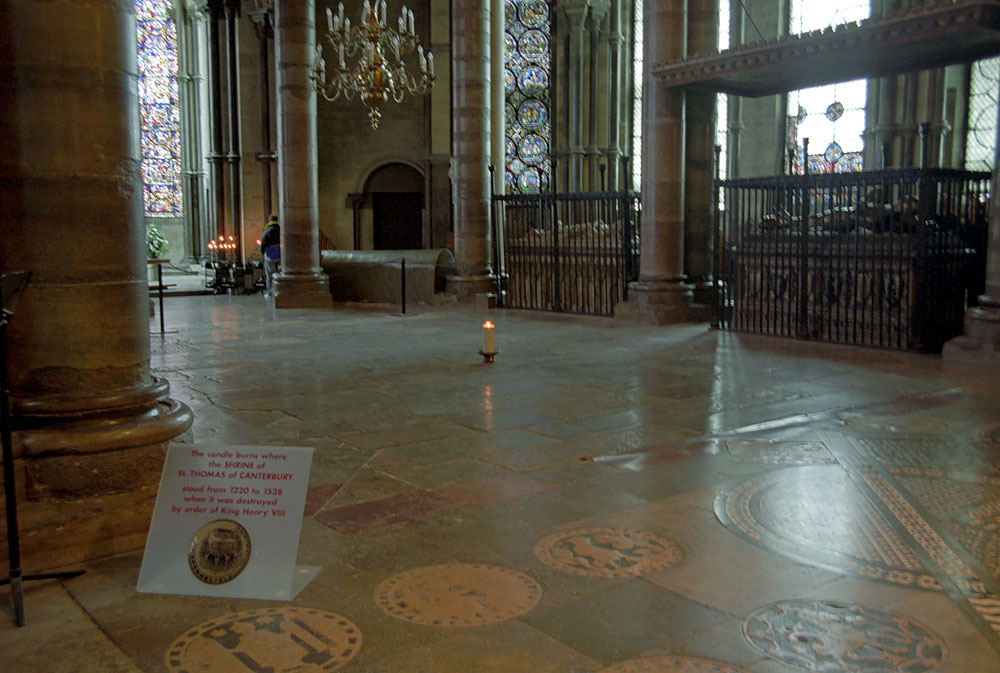
Former place of the Shrine of Thomas Becket in Canterbury Cathedral. Photo May 2003.

This was another one of those times that I had the perfect photo for the day a “Picture of the Week” fell on. The martyrdom of Becket occurred 840 years ago today in 1170 and the Tudor connection is that the shrine was destroyed in 1538 under orders of Henry VIII.

Sunday Short Takes – Monday edition

Yeah, I was goofing off and watching DVDs that I received for Christmas and totally forgot to do yesterday’s blog post. 🙂

* A newly built Elizabethan house – an update on a story I first posted about back in November 2007

* The secrets of Parliament’s Victoria Tower uncovered – neat video from the BBC

* The BBC Tudors Collection coming in April – A box set of Shadow of the Tower, The Six Wives of Henry VIII, The Other Boleyn Girl, and Elizabeth R US Amazon pre-order link below for anyone who is interested:

Tudor Cooking and Escape from the Tower of London

I’m way late in posting these cooking videos, but I wanted to be sure to get them up before Christmas for the two or three of you who haven’t already seen them. I’m going to just post the links to the YouTube versions because I recommend watching them at a higher resolution if you have the bandwidth!

From The Historic Royal Palaces Official YouTube page:

* Ryschewys close and fryez: Tudor cook-along video

* Fylettys en Galentyne: Tudor cook-along video

* Tartes owt of Lente: Tudor cook-along video

And if you have an iPhone and happen to be visiting the Tower of London, you can play “Escape from the Tower of London”, which looks like it could be a lot of fun.

Picture of the Week #102

Arms of Catherine of Aragon at Carew Castle in Wales. Photo May 2003.

This is a close-up of Catherine’s arms that are visible in the wider shot that I had way back as Picture of the Week #8. Her arms are a combination of those of Aragon (upper right and lower left) and Castile (upper left and lower right), as seen below (image adapted from a file at Wikimedia Commons):

France’s Henri IV’s head identified

A lot of you know that I get a big kick out of being able to link to articles on Scientific American here at a history blog. 🙂

From SciAm:

The severed head of King Henri IV has been identified from the jumbled remains in the mass graves in Paris’s Royal Basilica of Saint-Denis. A team of researchers used a host of scientific strategies to confirm the head’s owner, who was killed in 1610.

Henri IV was embalmed and then interred at the Basilica of Saint-Denis. But his – along with other royal graves there – was destroyed during the 1793 revolution. The remains were mutilated and mixed together in mass graves.

[…] although there were traces of hair left on the head and face, the researchers lacked adequate mDNA material to run a genetic test. So they turned to other methods to confirm the regal provenance of the cranium, including the following:

* Radiocarbon dating provided a 200-year window (1450 to 1650), which matched with Henri’s lifespan (1553 to 1610).

* Computed tomography (CT) scans of the head matched up nicely with details in a mould that was made just after the king’s death (now at the Saint-Genevieve Library in Paris).

* Raman spectroscopy showed traces of an amorphous carbon known as ivory black, which was used by the physician Pierre Pigray during the embalming process (specifically requested by the king to be “in the style of the Italians” rather than conforming to more typical French burial preparations). “This charcoal, obtained by anaerobic calcinations of animal bones, corresponds to that deposited by the surgeon Pigray on the surface of the cadaver to absorb decomposition fluids and putrefactive gases,” the researchers noted.

Full article

For context, Henri IV was King of France from 1589-1610 and King of Navarre from 1572-1610, contemporaneous with the last part of Elizabeth I’s reign.

You can see the research article at the British Journal of Medicine here, including imagery of the head.

Picture of the Week #100

Carvings under the Anne Boleyn Gatehouse at Hampton Court Palace. Photo June 2000.

Wow, I’ve hit 100 Pictures of the Week!

If I remember correctly, these carvings are Victorian. The figures are an entwined “H&A” and “A&H”, the portcullis (a Beaufort symbol), Anne Boleyn’s falcon badge, the fleur-de-lis and in the center, an intricate Tudor rose.

New Mary Rose collectible items


Image from The Royal Mint

From Portsmouth.co.uk:

THE MARY Rose has been chosen to feature on a set of commemorative coins for 2011.

The historic ship, housed at Portsmouth’s dockyard, is one of six coins that will be in circulation from next year and has been produced by the Royal Mint.

The Mary Rose, which was King Henry VIII’s flagship, has been chosen as next year marks the 500th anniversary of the great ship’s maiden voyage.

The image has been done by designer John Bergdahl and around the edge of the coin, a Latin inscription reads ‘your noblest shippe 1511’.

Full article

You can get a collectible version with an information folder from The Royal Mint here. I’ll be getting one to go with my Henry VIII 500th and Elizabeth I 450th accession anniversary special coins. 🙂

And…


Press release image from The Mary Rose 500 Appeal

Unfortunately this particular collectible is a little out of my price range…

Press release from The Mary Rose 500 Appeal:

Alan Titchmarsh Pledges Support to New Mary Rose Museum Campaign

Broadcaster and author Alan Titchmarsh is putting his weight behind the campaign to build a spectacular new

16th Century Danish Astronomer Tycho Brahe Exhumed


Image of Tycho Brahe from the University of Texas at Austin Department of Astronomy image collection

This is another one of those stories that comes along every so often that allows me to geek out from both the history and science perspective (and in this case, my actual career science field – astronomy!). Tycho is one of those interesting characters of science that seems to cause endless fascination, so I’m not surprised to see this. And yes, he’s the one who famously had a metal replacement nose after losing the flesh one in a duel!

From The BBC:

Danish astronomer Tycho Brahe exhumed to solve mystery

Tycho Brahe was a Danish nobleman who served as royal mathematician to the Bohemian Emperor Rudolf II.

He was thought to have died of a bladder infection, but a previous exhumation found traces of mercury in his hair.

A team of Danish and Czech scientists hope to solve the mystery by analysing bone, hair and clothing samples.

Tycho was born Tyge Ottesen Brahe in 1546 in Scania, which at the time was a Danish province, and studied astronomy at the University of Copenhagen, as well as German academic institutions.

He catalogued more than 1,000 new stars and his stellar and planetary observations helped lay the foundations of early modern astronomy.

Professor Jens Vellev, from Aarhus University, is leading the team of scientists and archaeologists which opened the tomb in Tyn Church on Monday.

He says he hopes to get better samples of hair and bones than were taken in 1901.

The use of the latest technology to test the samples may also help shed more light on the mystery of the astronomer’s death, although Professor Vellev is not promising anything.

“Perhaps, we will be able to come close to an answer, but I don’t think we will get a final answer to that question,” he said.

The scientists also hope to determine what kind of metal Brahe’s prosthesis was made of – it was commonly believed to have been gold and silver, but others suggested it might have contained copper.

Full article

More articles (all of the articles have interesting pictures):
NPR: Danish Astronomer’s Remains Exhumed In Prague
Scientific American: Was Tycho Brahe poisoned? 16th-century astronomer exhumed–again

And finally, a bunch of photos and some video from the research are available on the Opening of Tycho Brahe’s Tomb pages from Aarhus University

[Comments are closed on older posts. If you wish to make a comment, please contact Lara via the link in the sidebar.]

Picture of the Week #98

Sign on the tree in Hatfield Park at the spot where Elizabeth was told of the death of Mary I and that she was now Queen. Photo May 1998.

The text of the sign reads:

THIS OAK TREE WAS PLANTED BY
HER MAJESTY QUEEN ELIZABETH II
ON 22nd JULY 1985
ON THE SITE OF THE ORIGINAL OAK
TREE UNDER WHICH
HER MAJESTY QUEEN ELIZABETH I
HEARD OF HER SUCCESSION TO THE THRONE

If I remember correctly, the original tree fell in a storm, which is why the replacement was planted in 1985 (a month before the 500th anniversary of the beginning of the Tudor dynasty, I would add). I don’t remember seeing it, but I’ve been told that remains of the original tree are (or have been) on display at the property. From more recent photos I’ve seen tree has grown quite a bit since I saw it last (in May 2000) and the sign is now mounted higher and is easier to see.

Academic research in to portraits of Lady Jane Grey

Update November 17 – I added in a couple of new links to the post and here’s a link to a new article about the The van de Passe Engraved Portrait

Some of you might recall a post from last year highlighting some of the research work that goes in to researching Tudor-era portrait identification by Dr. J. Stephan Edwards of Some Grey Matter. Now here’s a follow-up with some of the work he’s done in his search for an authentic image of Lady Jane Grey. Here’s a summary his work so far and a tease about some work that he recently completed:

As part of my ongoing research on Lady Jane Grey, I have for the past five years been attempting to identify and locate every portrait of Jane Grey mentioned in the historical record that might potentially have been created in the sixteenth century. The project started in September 2005 with the Fitzwilliam portrait, which I thought at that time might be a portrait of Jane. I have since reversed that opinion and am convinced that it is not.

Thus far, I have located over a dozen portraits that were each at one point called “Lady Jane Grey.” Many of them, like the Althorp and Madresfield portraits, were easily shown to have been painted outside England by artists who were dead before Jane was even ten years old. Others, like the Melton Constable portrait, can be identified as some other known person. Another larger group, including the Bodleian and Somerley portraits and the National Portrait Gallery’s painting accession number 764, have no surviving documentation or image content that allows them to be properly identified. Still others, such as the Houghton, Northwick, and Portland portraits, have yet to be located and studied.

The process has generated one or two small controversies, the most prominent of which involved the Yale Miniature. It was put forward by renowned celebrity-historian David Starkey in 2007 as a possible portrait of Jane Grey, but I and others subsequently disputed his findings. That dispute was described in an article in The New Yorker magazine in mid October 2007.

To date, only one portrait has been generally accepted by art historians as a potentially authentic likeness. The Streatham Portrait was acquired by the National Portrait Gallery (as NPG 6804) in 2006 and displayed briefly in the Tudor Gallery. It has since been determined that the painting was created more than forty years after Jane Grey’s death. Curators have suggested it might be a copy of a lost original, though I am suspicious that it is simply the product of some artist’s imagination. The NPG has now removed it from display and has no plans to re-exhibit it, perhaps because of the questionable identification.

In August 2010, I did finally locate what I believe may be a previously ‘lost’ authentic likeness of Jane Grey mentioned in a document from the 1560s. I