16th century wood carvings from Stirling Castle studied

From The BBC:

Researchers are working to uncover the mysteries of 33 wood carved medallions which would have decorated the Royal Palace at Stirling Castle.

Historic Scotland is trying to find out why the works, known as the Stirling Heads and carved between 1530 and 1544, were created and whom they depict.

The carvings are thought to feature monarchs such as James V and England’s Henry VIII.

The research is part of

Tudor connection to Prince Charles’ new home

I have to admit that I was kind of amused at how they had to put in that the house was originally owned by someone related to Anne Boleyn. I guess they know what grabs the eyeballs these days! Well, and it is what caused the article to show up on my Google alerts…

From the BBC:

Prince Charles may have only recently bought his first home in Wales, but its royal connections go back centuries, an historian has discovered.

The original owner of Llwynywermod in Carmarthenshire was related to the second wife of Henry VIII, Anne Boleyn.

Mark Baker, of Prestatyn, Denbighshire, unravelled the history of what was once one of Wales’ finest homes.

“I have uncovered that [the house] goes back to about the 13th or 14th Centuries when it was owned by relatives of Anne Boleyn, Henry V111’s second wife.

“And the Griffies-Williams family in the early 18th century were quite close to the royals and received a baronetcy.

Mr Baker said the house’s renaissance only began about 10 years ago when the previous owner John and Patricia Hegarty bought the farm and land for

Another property for sale

Since I just posted a story yesterday about a property for rent, I was going to pass by this one for sale, until I read the following sentence:

It is run as a hotel for part of the year, with visitors able to enjoy a 17th century medieval experience and six-course banquet along with typical medieval housekeeping staff.

So, what is a 17th century medieval experience? Is that anything like the 21st century renaissance experience I had last weekend? And I’m kind of scared of what a ‘medieval housekeeping staff’ would be like. (Apologies to my friends and any readers who hate hearing the word ‘medieval’ used as a colloquial term for all things bad.)

All snark aside, it is an amazing-looking house. I’m a sucker for black-and-white timbering.

Original article

Property listing (with more photos)

House next to Hever Castle for rent

Yet another one of those neat properties … although this one is only for rent, not for sale.

From The Times Online property pages:

Renting a country house is in. Potential buyers biding their time for further price falls are in need of a stopgap home, and are renting from those who are holding off from selling. Stables House, in Kent, is to let – for

Update on Kenilworth Gardens

As most of you probably know by now, I’m a big fan of the project to recreate the Elizabethan gardens at Kenilworth Castle, based on archaeology and the accounts from Elizabeth’s famous visit in 1575.

Here’s an article from Building Design online about the architecture firm doing the gardens and the project in general, including some neat pictures (small version of one of them above).

In 1575, Elizabeth I

Search for a Tudor carnation

Here’s a neat article from The Telegraph that caught my eye last week:

The grim and impressive ruined battlements of Kenilworth Castle in Warwickshire seem an unlikely setting for a garden of fragrance. But if English Heritage’s latest restoration project goes to plan, visitors moving from the dank environs of the Norman Keep into the light will be greeted by a waft of spicy clove scent, just as Elizabeth I was when she visited in July 1575.

John Watkins, head of gardens and landscapes at English Heritage, is patiently unpicking the genetic profile of a prized carnation that will occupy pedestalled clay pots at the top and bottom of the stairs. His study of engravings of contemporary gardens by Dutchman Hans Vredeman de Vries revealed that urns bearing plant rarities appear in strategic spots – and in some he could discern a trelliswork of willow holding carnations at nose height.

“The carnation was very much a fashionable plant at the time, introduced in 1540,” says Watkins. “It came over from the Turkish court and was probably Dianthus caryophyllus, the true carnation found in mountains around the Mediterranean. The true carnation has a very distinct, spicy nutmeg-clove fragrance. The pinks we know today are much sweeter.”

Full article

Tudor-era paneling returned to Raglan Castle

After being part of a cow shed for a while…

From the BBC:

Tudor wooden panelling, missing from a castle for more than 300 years, is to be returned to its home after once being part of a farmer’s cow shed.

It was among items taken from Monmouthshire’s Raglan Castle during the Civil War in the 17th Century.

But the large panel, once owned by a courtier of Henry VIII, was found after it was sold by a collector, who bought it from a farm for

Videos of Bradgate House

The following email and videos are courtesy of Dave Postles (originally posted to H-ALBION and then forwarded to my Tudor list and sent to me directly by kb)

Bradgate House and Lady Jane Grey

The house is paradigmatic of a late-medieval courtyard house, constructed c.1490-1505 by Thomas Grey, Marquis of Dorset, grandfather of Lady Jane Grey who was born in this house. Brick, but with stone quoins, from local Triassic clay with diaper work in vitrified brick. It was left to decay from 1739, the parkland and house bought in 1928 by Charles Bennion and entrusted to the City of Leicester.

The parkland is partly located in a small gorge. The pre-Cambrian rock which is the bedrock is the oldest in Britain. It was overlaid by Triassic clay. The R. Lin eroded the clay, encountering below the pre-Cambrian rock, cut a smaller channel, creating the small gorge – what geomorphologists call superimposed drainage. Despite its smallness, the Lin here represents all the elements of the cycle of erosion in this superimposed drainage system.

The vill of Bradgate was removed outside the park to the new site of Newtown Linford, a linear or street village along the edge of the park. Several cruck or raised cruck cottages are dispersed in this ‘new’ village.

The southern extension of the park was deer park, with the park pale still discernible on the boundary with the adjacent parish of Anstey.

The video clips are designed to illustrate all these features.

1 The small gorge at the Linford entry to the park

2 The deer park on the south bank of the Lin

4 The deer park again

5 The end of the gorge, opening out of the park and house in the distance

6 One of the many exposed outcrops of pre-Cambrian rock

7 The house

8 The house

9 The deer park

[Copyleft – i.e. copyright-free]

Be sure to check out his other videos!

[July 1 – corrected quoted email to read “Thomas Grey … grandfather of Lady Jane Grey”]

Astley Castle to be saved

From 24 Hour Museum:

Astley Castle in Warwickshire is one step closer to being saved by building preservation charity the Landmark Trust following news that the Heritage Lottery Fund (HLF) has given a pledge of support for a grant of

Another in a long list of properties I wish I had the money to buy!

This time it is a 16th century coaching inn that has been turned into a private residence. And as a bonus feature… Shakespeare is believed to have stayed at the inn.

From The Telegraph:

The inn at Grendon, where the playwright reputedly stayed, was The Ship, an enormous building for the time and purposebuilt in the 1570s: three floors of brick and timber; 20 bedrooms on the upper floors and several large public rooms with enormous fireplaces and intricate wall paintings on the ground floor.

The building, now a private home called Shakespeare House, has been saved from demolition at least twice and its present owners had to rebuild the back wall when they bought it five years ago. “It was a wreck,” says Nick Hunter. “The timbers in the back wall were so damaged and rotten that it was on the verge of collapse. At some time in the past someone had sawn through two major purlins [the horizontal roof beams which support the rafters] so they could install a dormer window and the rear roof was sagging.”

Shakespeare House is for sale through Strutt and Parker (01844 342571), as a whole for

Private tours of Historic Royal Palaces on eBay

From the BBC:

People are being given the chance to bid for exclusive tours around some of London’s historic palaces.

A look around the hidden areas of the Tower of London or a roof top walk on Hampton Court Palace are being offered.

The money raised from the auction on the website eBay will go to the upkeep and restoration of the palaces.

Full article

More information from the Historic Royal Palaces website

I’m not sure if I should thank Kathy for sending this along or not… I’ll be totally jealous of the people who get to do this! 🙂

Behind the scenes tour at Hardwick Hall in mid-May

To mark the 400th anniversary of the death of Bess of Hardwick, the public is being given the chance to see areas of her famous building. I’d love to be able to see it myself!

From The Yorkshire Post:

As part of the events to mark the 400th anniversary of the death of Bess of Hardwick, Hidden Hardwick tours will take place at the hall, near Chesterfield, on May 13 and 19.

They are an opportunity not only to have a tour of the hall with an experienced guide but also to go off the normal visitor route and explore previously hidden areas.

“From the hidden floor which cannot be seen from the outside to the secret door between the High Great Chamber and the Long Gallery, visitors love the fact they are in places that others are not normally allowed into.”

The tour will also include areas of the roof space where visitors will be able to see the timber frame with the wattle and daub lining of the rooms and the secret servants’ floor.

Full article

Harwick Hall’s page at the National Trust

WANT

Every once in a while a property listing will come through on my Google News alerts (like the one for Rochford Hall about this time last year) and I just melt when I see them. It also reminds me that I should probably buy at least one lottery ticket a week…

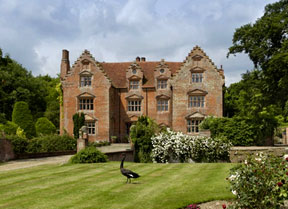
This one is called West Stow Hall and is near Bury St. Edmunds. It’s not as grand as some houses I’ve seen up for sale, it just grabbed me when I saw it. The full listing is here, with several more pictures, including interiors (with a bunch of wonderful beams!!).

Cleaning and conservation work at the Tower of London

When I used to look through picture books of England as a child, one of the things I remember noticing in the old photos (probably mostly taken in the 60s and 70s) was the dark coating from pollution on some of the buildings, in particular the Tower of London (the White Tower) and Westminster Abbey. By the time I saw these buildings in person for the first time (May 1998), the Abbey and the south face of the White Tower had been all cleaned up and were strikingly bright compared to their previous condition. Now, the other three faces of the White Tower are setting cleaned and conserved in preparation for the 2012 Olympics in London.

You can find out more about the project and follow the project manager’s diary at the project website at the Historic Royal Palaces site. There is also information on a new display at Hampton Court about the young Henry VIII, since we’re approaching the 500th anniversary of his accession to the throne.