Archive for August, 2009
August 31, 2009 at 8:09 pm
· Filed under Art News, Tudor History news and events
From The Daily Mail:
Scotland’s earliest harp music was encrypted in an unknown binary code in a ceilings at Stirling Castle.
Wood carver John Donaldson discovered the mysterious code around the head of a woman in a wood panel that adorned the bed chamber of King James V of Scotland.
And now, for the first time in almost 500 years, the historic music has been brought to life on harps played by pupils at Allan’s Primary School in Stirling.
Mr Donaldson, 62, noticed the 0 and I Roman numeral markings immediately when he began creating new versions of the roundels over five years ago. But he failed to understand the meaning of the unusual sequence of Roman numerals.
It was his musical son, Gregor, who eventually converted the markings into a sensible sound.
Full article, with pictures
Previous posts on the Stirling carvings:
16th century wood carvings from Stirling Castle studied
Stirling Castle carvings update
Update: Here’s a BBC article with a recording of the music
Permalink
August 31, 2009 at 7:59 pm
· Filed under Tudor History news and events
A member of my email list posted about an upcoming lecture on Elizabethan shipbuilding at Gresham College (founded by Thomas Gresham in 1597), so I took a look and starting exploring their site. I was delighted to find a bunch of past lectures online, some of which are Tudor history topics.
Here are some upcoming lectures on Tudor history topics (and that I hope will be posted in their archives):
Elizabethan Merchant Ships and Shipbuilding
The Faces of a King: New research on portraits of Henry VIII
And I’ve got to put a plug in for this one:
400 years of the telescope
Permalink
August 31, 2009 at 7:45 pm
· Filed under Archaeology News, Tudor History news and events
I just wanted to post a reminder for anyone heading to or in the vicinity of Portsmouth that the Mary Rose ship hall will be closing on September 20 in order for construction of the new museum to begin. The new facility is due to open in 2012.
More information at the Mary Rose Trust website
Permalink
August 26, 2009 at 9:31 pm
· Filed under Tudor History news and events
From The National Post (Canada):
British historians have unearthed a letter written 510 years ago by King Henry VII that sheds startling new light on Canadian history.
The letter reveals a previously unknown English expedition to this country in 1499 and may add the name of William Weston — an obscure shipping merchant from the west England port of Bristol — to the pantheon of early New World explorers.
The regal dispatch, believed to have been written the year after Anglo-Italian navigator John Cabot perished on his second voyage of discovery to Canada, indicates Weston was set to embark on his own transatlantic journey to “serche and fynde” the same distant territory.
Specifically, the king names Weston’s destination as “the new founde land” reached by Cabot in June 1497 — the first European landfall in North America since the age of the Vikings.
That makes Henry’s letter, believed to have been written on March 12, 1499, the earliest known use of the phrase that would eventually be used to designate Canada’s easternmost province.
Until now, the first mention of “new found land” in connection with Canada’s Atlantic shore was from a 1502 entry in Henry VII’s royal daybook.
Full article
And another article, with the same text but includes an image of the letter
Update: BBC History Magazine will have an article about this discovery in the September issue.
And here’s an article from PhysOrg
Permalink
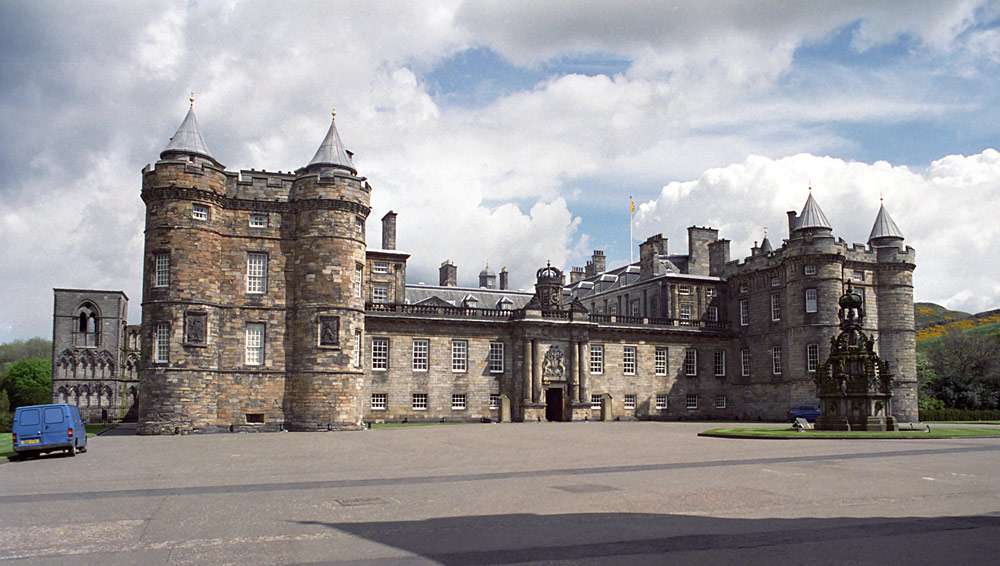
August 26, 2009 at 9:20 pm
· Filed under Picture of the Week

Palace of Holyroodhouse, Edinburgh, Scotland. May 2000.
Unfortunately, this is the only view I got of Holyroodhouse because they were preparing it for Prince Charles’ visit and it wasn’t open to tourists. But, as always, it just gives me an excuse to go back!
Permalink
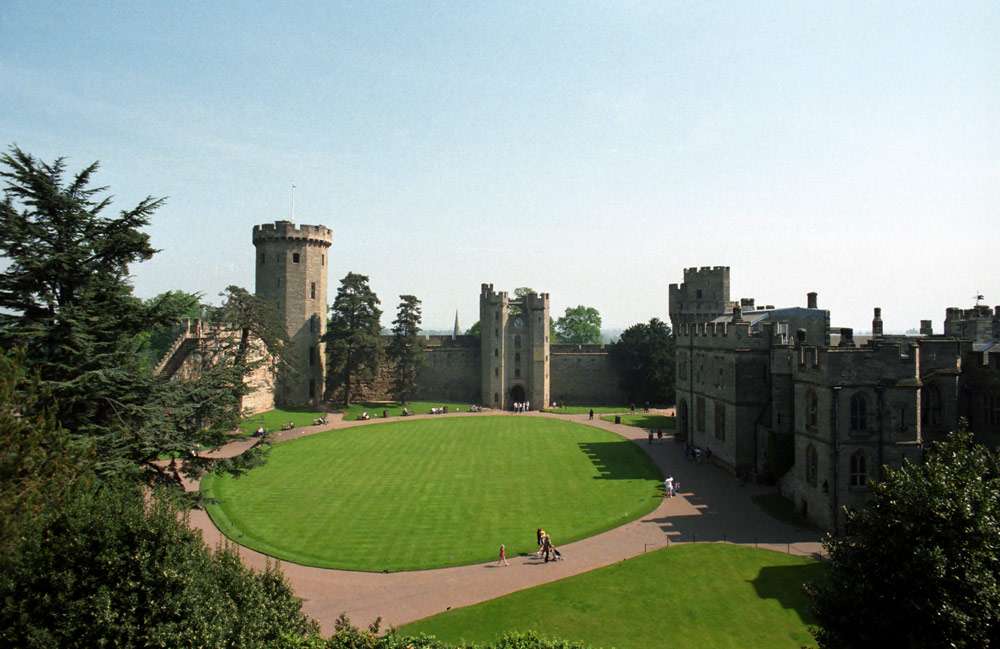
August 24, 2009 at 6:51 pm
· Filed under Picture of the Week
Since I accidentally re-used a photo last week, here’s a bonus:

Overview of Warwick Castle from the Norman motte. Photo – May 1998.
Permalink
August 22, 2009 at 2:18 pm
· Filed under Archaeology News, Tudor History news and events
From the BBC:
Rare Valencian tiles have been uncovered by archaeologists during excavations at the ruins of a Surrey palace, once owned by Henry VIII.
The items, which were made in Valencia, Spain, between 1450 and 1490, were discovered at Woking Palace.
More than 100 members of the public took part in the dig at the palace, which fell into disrepair in 1620 and was later virtually demolished.
…
A spokeswoman for the authority said: “The teams uncovered walls of the Palace of Henry VII, Henry VIII and Elizabeth, and evidence for earlier medieval buildings.
“The most exciting finds were rare Valencian tiles which were made in Valencia, Spain. They have only been found in a few other locations across the UK, according to the archaeologists working at the dig site.”
Full article
Permalink
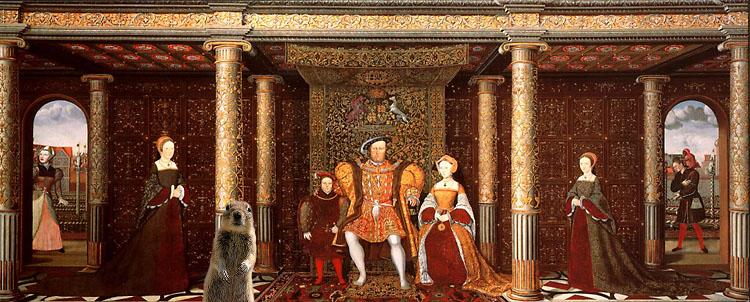
August 22, 2009 at 2:03 pm
· Filed under Entertainment

Click for a larger version.
And if you have no idea what this is about, go here first, then here, and here is where you can make these yourself. Enjoy!
Permalink
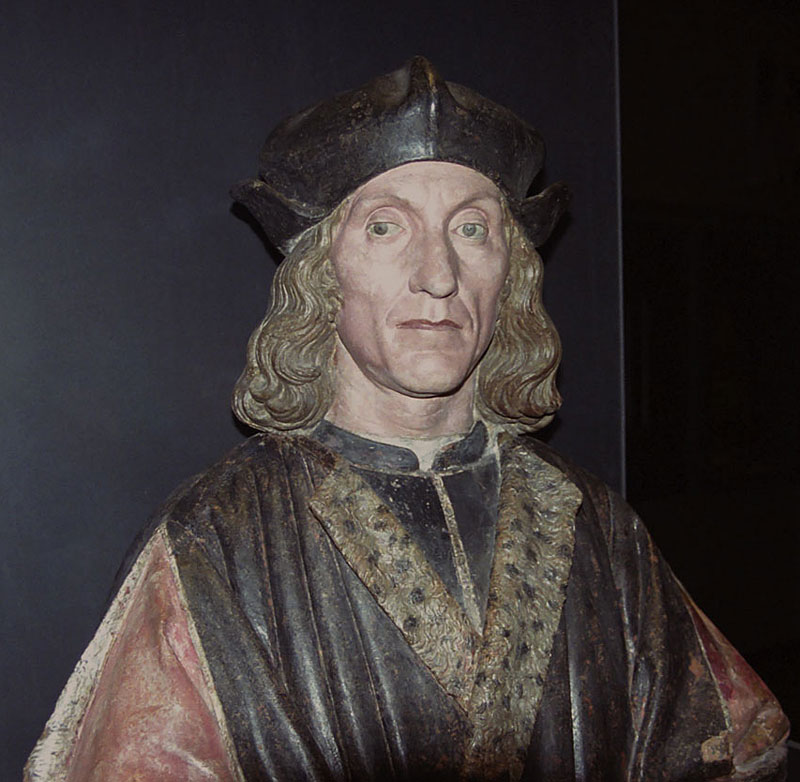
August 19, 2009 at 3:43 pm
· Filed under Picture of the Week

Terra cotta bust of Henry VII by Pietro Torrigiano on display at the Victoria & Albert Museum. Photo May 2003.
Torrigiano also created the effigies on the tomb of Henry VII and his wife Elizabeth of York, as well as that of his mother Margaret Beaufort. You can learn more about this object at the V&A website (and see a lot better photos of it than the one I took!).
Permalink
August 17, 2009 at 4:44 pm
· Filed under Book news
Update: I just received an email from Leanda de Lisle with some more information on the US edition and the UK paperback. First, the US edition will have updated information from the UK hardcover edition, including information on the Spinola letter. And second, the UK paperback has been pushed back to March to coincide with the National Gallery exhibition I blogged about previously. She’s also going to be giving at talk at the gallery that month on the 5th.
The first is a reminder of sorts, since the book has been out in the UK for a while – but the US edition of Leanda de Lisle’s The Sisters Who Would Be Queen is due out in the US in October, along with UK paperback edition (update – the paperback is now due out in March 2010). Here are both the US and UK pre-order links:
Next is a book I’ve mentioned in passing, but I haven’t put up affiliate links for – Alison Weir’s latest, The Lady in the Tower: The Fall of Anne Boleyn. See the podcast of her talk at the British Library for more information about the book.
And finally, I haven’t posted anything about this lately, but Eric Ives’ book on Lady Jane Grey is also due out in the UK in October. I haven’t found anything on a US release yet, but I’ll keep an eye out. UK Amazon pre-order link below.
Permalink
August 17, 2009 at 4:20 pm
· Filed under Tudor History news and events
If any of you subscribe to the newsletter of the National Archives (UK) you may have already seen this, but they mentioned in the most recent issue that they are offering a one month trial of the State Papers Online Part II. Just follow the link for instructions.
Permalink
August 15, 2009 at 1:42 pm
· Filed under Entertainment
From The BBC:
The Starstruck exhibition features up to 100 costumes, many of which have been worn by stars in Oscar-winning films and major television series.
The event will raise money for the cathedral, its mission and outreach work, a spokeswoman said.
The three-week exhibition will run until 6 September, but will not be open on Saturday 22 August.
The costumes include those worn by Dame Judi Dench, Dame Helen Mirren and Cate Blanchett for their individual portrayals of Elizabeth I.
Full article
Another article (with more pictures) from Berrow’s Worcester Journal
The official site for Worcester Cathedral and more on the exhibition
Permalink
August 15, 2009 at 1:33 pm
· Filed under Art News
From the Times Online:

Is this Mary Tudor, England’s Catholic queen who has gone down in schoolroom history as Bloody Mary?
If it is, as some scholars believe, the painting could make a virtuous circle to delight the heart of a Home Counties Jesuit parish priest. “It could be a small miracle,” says Canon Timothy Russ. And the secrets it contains could also bear new witness to the torrid religious politics of the mid-16th century.
Canon Russ is prepared to sell the painting he inherited in order to rescue Sawston Hall, near Cambridge, the 16th-century home of the recusant Huddleston family, and turn it into a Catholic heritage centre and refuge.
…
This year it was seen by Dr Tarnya Cooper, 16th-century curator at the National Portrait Gallery. “We concluded that while it is undoubtedly a very interesting and important painting, it cannot represent Mary I mainly because of facial dissimilarity with other authentic portraits of her. It is more likely to be a member of the nobility, possibly from within Princess Mary’s circle,” she said.
Sir Roy Strong, former director of the NPG and an authority on Tudor portraiture, is a patron of the charity set up to save Sawston. He said he has never been convinced that the portrait is of Mary, “and I have seen nothing to change my mind. The mid-16th century was a very dark time and it is extremely difficult to be certain.” But Professor Jack Scarisbrick, the Tudor and Catholic scholar, says it is too grand a portrait to be of anyone but royalty. “There was nobody outside the royal family important enough for such a lavish full-length painting — and if it is isn’t Mary, who is it? Nobody else fits the bill,” he said.
So convinced is Linda Porter, the author of a recent biography of Mary Tudor, of the sitter that she used the image on the cover of her book. “I’m certain it’s Mary,” she said. “It was quite fashionable in the last decades of the 20th century to question the identity of sitters in several well-known Tudor portraits, but some of this scepticism has now come full circle — the portrait of Katherine Howard that was questioned at this period is now thought to, indeed, be her. My own view is that family traditions are very often reliable. Plus which, to me at least, it looks like her.”
Full article
Here’s a larger, full-length scan of this portrait
Permalink
August 15, 2009 at 1:10 pm
· Filed under Book news
I just recently heard about this forthcoming book during the podcast talk by Alison Weir at the British Library. I haven’t found any information on whether there will be a US edition, but I’m going to send a few emails and see if I can find out.
Update: I emailed Ms. Borman and she said that a US edition is due in September of 2010! I’ll post a reminder about it when we get closer to that date.
From author Tracy Borman’s website:
Tracy’s next book, Elizabeth’s Women: The Hidden Story of the Virgin Queen, will be published by Jonathan Cape on 24th September 2009. It will explore all of the most important women in Elizabeth’s life: from her bewitching mother, Anne Boleyn, to her dangerously obsessive sister, Mary Tudor, and from the rivals to her throne such as Mary, Queen of Scots and the sisters of Lady Jane Grey, to the ‘flouting wenches’ like Lettice Knollys who stole her closest male favourite. These were the women who shaped the Virgin Queen and it is through their eyes that the real Elizabeth, stripped of her carefully cultivated image, is revealed.
And here’s my Amazon.uk affiliate link if you want to pre-order and throw a few pence my way.
Permalink
August 12, 2009 at 2:49 pm
· Filed under Picture of the Week

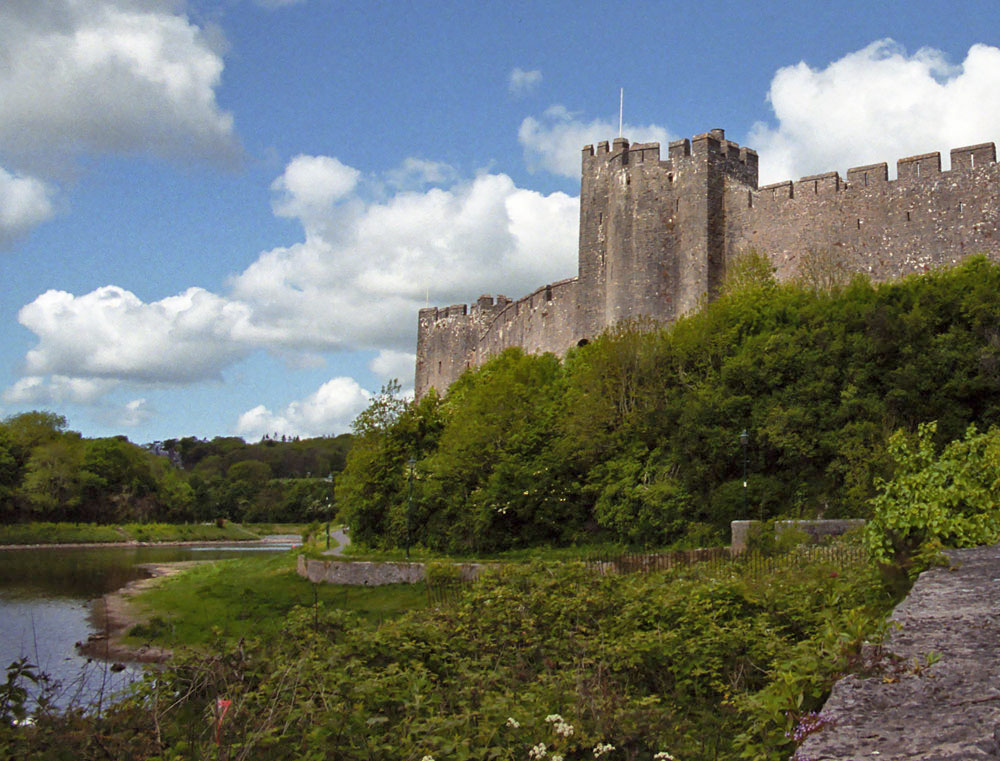
Outside the walls of Pembroke Castle, birthplace of Henry VII. May 2003.
Permalink
August 10, 2009 at 9:05 am
· Filed under Tudor History news and events
This poem should be familiar to a lot of fans of Tudor history
Whoso List to Hunt by Thomas Wyatt
This week, a heartfelt but enigmatic love poem from the court of King Henry VIII
Thomas Wyatt’s double life as poet and Tudor courtier brings to mind a famous aphorism of WH Auden’s: “Private faces in public places/ Are wiser and nicer/ Than public faces in private places”. Wyatt was a successful “public face”: he first entered the service of Henry VIII at the age of 13, and, despite vicissitudes (including two spells of imprisonment), he retained his head, and enjoyed a triumphant later career as ambassador to the court of Charles V. He travelled widely through southern Europe: he imported, popularised and, with the help of the Earl of Surrey, gave an English shape to the Petrarchan sonnet. But what we hear in his poetry is never secondhand or artificial: it is a personal note, a note of authentic private feeling, which dominates, and is never dominated by, poetic conventions. Perhaps it was a similar note of personal credibility that sustained his popularity in the public glare of the court. Or perhaps it was sheer cunning.
…
Whoso List to Hunt
Whoso list to hunt, I know where is an hind,
But as for me, alas, I may no more;
The vain travail hath wearied me so sore,
I am of them that furthest come behind.
Yet may I by no means my wearied mind
Draw from the deer, but as she fleeth afore
Fainting I follow; I leave off therefore,
Since in a net I seek to hold the wind.
Who list her hunt, I put him out of doubt,
As well as I, may spend his time in vain.
And graven with diamonds in letters plain,
There is written her fair neck round about,
‘Noli me tangere, for Caesar’s I am,
And wild for to hold, though I seem tame.’
Full article
Permalink
August 9, 2009 at 2:45 pm
· Filed under Archaeology News, Shakespeare, Tudor History news and events
From The Telegraph:
Tomb search could end riddle of Shakespeare’s true identity
A sarcophagus in an English parish church could solve the centuries-old literary debate over who really wrote the plays of William Shakespeare.
Parishioners at St Mary’s church in Warwick have sought permission to examine the contents of the 17th monument built by Fulke Greville, a writer and contemporary of Shakespeare who some believe is the true author of several of the Bard’s works.
In an echo of the blockbuster book and film, The Da Vinci Code, the search has been prompted by the discovery by an historian of clues in Greville’s writings which suggest he had several manuscripts buried there, including a copy of Antony and Cleopatra.
A radar scan of the sarcophagus has already indicated the presence inside of three “box like” shapes. The searchers believe these could contain documents and a further examination is now being proposed which they hope will finally prove the link between Greville and Shakespeare.
The initial search, using ground penetrating radar, was approved by the parochial church council and the diocesan council. The team now wants to use an endoscope – a tiny video camera on a long thin tube – to be inserted into the monument to test his claims.
The work would be supervised by Professor Warwick Rodwell, consultant archaeologist to Westminster Abbey, who is keen for the project to go ahead.
…
The parochial council also wants the sarcophagus to be opened because it believes that any new evidence will bring extra visitors and save the church, the foundations of which date back 900 years, from bankruptcy.
“St Mary’s is a beautiful church but is in desperate financial straits,” a spokesman said. “Any manuscripts that are found would safeguard its future.”
However, the diocesan advisory committee and the Church Buildings Council are resisting the new search, on “ethical grounds” and a final decision could now be taken by the diocese’s consistory court.
Full article
This is the same church I mentioned in Picture of the Week #21. And here is a link to their official website.
Permalink
August 7, 2009 at 2:09 pm
· Filed under Tudor History news and events
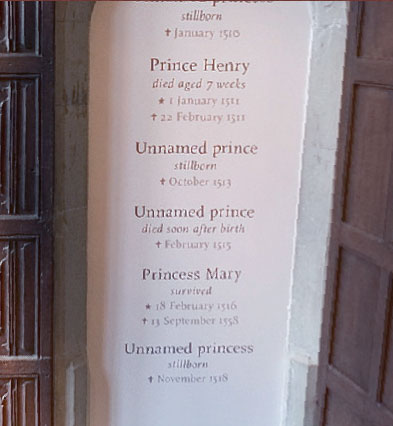
This has been sitting in my “draft” folder for a while, so of course I now have forgotten who pointed this out. The image below was taken from the video tour of an exhibit at Hampton Court this year for the Henry VIII 500th anniversary events.

(Click for a larger view)
Notice the death date for Mary?
Permalink
August 5, 2009 at 2:47 pm
· Filed under Picture of the Week

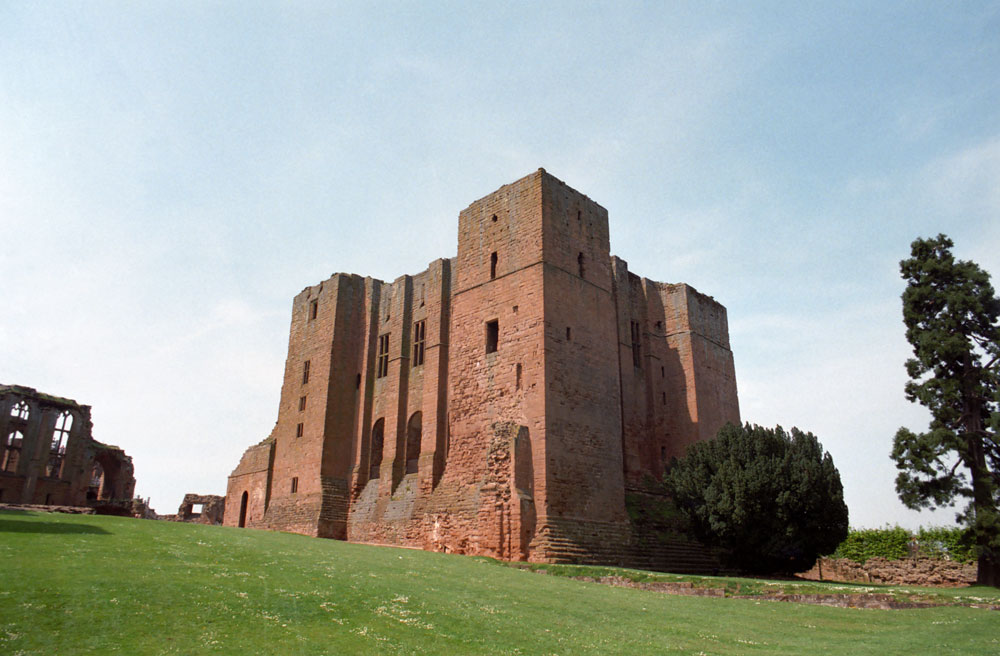
The 12th century keep at Kenilworth Castle. Photo May 1998
Kenilworth is definitely on my “re-visit” list for some future trip back to England. Besides the new Elizabethan gardens, I want to see the the finished work on the gatehouse, which was still undergoing restoration (and consequently covered in scaffolding) when I was there in 1998.
Permalink
« Previous entries Next Page » Next Page »