Henry VIII radio programs
Spotted at The Anne Boleyn Files blog – head on over there for links to two programs from BBC Radio 4.
If you haven’t played with the British Library’s “Turning the Pages” site before, it is definitely worth a look if you love old books. They just added Henry VIII’s Psalter, which is currently on display in the Henry VIII: Man and Monarch exhibition.
(Spotted at the British Library’s Henry exhibition blog)
A new book is out about another anniversary this year – the first publication of a complete collection of Shakespeare’s sonnets in 1609. It seems that a lot of interesting things happened in years ending in a 9!

So Long as Men Can Breathe
By Clinton HeylinShakespeare’s Sonnets are famous the world over, but did their author intend to keep them from ever being published? In this lively, fascinating account of the publication of the Sonnets, noted biographer Clinton Heylin brings their convoluted history to light, beginning with the first complete appearance of the Sonnets in print in May, 1609. He introduces us to the “unholy alliance” involved in this precarious enterprise: Thomas Thorpe, the publisher, a self-described “well wishing adventurer;” George Eld, the printer, heavily embroiled in large-scale pirating; William Aspley, the prestigious bookseller, who mysteriously ended his association with Thorpe soon after. Leaving the calamitous world of Elizabethan publishing, Heylin goes on to chart the many editions of the Sonnets through the years and the editorial decisions that led to their present configuration. Passionate, astute, and brilliantly entertaining, the result is a concise and vivid history of perhaps the greatest poetry ever written.
Here’s the How to Order page from the publisher and my usual Amazon links are below (standard disclaimer – I earn a small amount from books purchased through the affiliate links):

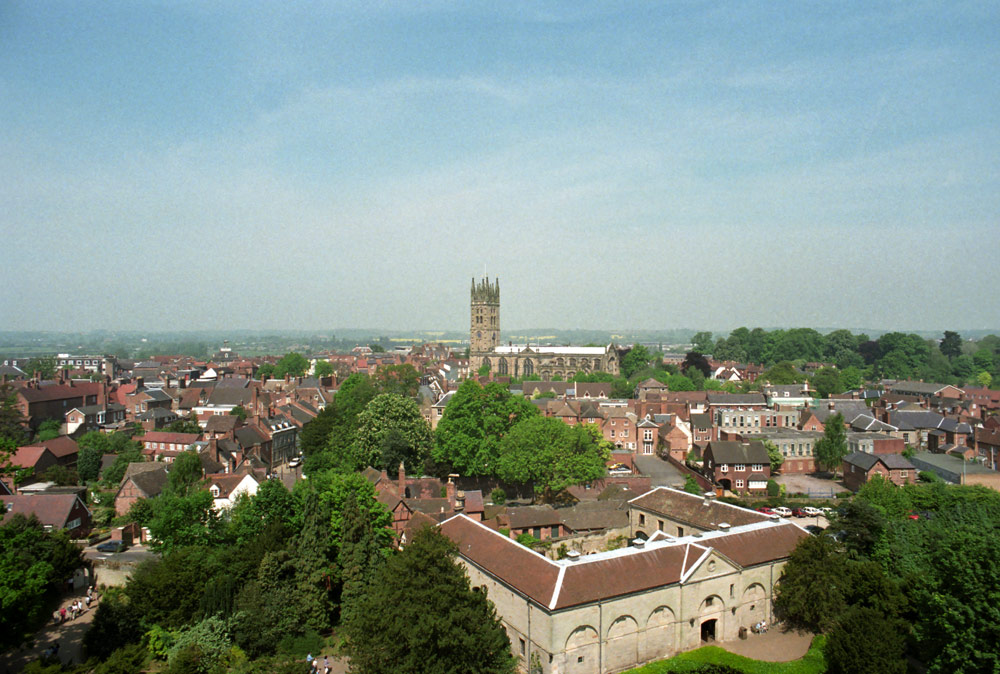
St. Mary’s as seen from the walls of Warwick Castle. May 1998.
The Collegiate Church of St. Mary, Warwick dates to the 12th century and was rebuilt in the 14th century. Ambrose and Robert Dudley (along with Robert’s wife Lettice and their son) are buried in the Beauchamp Chapel of the church.
Sorry I have been a little quiet on this blog over the last week or so! I’m just going to do a quick round up of a few things that I wanted to post about this week but got behind on.
From the London Evening Standard, an article about one of the winners at the Chelsea Flower show, which grew plants used in a recipe to create perfume for Elizabeth I.
Here’s another article about Henry VIII’s annulment request document that I blogged about previously.
Sent to me through Twitter – News on Alison Weir’s upcoming book launch at the Tower of London for her new bio on Anne Boleyn and details for a tour of Tudor England she’ll be leading in 2010, as well as news on other upcoming books (including a sequel to “The Lady Elizabeth”).
And finally, from Pop Tudors (the blog for the Showtime series “The Tudors”) – Ask a Tudor!. Your chance to ask Mark Hildreth, the actor playing Cardinal Reginald Pole, a question. You can submit them in the comments on the page linked to above.
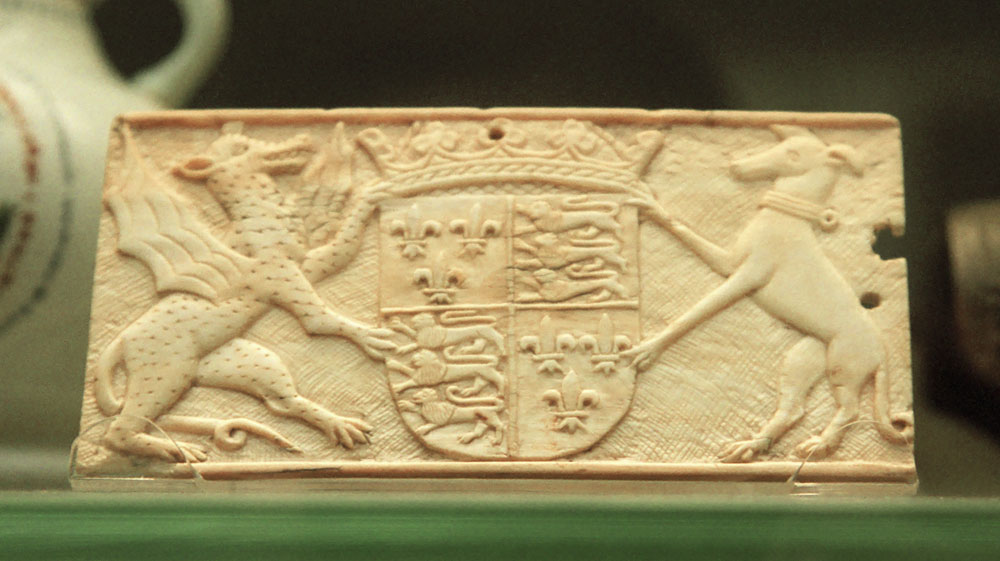
Ivory plaque with the arms of Henry VIII. British Museum, May 2003.
Here’s the page for this item at the British Museum website.
Just in case some of you haven’t been following the British Library blog or subscribed to their podcast for the Henry VIII: Man and Monarch, here is a link with the hour-long talk by David Starkey on the young Henry (1491-1509) (scroll down to get to Starkey’s talk).
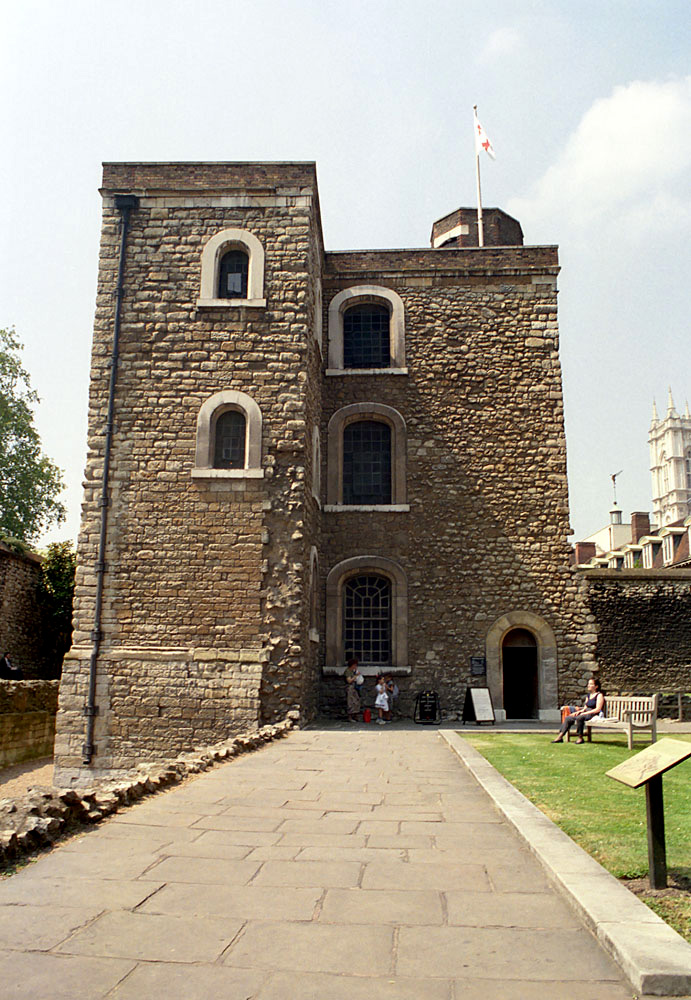
The Jewel Tower of the remains of the medieval Palace of Westminster. Photo May 1998.
If you’ve got about US$68,000 to spare.
From the New York Times:
The Vatican has opened its Secret Archives, the repository of centuries worth of documents pertaining to the Holy See, to let the world get a closer look at a document presaging England’s split from the Church of Rome. Dated July 13, 1530 and addressed to Pope Clement VII, the letter asks for the annulment of Henry’s marriage to Catherine of Aragon and includes the seals of dozens of peers of England who concurred with the request. A facsimile of the document will go on sale next month for about $68,000 from Venice-based publisher Scrinium, which plans a limited run of 199 copies.
Full article (with picture)
Page at the Vatican Secret Archives with more information on the document (with larger picture)
Wow, that is a LOT of seals!
I’ve been seeing various short articles coming through my news alerts saying that Joss Stone will be back as Anne of Cleves during the 4th season of “The Tudors”. I haven’t seen any information on how many episodes she’ll be in though.
I’ve been seeing a few interesting reviews about “Wolf Hall”, a novel about Thomas Cromwell, coming through on my Google news alerts and I also received a recommendation from Foose, so I thought it was time to look into this book some more! Here’s the product description from Amazon, as well as an order link for Amazon UK (where the book is already out) and a pre-order link for the US Amazon, where it will be out in October. I’m personally hoping it is eventually at Audible, since that’s how I “read” a lot of books these days!
In the ruthless arena of King Henry VIII’s court, only one man dares to gamble his life to win the king’s favor and ascend to the heights of political power
England in the 1520s is a heartbeat from disaster. If the king dies without a male heir, the country could be destroyed by civil war. Henry VIII wants to annul his marriage of twenty years, and marry Anne Boleyn. The pope and most of Europe opposes him. The quest for the king’s freedom destroys his adviser, the brilliant Cardinal Wolsey, and leaves a power vacuum.
Into this impasse steps Thomas Cromwell. Cromwell is a wholly original man, a charmer and a bully, both idealist and opportunist, astute in reading people and a demon of energy: he is also a consummate politician, hardened by his personal losses, implacable in his ambition. But Henry is volatile: one day tender, one day murderous. Cromwell helps him break the opposition, but what will be the price of his triumph?
In inimitable style, Hilary Mantel presents a picture of a half-made society on the cusp of change, where individuals fight or embrace their fate with passion and courage. With a vast array of characters, overflowing with incident, the novel re-creates an era when the personal and political are separated by a hairbreadth, where success brings unlimited power but a single failure means death.
There is a post up at the British Library’s blog for the Henry VIII: Man & Monarch exhibition about the location for the famous Field of Cloth of Gold, including a photo of the current marker. Check it out!

In addition to being the anniversary of Henry VII’s death and Henry VIII’s accession to the throne (and his marriage to Catherine of Aragon), it is also the 500th anniversary of the death of Lady Margaret Beaufort, mother of Henry VII. Christ’s College, Cambridge was founded by Margaret and they will be holding an event on June 27 in her honor including talks, evensong, a banquet and more.

(Picture taken with my laptop’s built-in webcam in my office at work)
I haven’t had a chance to do a thorough flip-through yet, but I can’t wait to dig in!
Andrea was kind enough to put together this timeline of Anne Boleyn’s fall, so you can following along in “real time” as we go through the month of May. If I was more organized and had more time, I’d set these up as individual posts to come on the appropriate days!
Late January 1536 – Anne Boleyn miscarries for second time
February – Anne Boleyn recovering
4 February – Henry busy with Parliament
Mid-March – Henry has become serious about Jane Seymour (the purse of soveriegns incident)
Lent – Henry facilitates Chapuys’ snub of Anne Boleyn
14 April – Old parliament dissolved
14-17 April - Easter
23 April – Order of the Garter goes to Sir Nicholas Carew (open supporter of Jane Seymour and open enemy of Anne Boleyn) Significantly, George Boleyn misses out
24 April – commission of Oyer and Terminer ( hear and determine) created. Cromwell sets up, and Henry signed the papers
27 April – Writs issued for new parliament; the speed of which is unprecedented
The trap is prepared and set…….Cromwell waits for some ” incriminating evidence” against Anne Boleyn
29 April – Mark Smeaton incident in Anne Boleyn prescence chamber30 April – Henry Norris incident ” dead man’s shoes”
- Norris approaches John Skip, Anne Boleyn’s Almoner to swear Anne’s integrity
- Anne Boleyn appeals to Henry with Elizabeth in her arms (The Princess had been staying over during Easter holidays)
- Late at night, the Progress to Dover is cancelled – the die is cast……1 May – Mayday jousts go ahead. This is the last time Anne Boleyn ever saw Henry. Henry leaves without saying good-bye.
- Norris is arrested and taken to London, over-nighting at York Place, and conveyed to the Tower the next morning
- Smeaton is arrested, taken to the Tower, racked for around 4 hours and confesses to adultery with the Queen2 May – Anne Boleyn is arrested at Greenwich Palace, questioned by the council and taken by barge along the Thames, entering through Traitors Gate, into the Tower. She is housed in the same apartments as on her Coronation night
- George Boleyn is arrested at York Place, where he was in attendance at court
- Archibishop Cranmer is summoned to court
- Anne Boleyn’s ladies are closely questioned
Temporary stand-still; no-one has actually admitted to anything except Smeaton.
3 May – Anne Boleyn alternates between hysterical outbursts, vengeance and merry optimism (that the situation may be resolved)
- During a hysterical babbling, she recalls an incident regarding Francis Weston
- Francis Weston is arrested and conveyed to the Tower4 May – William Brereton is arrested and conveyed to the Tower (this could be a personal vendetta for Cromwell regarding a hanging by Brereton in Wales of a man whom Cromwell supported “a judicial hanging”)
8 May – Richard Page and Thomas Wyatt arrested and conveyed to the Tower
12 May – Norris, Smeaton, Weston and Brereton tried in Westminster Hall and found guilty.
13 May – Anne Boleyn household is dismantled. Jane Seymour comes to London and stays in Chelsea, close to York Place. Henry promises Jane Seymour Anne’s condemnation – before the “trial”
15 May – Anne Boleyn and George Boleyn are tried inside the Tower, in the great hall, where Anne had had her coronation feast. Anne was tried first. Both were found guilty. Ironically, Lord Percy has to judge her as one of her peers. Her Uncle presides over the trial
16 May – It is decided that Anne Boleyn will die at the hands of the Executioner of Calais
17 May – All five men are executed on Tower Hill. Anne Boleyn’s marriage is anulled and Cranmer issues a dispensation for Jane Seymour and Henry to marry
19 May – Anne Boleyn executed on Tower Green, inside the walls of the Tower. The gates are left open but the time not announced. There are less than 2,000
20 May – Henry is betrothed to Jane Seymour
30 May – Henry marries Jane Seymour
4 June – Jane Seymour is proclaimed Queen, and attends Mass with Henry, as Queen. They dine in state afterwards, and Jane Seymour sits in the same chair occupied by Anne Boleyn only 5 weeks earlier
18 June – Cromwell recieves office of Lord Privy Seal (previously held by Anne’s father)