
Although I’ve linked to the exhibition stuff already, I wanted to point out this link to some key documents related to Henry VIII that the British Library has in their online galleries. They also have clips from Starkey’s “Henry: The Mind of a Tyrant” series.
Month: April 2009
Kenilworth Garden reopens this weekend
BBC News video:
Additional articles:
The Guardian: Kenilworth Castle garden reopens
The Independent: Recreated, the Tudor garden where an ambitious earl wooed the Virgin Queen
Picture of the Week #17

Leeds Castle. May 2003
If ever there was a place I need to go back and visit on a nicer day, it’s Leeds Castle! It’s such a beautiful castle and setting, it’s really a shame it was such so damp and dreary when we were there. Still, a lovely place to visit!
Queen honors Yeoman of the Guard and Henry VII
From The Telegraph:
Queen thanks Yeomen of the Guard on 500th anniversary of Henry VII’s death
The Queen expressed her thanks to the Yeomen of the Guard as she honoured the founder of the famous royal bodyguards.
More than 70 Yeomen – resplendent in their distinctive red and gold tunics, large white ruffled collars, scarlet stockings and flat brimmed black Tudor hats – gathered in Westminster Abbey in tribute to King Henry VII.
Henry VII created the Queen’s Body Guard of the Yeomen of the Guard in 1485 at the Battle of Bosworth.
To mark the 500th anniversary of his death, the Queen placed a posy at his tomb in the Abbey’s Lady Chapel.
The British Library is looking for a whole lotta Henrys
And you could win a
TudorCast #23 – April 2009
Here it is, finally!
Henry VIII 500th Anniversary events page
August 2007 podcast that included Empson and Dudley: http://tudorhistory.org/podcast/08-2007.html
[Comments are closed on older posts. If you wish to make a comment, please contact Lara via the link in the sidebar.]
Answers from Leanda de Lisle
Just wanted to let everyone know that the answers from Leanda de Lisle Q&A have now been posted over at the Lady Jane Grey Reference site!
Henry’s love letter to Anne at the British Library
From the Channel 4 website
Things you might not know about Henry VIII
I got this fun press release from the British Library in conjunction with the opening of the Henry VIII – Man and Monarch exhibition
They’ve also started a Henry VIII exhibition blog and a podcast!
And here is my previous post about the exhibition catalogue. I ordered mine yesterday and it has already shipped. Can’t wait to see it!
THE CREDIT CRUNCH KING
HOW HENRY VIII DIED IN DEBT AND OTHER THINGS YOU DIDN
What goes in to researching a portrait
If you’ve ever wondered what goes in to researching portrait identification, head on over to Stephan Edwards’ (a.k.a PhD Historian) website to see some fascinating work that he recently did.
Here’s the abstract:
In mid February 2009, I was contacted by a private collector in regard to a painting he had recently purchased from an estate. The painting, seen above, bears the label Princess Elizabeth (afterwards Queen) , “The Harington Portrait” and has been attributed in the past to the artist Antonio Mor (d. ca. 1578). The collector questioned the identification and requested my opinion on it. I was able to determine at first glance that it was not, in fact, an authentic portrait of Elizabeth Tudor, so the owner asked for my assistance in determining who the sitter may have actually been. Thus began a two-month period of intensive research, and the results of that investigation are now presented here for the first time.
Picture of the Week #16

Armor for man and horse of Henry VIII from about 1515, on display at the White Tower in the Tower of London. Photo May 2003.
In celebration of the 500th anniversary of Henry VIII’s accession to the throne this week, I went with this picture of armor from early in Henry’s reign. The gold-colored (it’s actually brass) border of the skirt on the human armor are the letters H and K (for Henry and Katherine). This armor is currently part of the Dressed to Kill exhibition at the Tower of London.
Follow Henry VIII on Twitter
From a press release found via Google news:
The Historic Royal Palaces, the independent charity that cares for Hampton Court Palace and the Tower of London, will send its followers updates on the events in the run-up to Henry VIII’s coronation at Westminster Abbey on June 24 – exactly 500 years after they happened.
It is believed to be the first time the website has been able to engage users in historical events from the first person perspective, and in real time over the actual period they took place, a spokesman for the charity said.
And here is the Twitter profile page for Henry/HRP
And some of you may have already seen over in the sidebar that I’m on Twitter too, although I’ll warn people now that I mostly post about science, tech and everyday life stuff, not much Tudor history. But if you’re interested – here’s my profile.
Quick Announcement
Just a quick audio announcement since I wasn’t able to get the new episode finished in time for the actual 500th anniversary date. And it was a test run on my new software – which might take some getting used to!
[Comments are closed on older posts. If you wish to make a comment, please contact Lara via the link in the sidebar.]
Showtime’s The Tudors: Historical vs. Hollywood
Just in case there are folks here who haven’t been over the The Raucous Royals blog lately, I wanted to post something here about Carlyn’s great analysis of this season’s episodes of “The Tudors”.
Here’s a link to the write-up for Episode 3 and the entries for previous episodes can be found at the bottom of that post.
More on the Henry VIII jousting incident
The Independent ran an interesting article about the jousting fall in 1536 that will be in an upcoming documentary:
The jousting accident that turned Henry VIII into a tyrant
Medical study uncovers turning point in king’s life. Michael McCarthy reports
Henry VIII became the tyrannical monster remembered by history because of a personality change following a serious jousting accident, according to a new historical documentary.
After the accident
The Year that Changed Henry VIII
From The Telegraph:
The year 1536 changed Henry VIII from a handsome, popular and athletic king to a corpulent tyrant who thought little of dispatching his many wives, a historian has claimed.
A new look at the life of one of England’s most famous monarchs argues that a series of calamitous events within the space of 12 months had an irreversible effect on his life.
Suzannah Lipscomb, a research curator at Hampton Court Palace and Oxford scholar, said the apparent betrayal by his wife, a dangerous fall from a horse and a religious rebellion all played their part in transforming Henry.
She said: “He did move from being the much f
Picture of the Week #15
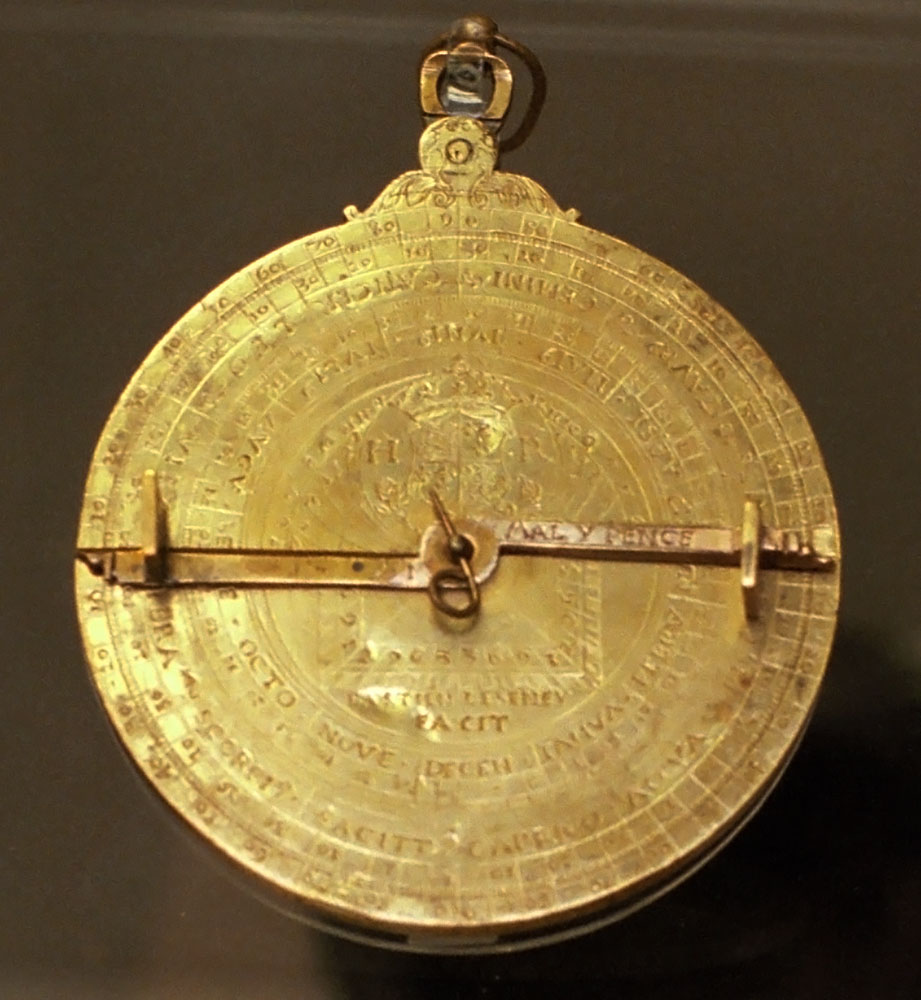
King Henry VIII’s astrolabe at the British Museum. May 1998.
From the British Museum website:
This small astrolabe, signed by Bastien Le Seney from Normandy, clockmaker to Henry VIII, is inscribed with the King’s motto and arms but surprisingly the quartering is mixed up and lions in the top left quarter face in the wrong direction.
Dimensions
Diameter: 85.5 millimetres
Thickness: 4.5 millimetres
Length: 124 millimetres (Overall length including suspension loop.)Curator’s comments
For the reversed quartering (namely England appearing in the first and fourth quarters rather than the second and third) cf. Philip Lankaster, ‘A note on some partizans with the Tudor royal arms in the Royal Armouries’, in: Royal Armouries Yearbook, 7, 2002, pp. 40-45 (Copy on file).The quality of the markings and the execution of the intrument as well as the lions in the first quarter facing sinister raise serious doubts about its authenticity as an instrument made for Henry himself.
Showtime officially picks up 4th season of “The Tudors”
This popped up all at once through various news sources, so I’ll just pick one:
From Broadcasting & Cable:
Jonathan Rhys-Meyers reign as King Henry VIII will end in 2010. Showtime has picked up a fourth and final season of drama The Tudors.
The series will return to the network for its final bow in Spring 2010, with production slated to begin this June in Dublin, Ireland.
Reminder about Q&A with Leanda deLisle
Head on over to the Lady Jane Grey Reference Site blog and submit them! The deadline is April 15.
[Please submit the questions at the link above, not at this site]
NY Times article on the “Vivat Rex!” exhibition
From The New York Times:
Just a King for His Time: Executions, Wives, Divorces and Bad Diets
THE Henry VIII whom Dickens called

