Yet another celebration of Henry VIII’s 500th!
From the British Library website:
Henry VIII: Man and Monarch
22 April
Yet another celebration of Henry VIII’s 500th!
From the British Library website:
Henry VIII: Man and Monarch
22 April
Thanks to Sandra for answering the questions and for getting back to me so quickly!

Kathy said:
What is your background?
From Historic Royal Palaces:
In 1972, Rick Wakeman, the keyboard player with the supergroup Yes, released one of the most iconic albums of all time, The Six Wives of Henry VIII.
The album was a massive success all over the world and to date has sold more than 15,000,000 copies on both vinyl and CD.
Amazingly, the music has never been performed in its entirety but all that is about to change. On 1 and 2 May, The Six Wives of Henry VIII will be performed in spectacular style on Hampton Court Palace’s West Front, to a limited audience of 5000 for each performance.
You can find out more about the event here
And just for the heck of it, here are Amazon links to the CDs:
You can have this one for about
Another event next year to mark the big Tudor anniversaries of 2009:
Tudor power, pageantry and propaganda
A one-day conference to celebrate the 500th anniversary of Henry VIII’s coronation and the 450th anniversary of Elizabeth I’s coronation
Saturday 21 March 2009
This one-day conference celebrates the 500th anniversary of Henry VIII
If I remember correctly, this portrait had been on loan to the gallery from the private owner for sometime, but now the gallery permanently owns it.
From the BBC:
Lady Dacre, and her son, Gregory Baron Dacre, by Hans Eworth, is described as “one of the finest works to be painted in Britain in the mid-16th century”.
The gallery paid just under
Okay folks, here’s your chance to ask Sandra Worth some questions! I’ll collect questions in the comments through the end of the day Wednesday, December 3rd, and then Sandra will reply in a guest post on the blog (instead of in the comments). If you’ve already thrown out a question in the previous posts about her new book, please submit them again here too so I can collect them all in one place.
Previous related posts:
http://tudorhistory.org/blog/2008/11/11/the-kings-daughter-by-sandra-worth/
http://tudorhistory.org/blog/2008/11/23/more-on-the-kings-daughter-by-sandra-worth/
[Dec. 4 – Comments are now closed. Stay tuned for Sandra’s answers!]
It’s so strange… I could have sworn that I posted this to the blog, but a search of the archives shows that I didn’t. I *did* post it over on the Movies and TV page, but not here. I remember a discussion of it, but it must have been on TudorTalk. Oh well, here it is now, if a bit late. 🙂
The Twisted Tale of Bloody Mary
Check out the site for a trailer, more about the film and ordering information.
(Thanks to Marty for the reminder!)
A virtual tour of the Young Henry VIII exhibition at Hampton Court Palace is now available on their website. For people like me stuck on the other side of the Atlantic, it is as close as I can get to seeing it in person. There are some neat paintings on display there and you can enlarge and zoom them. The rooms themselves are gorgeous too (I’m a sucker for old wood-paneled rooms).
Thanks to Tudor J. for the link and for creating such a great site!
From The BBC:
A mysterious Renaissance portrait has been identified as a painting of infamous Italian femme fatale Lucrezia Borgia by artist Dosso Dossi.
Australia’s National Gallery of Victoria said it could be the only surviving painted portrait of Lucrezia.
…
The painting will go on public display identified as Dossi’s Lucrezia Borgia later this week, following years of painstaking research, the gallery said.
…
“It has been very exciting to unlock the secrets of this beautiful and enigmatic painting, which now has unique standing in view of the fame of its sitter and the strength of the artist,” said Mr Villis.“Generations of art historians have attempted to identify portraits of Lucrezia Borgia, but this appears to be the only one which contains direct personal references to this intriguing historical figure.
Full article (with image)
Lucrezia Borgia is yet another one of those interesting Tudor-period contemporaries that I need to read more about. Tip of the French hood to Kathy for the link!

Consider this is a teaser for our upcoming open thread with the author, which will probably be during the US Thanksgiving break (Nov. 27-30). Start thinking of questions!
From Sandra Worth:
My Dear Readers,
I’m back with a new book due out December 2nd– just in time for Christmas! THE KING’S DAUGHTER: A NOVEL OF THE FIRST TUDOR QUEEN is about Elizabeth of York who you may remember closed out the epilogue in the last book of The Rose of York trilogy. You may think there’s not much more to learn about her than what you already know. You may think there’s not much more to learn about her than what you already know, but new details and research have shed light on this forgotten queen. Her story is amazing — and shocking!
What intrigued me most about Elizabeth before I began my research was how much mystery clings to her– how little is really known about her How could this be? Sister to the Princes in the Tower and mother of Henry VIII, the first Tudor queen lived at the epicenter of momentous events. So why does she hover barely visible on the fringes of history?
In fact, so little was known about her that her biographer had to resort to novelistic techniques in order to fill in the gaps of her life–the first time this was ever done! So I went researching, and slowly I found the clues I needed to explain the questions that troubled me.
Some of the questions were addressed in Richard’s story, The Rose of York, but others are downright curious. For example, why has so little survived of Elizabeth when so much is known about her husband, Henry VII, her son Henry VIII, and even her mother-in-law, Margaret Beaufort? Did the Tudors keep her captive, and why should she be a threat to them? Did she believe the Pretender, Perkin Warbeck, was really her lost brother, Richard, Duke of York–and was Henry VII in love with the Pretender’s wife?
I’ve included some reviews for you below. I hope you will read THE KING’S DAUGHTER and remember that it makes a great Christmas gift for family and friends who enjoy historical fiction. Write me when you’ve read it! You know how much I love hearing from you. Meanwhile, if you’re in the Houston area, I hope you can stop by one of my two booksignings so I can sign it for you. The information is below. I hope to see you there.
Wishing you a Merry Christmas, Season’s Greetings, and a very, very Happy New Year!
Sandra Worth
Reviews:
From the publisher: “In this groundbreaking novel, award-winning author Sandra Worth vibrantly brings to life the people

I love it when astronomy, archaeology, forensics and history come together!
From The BBC:
Researchers in Poland say they have solved a centuries-old mystery and identified the remains of astronomer Nicolaus Copernicus.
A comparison of DNA from a skeleton in Poland and strands of the astronomer’s hair found in a book in Sweden almost certainly confirm it is his skeleton.
Archaeologists found the skeleton in north-eastern Poland three years ago in a cathedral where Copernicus lived.
…
Three years ago, archaeologists dug up a skull and partial remains of a man aged about 70, Copernicus’ age when he died, near an altar at the cathedral.Jerzy Gassowski, the leader of the archaeologists’ team, said forensic facial reconstruction of the skull found that it bore a striking resemblance to existing portraits of the father of modern astronomy.
Scientists then matched the DNA from one of the skull’s teeth and a femur bone with two strands of Copernicus’ hair.
I have to admit that I was kind of amused at how they had to put in that the house was originally owned by someone related to Anne Boleyn. I guess they know what grabs the eyeballs these days! Well, and it is what caused the article to show up on my Google alerts…
From the BBC:
Prince Charles may have only recently bought his first home in Wales, but its royal connections go back centuries, an historian has discovered.
The original owner of Llwynywermod in Carmarthenshire was related to the second wife of Henry VIII, Anne Boleyn.
Mark Baker, of Prestatyn, Denbighshire, unravelled the history of what was once one of Wales’ finest homes.
…
“I have uncovered that [the house] goes back to about the 13th or 14th Centuries when it was owned by relatives of Anne Boleyn, Henry V111’s second wife.“And the Griffies-Williams family in the early 18th century were quite close to the royals and received a baronetcy.
…
Mr Baker said the house’s renaissance only began about 10 years ago when the previous owner John and Patricia Hegarty bought the farm and land for
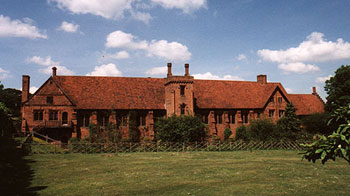
Remaining section of the Old Palace at Hatfield – Elizabeth’s residence when she became Queen.
“A Dominum factum est illud, et est mirabile in oculis notris”
“It is the Lord’s doing and it is marvelous in our eyes” – 118th Psalm
According to legend, these are the words that Elizabeth said upon hearing that her sister Mary had died and she was now Queen of England. I got a message from Heather at ElizabethI.org that the flowers we were collecting for have been sent. I doubt we’ll get a picture, but if we do I’ll be sure to post it.
And since this is also the anniversary of Mary I’s death, I’d like to say Requiscat in Pace – Rest in Peace.
Update – The Oxford Dictionary of National Biography has Elizabeth as the Life of the Day today.
[Comments are closed on older posts. If you wish to make a comment, please contact Lara via the link in the sidebar.]
This looks like fun (well, as fun as reading about women who you know met bad ends can be):
DOOMED QUEENS is a darkly humorous look at the dangers of being female and royal. Over the course of fifty illustrated and too-brief lives, it charts centuries of regal backstabbing and intrigue. Robin Maxwell, bestselling author of Mademoiselle Boleyn, described my book as “A smart, sassy overview of the
The article from the Telegraph focuses on Henry VIII’s letters to Anne Boleyn, but I’m sure a lot of you know what other treasures are in those papers. Being able to search them in this way is going to be wonderful. (Not to mention the book versions are darn heavy!)
From the article:
King Henry VIII’s passionate love letters to Anne Boleyn are to be made available to the public online for the first time.
The letters, penned by the King in 1527 when he was still married to Catherine of Aragon, reveal him to be besotted with the woman who would eventually become his second wife.
The private correspondence is among tens of thousands of Tudor documents which will be made available on the internet this week.
The documents, which are known as the State Papers and which were collected by the all-powerful Secretaries of State, provide a unique insight into key historical events such as the Reformation, the defeat of the Spanish Armada and the execution of Anne Boleyn.
…
Visitors to the site, which goes live on Tuesday 18 November, can draw up material by typing any word into its search engine. Key royal documents include those relating to the funeral of Henry VII and the succession of Henry VIII, love letters from Henry VIII, and the Dispensation by Archbishop Cranmer which allowed Henry VIII to marry Jane Seymour, who became his third wife.
…
State Papers Online, which is launched on Tuesday, contains thousands of original documents as well as summaries and translations known as calendars which were compiled in the nineteenth century.At the moment only the papers for the period 1509 to 1603 are available. But by 2010 the site will be expanded to cover the years leading up to 1714.
The “request a free trial” implies that this will be a subscription service (presumably along the lines of the OED and ODNB), so I hope my university subscribes!
From This Is Leicestershire:
Mystery surrounding one of the county’s medieval legends has been reignited after an ancient stone coffin linked to Richard III was unearthed on a building site.
The solid stone sarcophagus was discovered in the grounds of a property in Earl Shilton, by the home’s former gardener Reg Colver, where it had formed part of a water garden built in the early 1900s.
Archaeologists believe it dates from the time Richard died and could have been buried in the same church, Greyfriars, which once existed near Leicester Cathedral.
Richard Knox, of the county council’s archaeological services, said: “It is an important medieval artefact in its own right, it also shows the strength of the Bosworth myth which makes all local medieval finds somehow relevant to Richard and the Battle of Bosworth.”
…
Archaeologists have said they are confident the coffin unearthed yesterday is not that of Richard, but would never be able to rule out the possibility.Mr Knox said: “It is also quite possible that Richard’s coffin is still buried at the church at Greyfriars and was never dug up at all.”
Full article (with photo)
Seems like a tenuous link to me, but it is an interesting discovery regardless.
Previous post on the search for Richard’s bones (the news link in the post is no longer active)
Update: November 25, 2008 – Coffin to be donated to Bosworth Battlefield Heritage Center
From 24dash.com:
Ernie White, Leicestershire County Council
From The Telegraph:
For almost 500 years, the sinking of the Mary Rose has been blamed on poor seamanship and the fateful intervention of a freak gust of wind which combined to topple her over.
Now, academics believe the vessel, the pride of Henry VIII’s fleet, was actually sunk by a French warship

Since I just posted a story yesterday about a property for rent, I was going to pass by this one for sale, until I read the following sentence:
It is run as a hotel for part of the year, with visitors able to enjoy a 17th century medieval experience and six-course banquet along with typical medieval housekeeping staff.
So, what is a 17th century medieval experience? Is that anything like the 21st century renaissance experience I had last weekend? And I’m kind of scared of what a ‘medieval housekeeping staff’ would be like. (Apologies to my friends and any readers who hate hearing the word ‘medieval’ used as a colloquial term for all things bad.)
All snark aside, it is an amazing-looking house. I’m a sucker for black-and-white timbering.
Property listing (with more photos)


