Sunday Short Takes

I had a really busy week and lots of interesting stories that should have had dedicated blog posts came along, but unfortunately I just didn’t have the time to write them up. So, you get a massive link dump today instead. 🙂

* Early Journal Content on JSTOR, Free to Anyone in World – The electronic journal database JSTOR has opened up, for free access, content for which the copyright has expired.

* Oxford research ‘recreates’ Henry VIII’s Nonsuch Palace and A king’s ransom for Nonsuch Palace model – Neat reproduction of the lost palace

* Anne Boleyn gave birth to Princess Elizabeth on September 7th, 1533. Susan Walters Schmid provides an interpretation of Anne Boleyn’s life, who, even almost 500 years after her death, remains an intriguing figure. – Published on the History Today website on Elizabeth I’s birthday

* Mary Queen of Scots necklace on display – the necklace will be on display through October 31 at Annet House Museum in Linlithgow, Scotland

* Quadripartite Indenture – Indenture between Henry VII and the monks of Westminster Abbey from 1504 featured on the British Library’s Medieval and Earlier Manuscripts Blog

* McMullen Museum hosts rare treasures of British history – A great chance to see some Tudor and other British history treasures on display in the US. More information from the museum

From the “I really should pick up a lottery ticket department”:

* Homes of the Week: Castle Lodge, Ludlow – Just outside the walls of Ludlow Castle

* Up for sale at

Sunday Short Takes

* I’m sure most of you have already heard about this but the National Portrait Gallery announced last week that the funding goal for the preservation work on the Anne Boleyn portrait has been reached! They will update that page periodically with progress reports. (My original post about the needed work can be found here.)

* Vatican’s Secret Archives on display in Rome exhibition – From the article: “An appeal by the English Parliament asking the Pope to annul Henry VIII’s marriage to Catherine of Aragon will be among 100 priceless documents from the Vatican’s Secret Archives to go on display in an unprecedented exhibition in Rome.”

* Cardinal Thomas Wolsey statue unveiled in Ipswich – Pictures from the unveiling of the statue project that I’ve linked to in the past

* King Henry VIII Gets a New Coat – The Henry VIII statue at the Mary Rose Museum (my Picture of the Week #122) got a bit of a spruce up earlier this year and is now back in place

Sunday Short Takes

* Tudor coroners’ records give clue to ‘real Ophelia’ for Shakespeare – I saw a lot of articles going around last week on this discovery by Dr. Steven Gunn, but I liked the discussion in this one of safety in the period in general. I’m particularly intrigued by the fatal maypole accidents…

* Mary Arden’s Farm blog – If you’re interested in Tudor and Elizabethan daily life topics, check out this new blog from the Shakespeare Birthplace Trust

* English Heritage Free Sites Audio Tours – English Heritage has put up mp3 versions of audio tours for their free sites that you can download. Be sure to check out some of the other goodies in their multimedia library!

* Damon Albarn and the Elizabethan magical mystery man and The Mystical Artefacts Of John Dee At The British Museum – I don’t get a whole lot of hits on my “John Dee” news alert, so it was particularly surprising to get two in one week (even though they are related, prompted by a new opera)

* Gunpowder Plot documents among millions of papers put online by National Archives and Fourth and final part of State Papers Online – I’ve linked to related stories on this topic in the past and it’s nice to see that it is finally complete. Unfortunately there still doesn’t appear to be a way for individuals to access it without an institutional affiliation (which I’m lucky to have through work!).

* And finally, Mullions XP – Operating System For The Tudor Times, a fun video sent to me by Stephanie through twitter. Enjoy!

A little info on the new blog banner

If you’re reading this blog through the RSS feed and haven’t looked at the actual site in a while you probably won’t have any idea of what I’m talking about but I finally found a blog banner that I’m happy with after several months of experimentation. When I updated everything back at the start of the year to fix some issues, I updated to a new theme that had a big picture banner up at the top. I knew that I should take advantage of all that space to do something neat, so I broke out the Photoshop and starting cutting things out of portraits and mashing things together and was totally disappointed in how everything I tried turned out. Then I had a brainwave and started playing around with paintings of *places* (especially since they had good horizontal lines) and finally hit on something that I like! I know that somewhere along the way I saw a site with a similar style banner and it lodged in my head as a neat design idea. (I wish I could remember something more specific to give proper credit!)

I’ve put four new banners together (so far) but I’ll leave the other three as future surprises and switch them out every few months.

So, a little information about the first new picture banner:
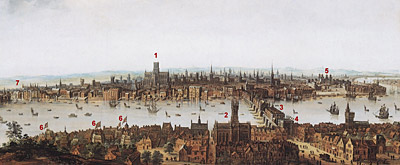

Click on the image for a larger version

London from Southwark Anglo-Dutch School c. 1630
Oil on panel (Baltic Oak) 57.7 cm x 85.7 cm (22 3/4 in x 33 3/4 in)

This version is the one at the Museum of London, which you can order a print of here. (There is a similar version at Chatsworth in the Collection of the Duke of Devonshire.) This is the earliest surviving oil painting with London as the sole subject and it shows a panorama from Whitehall on the left to past the Tower of London at the right.

I’ve added some labels to the picture above with identifications below:

1. Old St. Paul’s Cathedral. The spire was destroyed by fire in 1561 and was not re-built before the Cathedral itself was destroyed by the Great Fire in 1666

2. St. Mary Overie, re-named St. Saviour’s after the Dissolution and Southwark Cathedral since 1905.

3. Old London Bridge

4. Heads on spikes at the end of London Bridge

5. The Tower of London.

6. Four theaters (see below)

7. Whitehall and Westminster (sadly I don’t have a high-enough resolution version to pick out the exact details)

Trying to sort out which of the theaters was which on the south bank has been a challenge but they probably include some combination of The Swan, The Globe, The Hope, The Rose, or The Bear Garden (for bull and bear baiting). Part of the problem is that the painting’s date isn’t firm, and it probably drew on earlier drawings and etchings. The theaters changed several times from the late Elizabethan times through the first half of the 17th century so figuring out which ones are portrayed in this painting is hard (assuming that it even represents an accurate image of the city at the time). The one at the far left is almost certainly The Swan, and I’m thinking that the one at the far right is The Globe. The one tucked behind it might be The Rose, but I can’t be sure. If anyone finds more concrete identifications, please leave a note in the comments!

Sunday short takes

* Bess of Hardwick’s life of letters to go on display – Related: Hardwick Hall at the National Trust website

* Dr. Stephan Edwards has updated his Lady Jane Grey website Some Grey Matter with a new design and new information, including research on The Syon Portrait

* The Folger Shakespeare Library’s exhibit Manifold Greatness for the 400th anniversary of the King James Bible has a nice online companion site and there is some Tudor history content in the section on the lead-up to James’ reign and creation of the Bible. I was also thrilled to see that the only other US venue for the original version of the exhibition after its run at the Folger will be at the Harry Ransom Center at the University of Texas at Austin!

(Updated 04-19-11: I should mention that the exhibition is currently at the Bodleian Library at Oxford until September before it goes to the Folger in Washington D.C. and finally comes to the Harry Ransom Center here in Austin)

* For my fellow needleworkers, a CBS story visiting the Royal School of Needlework at Hampton Court Palace (Hopefully this video will work outside the US. If not, I apologize in advance!)

* There was a neat article with lots of images in the Daily Mail about a new reprint of Braun and Hogenberg’s Cities of the World, an atlas from the 16th century. Amazon links below, along with a couple of books that I have with Tudor-era maps that some of you may be interested in:

The Counties of Britain – A Tudor atlas by John Speed

Maps in Tudor England by P.D.A. Harvey

Midweek news round-up

Since I haven’t gotten around to a Sunday Short Takes for the last couple of weeks, here’s a midweek round-up:

* The new Fit for a King exhibit of 500 years of royal armour opens April 1 at The Tower of London. The exhibit will be on the top floor of the White Tower.

* The Anne Boleyn Files has started a calendar competition for photos of Tudor places they will be producing in 2012. Check out the details here!

* And also at the Anne Boleyn Files, a nice write-up of a lecture by David Starkey on Acton Court, Henry VIII and Anne Boleyn

Sunday Short Takes

Not quite as large a link-dump as last week. 🙂

* The Blood of Henry VIII – Site for the research into the possibility that Henry VIII had McLeod Syndrome and was positive for the Kell blood group. The researchers are also seeking permission to exhume Henry VIII for testing, although it doesn’t seem likely the Crown will approve it.

* A neat timeline of the English language from the British Library. Lots of neat documents there, including some from the Tudor period.

* A little more on the restoration work beginning at Chichester Cathedral that I mentioned last week

* And, in honor of the anniversary of the execution of Jane Parker Boleyn in 1542, The Accidental Thespian has written up her research into Lady Rochford for portraying her at the Maryland Renaissance Festival.

16th Century Danish Astronomer Tycho Brahe Exhumed


Image of Tycho Brahe from the University of Texas at Austin Department of Astronomy image collection

This is another one of those stories that comes along every so often that allows me to geek out from both the history and science perspective (and in this case, my actual career science field – astronomy!). Tycho is one of those interesting characters of science that seems to cause endless fascination, so I’m not surprised to see this. And yes, he’s the one who famously had a metal replacement nose after losing the flesh one in a duel!

From The BBC:

Danish astronomer Tycho Brahe exhumed to solve mystery

Tycho Brahe was a Danish nobleman who served as royal mathematician to the Bohemian Emperor Rudolf II.

He was thought to have died of a bladder infection, but a previous exhumation found traces of mercury in his hair.

A team of Danish and Czech scientists hope to solve the mystery by analysing bone, hair and clothing samples.

Tycho was born Tyge Ottesen Brahe in 1546 in Scania, which at the time was a Danish province, and studied astronomy at the University of Copenhagen, as well as German academic institutions.

He catalogued more than 1,000 new stars and his stellar and planetary observations helped lay the foundations of early modern astronomy.

Professor Jens Vellev, from Aarhus University, is leading the team of scientists and archaeologists which opened the tomb in Tyn Church on Monday.

He says he hopes to get better samples of hair and bones than were taken in 1901.

The use of the latest technology to test the samples may also help shed more light on the mystery of the astronomer’s death, although Professor Vellev is not promising anything.

“Perhaps, we will be able to come close to an answer, but I don’t think we will get a final answer to that question,” he said.

The scientists also hope to determine what kind of metal Brahe’s prosthesis was made of – it was commonly believed to have been gold and silver, but others suggested it might have contained copper.

Full article

More articles (all of the articles have interesting pictures):
NPR: Danish Astronomer’s Remains Exhumed In Prague
Scientific American: Was Tycho Brahe poisoned? 16th-century astronomer exhumed–again

And finally, a bunch of photos and some video from the research are available on the Opening of Tycho Brahe’s Tomb pages from Aarhus University

[Comments are closed on older posts. If you wish to make a comment, please contact Lara via the link in the sidebar.]

Sunday Short Takes

Here are several things that stacked up during my very busy week!

* Turkey presents Ottoman Sultan’s letter to Elizabeth I to UK

* Cash boost to restore Tudor dynasty church on Anglesey (This is the church that I’ve blogged about before here and here.)

* Restoration work at Stirling castle on Youtube – and here’s a link to the YouTube channel for Historic Scotland. The project is restoring parts of the castle to their appearance in the 1540s.

* A new website from the UK National Archives: legislation.gov.uk launched last week.

* Giant maze to open in Trafalgar Square – the hedge maze will be in the Square from August 2 to 6.

* And finally – the fourth and final season of The Tudors will be out on DVD in October in the US (I haven’t heard a UK release date yet, but I’ll update when I find out). Here’s a pre-order link through my Amazon affiliate account for anyone so inclined. 🙂

Connected Histories search engine

This sounds pretty cool –

From the BBC:

Search engine collects historical resources

A search engine is being created to help historians find useful sources.

The Connected History project will link up currently separate databases of source materials.
Once complete, it will give academics or members of the public a single site that lets them search all the collections.

Once completed the search engine will index digitised books, newspapers, manuscripts, genealogical records, maps and images that date from 1500-1900.

“There are a number of electronic resources that have been created by universities and by commercial providers,” said Professor Robert Shoemaker from the University of Sheffield which is heading the project. “They are all available, and all separate and some require subscriptions.”

“What we are trying to do is join them up to create an integrated search facility so you do not have to conduct more searches than necessary,” Professor Shoemaker told BBC News.

Full article

Here’s the project page from the Institute for Historical Research:
http://www.history.ac.uk/connectedhistories

And their blog:
http://connectedhistories.wordpress.com/