From The Times Online:
Early in Henry VIII

From The Times Online:
Early in Henry VIII
From The Telegraph:
A partnership with the Public Catalogue Foundation charity will see the paintings
From Forbes.com:
A collector of old books turns his fixation on the Tudors into a big exhibit celebrating England’s most colorful ruler.
Henry VIII is best known for lopping off heads, marrying six times and expanding his gut. But his legacy, insists antiquarian-book collector and Tudor enthusiast Arthur Schwarz, runs much deeper. An accomplished theologian and sportsman, Henry wrote poetry and music and displayed a keen interest in astronomy and maps. Perhaps most important in Schwarz’s view, Henry VIII broke from Rome and established the Church of England, laying the ground for an expansion of British power.
Be sure to check out the slide show and video

Bust of Henry VII by Pietro Torrigiano in the Victoria and Albert Museum, London. May 2003.
Happy 552th birthday Henry VII!
Torrigiano also sculpted the effigies of Henry, Elizabeth of York and Margaret Beaufort on their tombs in Westminster Abbey.
Kathy offered over at the Q&A blog to pass on any questions to Alison Weir (if the change arises) at the Feb. 7 workshop at the Smithsonian. Please submit any questions you have over there in that thread. Thanks for offering Kathy!
From Worcester News:
Worcester Cathedral is to be given
From The Scotsman:
Deep in an archive, more than two dozen letters written by Mary, Queen of Scots, lie largely unseen for centuries.
Many are written in a secret code as Mary fought to preserve and protect the Catholic faith in Scotland after the 1560 Reformation which saw the country break with Rome.
But soon the letters, which in recent years have only been seen by a select group of historians, will be available to view on-line.
Visitors to the Scottish Catholic Archives website will be able to examine the letters, which also contain details of Mary’s power struggle with her Protestant cousin, Queen Elizabeth, who was on the throne in England. The struggle eventually led to Mary’s execution in 1587.
Scottish Catholic Archives website
(Thanks to Linda for the reminder of this article… it fell through the cracks during the computer migration!)
Sorry I have been a little more scarce than usual with posts lately. I’ve been super busy at work and I was dealing with a dying laptop. Thankfully the second of those has been taken care of, but the first will continue for a while longer – but at least work that needs to be done on a computer will go a little faster now, courtesy of my new laptop via work (there is no way I could afford it myself right now!).
Two news posts coming shortly… I think I’m going to soak in a hot bath for a little while first. In addition to everything else, I might be coming down with a cold… no doubt courtesy of at least one of the many school children that I talked astronomy with last week!
Since I’m in a rush today, I’ll just link to the blog for the Lady Jane Grey Reference site, where you can see links to a recent Q&A about Lady Jane in the Telegraph.
And over at Executed Today – Edward Seymour, deposed Lord Protector.

Model of the Mary Rose, from the Mary Rose Museum in Portsmouth. June 2000.
As most of you know, the Mary Rose was a ship in the navy of Henry VIII that sank in 1545 and was raised in 1982. A significant portion of the ship and numerous artifacts have been brought up and are on display in a museum at the Historic Dockyard in Portsmouth. I enjoyed my visit in 2000 and I can’t wait to go back someday when the new museum is complete!
See The Mary Rose Trust website for more information on the ship and their plans for their new museum.
Some related older threads on the sinking of the Mary Rose:
http://tudorhistory.org/blog/2008/11/15/new-suggestion-for-what-sank-the-mary-rose/
http://tudorhistory.org/blog/2008/07/31/new-ideas-about-why-the-mary-rose-sank/
This is not the same project that I posted about back in November and 85% of this project is available for free. See more info below:
Putting the Complete Calendars of State Papers Online
www.british-history.ac.ukBritish History Online is pleased to announce that 200 volumes in the AHRC-funded State Papers project are now live. The goal of the project is to complete the digitisation of the Calendars of State Papers in verbatim transcriptions of at least 99.9% accuracy.
The Calendars of State Papers are summaries of hundreds of thousands of handwritten documents relating to the administration of England, and its foreign relations, in the early modern period. Highlights of the AHRC project are Letters and Papers of Henry VIII, State Papers Foreign, Elizabeth I, and State Papers, Colonial; these important documents are now freely accessible to the academic community and the general public alike.
In order to foster scholarly collaboration we have also included a feature which allows any interested user to update, correct, or enhance the calendars for the benefit of all. We plan to make the remaining 150 books in this project live within the next twelve months.
The total number of volumes on British History Online is now just over 800, of which 85 percent are completely free; the remainder

Great Hall of Warwick Castle. May 1998. Click on the photo for a larger version.
The wood buffet in the center of the photo was made in the mid-19th century from a large oak from the grounds of nearby Kenilworth Castle and shows scenes of Elizabeth I’s famous visit in 1575. The hall itself dates from the 14th century, was rebuilt in the 17th century, and then restored in the late 19th century after a fire.
Tomorrow, January 15, is the 450th anniversary of the coronation of Elizabeth I. So instead of going for something obvious like Westminster Abbey, I chose this photo of the Great Hall at Warwick. Mini trivia contest (sorry, only prize is braggin’ rights) – does anyone know the connection? It’s probably a bit esoteric, but I’ll bet some of you know why my brain linked the two. 🙂
Just a warning that I’ll be upgrading WP today around noon US Central time, so things might be unavailable or look a little weird for a time this afternoon.
Updated 1:15 p.m. – Seems like everything is working okay. And of course the blasted RSS bug is still there. I spent about three hours last night trying to fix the same problem on my science blog (since it was already at the latest version of WordPress) and I still haven’t been able to find the line in the code causing the problem. It’s very frustrating since I know what the problem is, I just can’t find the offending file with the bug!
Alisa M. Libby has a second book coming out in a few months in the US and UK that is a Young Adult novel about Kathryn Howard (pre-order links below). She’s an interesting choice of subject for a book aimed at that age group. I’ve bought a few young adult Tudor novels over the years but I’m ashamed to say I haven’t had a chance to read any of them yet, even though I know that they have been driving teen readers to my website after they get hooked on the period. I’ll have to add this one to my ‘to be read pile’ and finally read some of them one of these days!
Unfortunately this isn’t a big announcement that I have finally updated the FAQ pages that have languished untouched for far too long. But, it is my rough analysis of popular people and topics based on a year-and-half of submissions to the Tudor Q&A blog. I try to go through and erase the old emails about every six months (I just hold on to them for a little while in case I need to get back in touch with the original submitter), but I had gotten lazy and still had emails back to mid-2007. So, I decided it would be fun to glance through them and see what topics and people came up a lot. I also had saved the questions that I just answered directly (usually because the question had already been covered on the blog), so it did help give me a good idea of who and what piques people’s curiosity the most.
– By far the most-asked-about person was Anne Boleyn. And, specifically, her jewelry and her relationship with her daughter top the list. Her death, burial and remains were popular topics for discussion as well.
– The over-all most popular topic was Henry VIII and mistresses (and any resulting children). Someday I’m going to have to put together a timeline chart of all the known and rumored affairs (and any resulting children, real or rumored).
– I think “The Other Boleyn Girl” actually edged out “The Tudors” in number of inquiries prompted by Tudor fiction. But, I think that is good evidence that people are digging further into the real history after encountering the fictionalized versions.
– Jewelry is a pretty popular topic (as mentioned with Anne Boleyn), but in particular rings and ring-wearing customs have shown up a number of times.
– Jane Parker Boleyn, Lady Rochford (I never know which of her associated names to use so people will know who I’m talking about…) and Jane Seymour were asked about quite a bit, perhaps because of recent books and television since both Janes showed up in the second season of “The Tudors” and Lady Rochford was featured in a non-fiction book. With Jane Seymour starting out season three of “The Tudors” this year, I expect more questions on her in 2009.
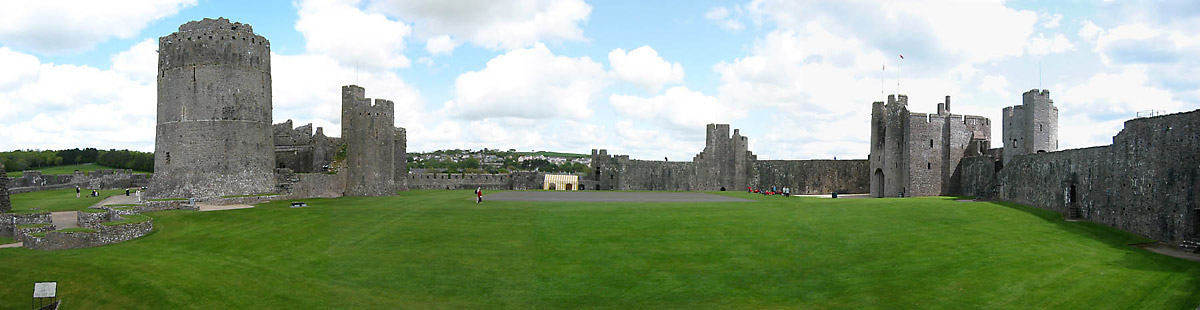
Panorama of the outer ward of Pembroke Castle, Pembrokeshire, Wales. May 2003. Click on the photo for a larger version.
It seemed appropriate to start the Picture of the Week with the birthplace of the first Tudor monarch – Henry VII.
The first castle on the site dates back to the last 11th century, but the earliest stone buildings date to the late-12th to early-13th century when William Marshall became the Earl of Pembroke. The impressive Great Tower (the round tower at the left of the photo) dates to that period.
In the mid-15th century, the earldom and castle became the property of Jasper Tudor, half-brother to King Henry VI and it was in 1457 that the young, recently-widowed Margaret Beaufort gave birth to Henry Tudor, her only child, in her brother-in-law’s castle. The tower to the far right of the photo is known as Henry VII’s tower, since he is thought to have been born in a room in that section of the castle.
I’ve been wanting to start this for a while and I decided that the beginning of the year is just the time to get going on it. The reasoning behind this is similar to part of the reason I started the (still temporarily on hold) podcast – forcing me to do a little research for things on a regular basis. I don’t think I’ll be doing lengthly write-ups for most of the photos, but even starting to write some short captions will be helpful for updating my photo gallery information. Or in the case of the first photo (coming in the next post), starting from scratch on pages that I’ve been putting off for going on 6 years now!
This one is here in the States, at the Smithsonian in Washington DC. Link to full details are at the bottom of the post.
Queen Elizabeth I

