Archive for October, 2009

More Bosworth Field investigation news

My Google news alerts went crazy with all of these articles on the Bosworth Field investigation! Here is my last post on the subject and I’ve linked to several of today’s stories below this excerpt from the Guardian article:

Five centuries of searching for one of Britain’s most significant battlefields has finally ended with the discovery of “extraordinary and unexpected” pieces of artillery in a Leicestershire field.

The finds near Market Bosworth at last pin down the notoriously “wandering site” of the battle that overthrew Richard III – the last English king to die at the head of an army – and established the Tudor dynasty and the modern state.

Surrounded by school parties still studying at least four wrong locations, a bevy of archaeologists unveiled 22 primitive pistol bullets and cannonballs, alongside soil surveys and data from metal detection over 2.7 square miles.

The revelations arise from an overlooked trough of rolling countryside two miles from the previously most widely accepted battlefield, below Ambion Hill.

The scale of the ammunition haul transforms the battle of Bosworth’s significance from a national landmark (it is usually ranked with Hastings, Naseby and the Battle of Britain) to international importance.

Glenn Foard, who led the £1m three-year survey for the Battlefields Trust, said: “We are seeing here the origins of firepower which led to an empire spanning the globe. Now this needs to be explored on every battlefield of the period in Europe.”

Pictures of stalwart yeomen with bows and arrows have been instantly outdated by the find, which shows how the battle, in 1485, was a change from previous encounters in the Wars of the Roses.

Full article

More articles:

BBC: New battle over Bosworth’s site

The Daily Mail Online: 500 years of history missed Bosworth Field by two miles

And 3 articles from Times Online:
Battle of Bosworth moves two miles, thanks to archaeologist Glenn Foard
Battle of Bosworth Field… located in the wrong field
Why the Battle of Bosworth Field is difficult to reconstruct

Update:
Here’s a video report from the BBC
and I’m also moving the link Kathy posted in the comments up here:
From the Bosworth Field Official Site: New Archaeological Find

Comments (2)


Picture of the Week #43

Wax figure of Anne of Cleves at Madame Tussauds London. Photo May 1998.

I think this is my favorite of the group. :)

Comments (3)


How to wash a giant 16th century tapestry

Posted by the Historic Royal Palaces on their YouTube page (you can watch a larger version there).

Comments


New book – The Tudors: The Complete Story of England’s Most Notorious Dynasty

I received an email about a new book on the whole Tudor dynasty that is coming out next year (apologies to the person who sent it… this post was accidentally still sitting in my drafts folder!). I don’t have any additional information about it and there isn’t much on the Amazon page, but I’m sure more will come as the publication date gets closer.

The usual Amazon pre-order links below:

Comments (4)


Real posts returning soon

Sorry I’ve been quiet for the past week, it’s been crazy at work (including two extra nights of working until 10 p.m. – thankfully my regular telescope night was rained out because three nights of working until 10 p.m. probably would have made me homicidal!). Next week will also be very busy, but I’ll do my best to keep up.

In the meantime, here’s a screen shot of my Wordpress dashboard for this blog from last week showing that, for this blog at least, 99% of the comments are spam. Thank you Akismet for making it manageable!

Comments (1)


Picture of the Week #42

Wax figure of Jane Seymour at Madame Tussauds London. Photo May 1998.

Comments (2)


New book – Cromwell to Cromwell: Reformation to Civil War

I received an email about this new book from The History PressCromwell to Cromwell: Reformation to Civil War

From the link above:

The English reformers of the 1530s, with Thomas Cromwell at their head, continued to have a strong belief in kingly rule and authority, despite their radical approach to the power of the Pope and the Roman Catholic Church. Resisting the king was tantamount to resisting God in their eyes, and even on a matter of conscience the will of the king should prevail. Yet just over 100 years later, Charles I was called the ‘man of blood’, and Oliver Cromwell famously declared that ‘we will cut off his head with the crown on it’. But how did we get from the one to the other? How did the deferential Reformation become a redical revolution? Following on from his biography of Thomas Cromwell, John Schofield examines how the English character and the way it perceived royal rule changed between the time of Thomas Cromwell and that of his great-great-grandnephew Oliver.

And here is an info sheet about the book (PDF) which includes a discount offer.

And finally, the standard Amazon affiliate links below:

Comments


UK National Archives early maps of Ireland

From the BBC:

Wild wolves, fearsome chieftains, forts, castles and sea monsters – one could be forgiven for thinking this a fairytale. But it isn’t – this was the serious business of State map making – four centuries ago. Today, for the first time, The National Archives is launching a digitised collection of Early Irish maps (c.1558 – c.1610) from the ‘State Papers Ireland’.

The collection comprises more than 70 different maps , amongst the earliest cartographic representations of Ireland, depicting plantations, fortifications and townships during the reigns of Elizabeth I and James I.

The maps were usually made in response to a particular threat, to show a siege or battle, or to help inform defence strategy against a background of ongoing clashes with Irish chieftains.

Maps were one of the English colonists’ tools, along with the written survey and the gun. They show information useful for defence, such as the location of castles and forts, difficult terrain for armies such as mountains and lakes, and strategic islands and river crossings.

The job of map making required quick-witted, brave and determined men who were willing to risk life to paint a picture of the countries beyond the seas from England.

Full article

Link to slide show of some of the maps

Link to the Irish Maps collection at the National Archives

Comments


Picture of the Week #41

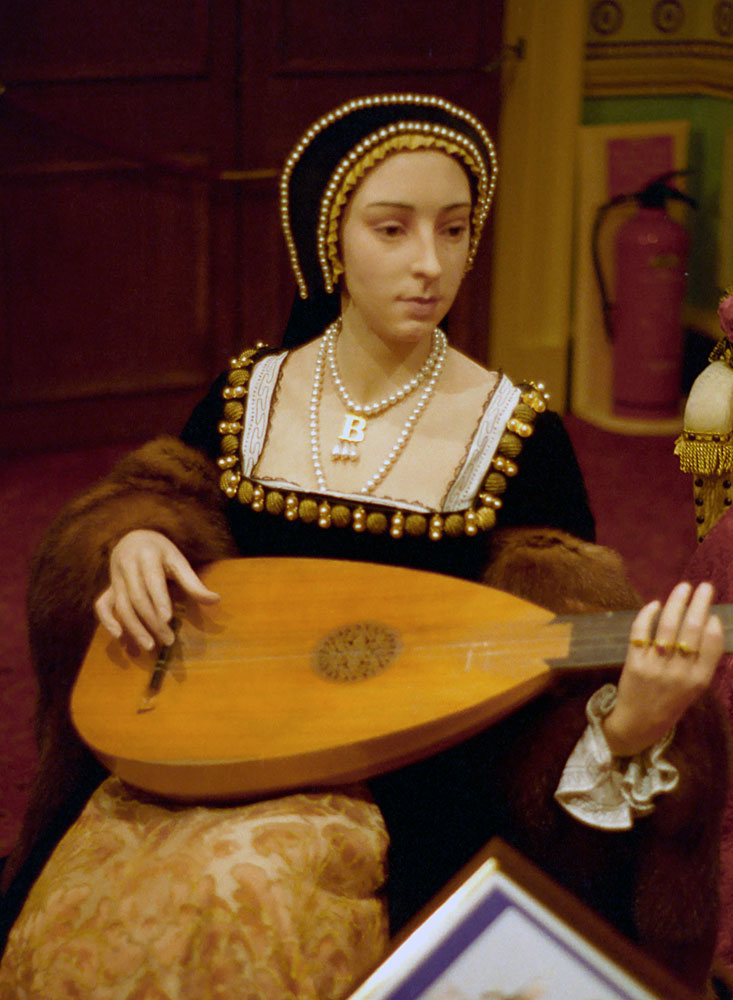
Wax figure of Anne Boleyn at Madame Tussauds London. Photo May 1998.

[This was supposed to magically appear as a pre-scheduled post as a test and it didn't work, so here it is again. - Lara]

Comments (4)


Previously unseen artifacts from the Mary Rose

The Mary Rose Trust unveiled some previously unseen artifacts as part of their new fundraising initiative that I posted about yesterday. Here is the press release and a few articles with photos of some of the artifacts.

BBC: New Mary Rose artefacts on show

The Guardian: The Mary Rose ship reveals a haul of old treasures

The Daily Mail: Saved from the sea, the secret Tudor hoard of the Mary Rose on display for the first time

Comments (2)


Five things you probably didn’t know about the Mary Rose

The Mary Rose Trust will be launching their public appeal tomorrow (Oct. 12) and have sent out this informational email. I previously mentioned the new appeal briefly here.

Five things you probably didn’t know about the Mary Rose

1. The debate continues as to why the Mary Rose mysteriously sank off the Portsmouth coast in 1545. Four of the suggested possibilities are:

* Too many cooks and not enough skilled seamen on board
* Poor communication and slow responses from an international crew
* A hole made by a French cannonball in battle led to the Mary Rose taking water onboard
* The Mary Rose was too top heavy and keeled over when changing course

2. On 19th July 1545 Henry VIII was watching his fleet set sail to battle the approaching French and saw the Mary Rose sink. So did the wife of Vice Admiral Sir George Carew, who was on board – not surprisingly, she fainted

3. Scientists have used Facial Reconstruction technology to illustrate the facial features of the crew of the Mary Rose from skulls found on board (click image for a larger view):

4. As well as iron bolts The Mary Rose was held together by thousands of wooden pegs – each one made by hand

5. Celebrated Marine Artist Geoff Hunt researched the Mary Rose for 113 hours before he began his new painting of the ship, unveiled earlier this year. His research revealed that King Henry VIII’s flagship had one more fighting castle deck than had previously been thought, fuelling speculation that it was the ship’s top heaviness that may have led to her mysterious sinking (click image for a larger view):

Links for more information:

www.maryrose500.org

www.facebook.com/MaryRose500

www.twitter.com/MaryRose500

www.youtube.com/maryrose500appeal

www.maryrose.org

www.historicdockyard.co.uk

Comments


Holbein painting of Henry VIII featured in The Bulletin

The headline made me do a double-take:

Henry VIII In Wedding Dress (1540) By Hans Holbein The Younger

I know what they meant, but of course my brain instantly jumped to a vision of Henry VIII in white satin and lace with a bridal veil.

The article is an informational one about Holbein, his painting in general and specifically his portrayal of Henry VIII. Read it here

(And while I’m on a kick of being pedantic and talking about some of my reporting pet peeves, there is one in this article. Holbein was not at the British court, he was at the English court!)

Comments (2)


Update to “Mary Queen of Scots in the Tower”

Well, I tried to update the post I made about this earlier in the week and it seems to have disappeared into the ether. In case it doesn’t reappear, here’s a link to the correction page at The Guardian which notes the error.

Comments (2)


Picture of the Week #40

Wax figure of Catherine of Aragon at Madame Tussauds London. Photo May 1998.

Comments (5)


Wolf Hall wins The Man Booker Prize

Congratulations to Hilary Mantel for winning The Man Booker Prize in Fiction with her novel about Thomas Cromwell’s rise to power, Wolf Hall.

Official website of The Man Booker Prize

Comments (3)


Oatlands exhibition now open

The exhibition that I mentioned in this post from August is now open. Here is the website for the Elmbridge Museum, which is hosting the exhibition.

Here’s an excerpt from an article in the Surrey Comet about the exhibition:

Oatlands Underfoot: Stones and Stories From a Forgotten Palace, was opened on September 26 by the mayor of Elmbridge, Councillor James Vickers.

It reveals the story of Oatlands Palace, which was built by Henry VIII and once stood near the centre of Weybridge.

Coun Vickers said: “Oatlands Underfoot is a wonderful insight into King Henry VIII’s passion for architectural opulence.

“Although very little remains today, the exhibition brings the walls back to life and offers visitors the unique opportunity to gain a greater understanding of the great monarch’s influence on the local history through the fascinating pieces which were excavated from the Oatlands site.”

Full article

Comments


William Tyndale featured at Executed Today

Comments (3)


Watch the installation of the new Constable of the Tower live

Historic Royal Palaces will be broadcasting the installation of General Sir Richard Dannatt as the 159th Constable of the Tower of London. Tune in to the website October 7!

Comments (4)


I’m probably being pedantic here…

… but this kind of set my teeth on edge:

From The Guardian:

One unfortunate consequence of being the Virgin Queen was the lack of any heir to Elizabeth I’s throne. So concerned were she and her advisers at court about the threat of her cousin, the unpredictable – and Catholic – Mary Stuart, Queen of Scots succeeding to the throne, that she was locked up in the Tower of London in 1568, and finally executed in 1587, leaving the way clear for Mary’s son, James I — a rather extreme way for a leader to ensure they get the sucessor they want.

Quote source

I know I’ve been really busy and tired of late, but my brain hasn’t melted to the point that I’m incorrect in saying that Mary Queen of Scots was never in the Tower of London, right? I know it was from a business pages article, but still…

Update: If you go to the original source now, there is a correction at the top of the page. Yay!

[The original of this post went missing when I tried to update it, so this post was recovered from the Google cache. I'll link to the cached version in the comments so people can see the original comments on this post.]

Comments (1)