Queen Elizabeth II marks Westminster anniversary

From the Westminster Abbey website:

HM The Queen, Visitor of the College of St Peter in Westminster, and HRH The Duke of Edinburgh attended a Service on Friday 21 May 2010 to Celebrate the 450th Anniversary of the Collegiate Foundation of St Peter in Westminster Abbey.

The Charter granted by Queen Elizabeth I on 21 May 1560 re-founded the former Benedictine monastery at Westminster as the Collegiate Church of St Peter under the governance of a Dean and Chapter and as a Royal Peculiar, that is not subject to bishop or archbishop but directly answerable to The Sovereign.

Read more

The Queen also unveiled a statue of Queen Elizabeth I at Westminster School, which you can see photos of here.

Treasures of Lambeth Palace Library Exhibition

From the Lambeth Palace webpage for the exhibition, which opens next Monday:

Highlights of the exhibition include:

* The MacDurnan Gospels, written and illuminated in Ireland in the 9th century

* The Lambeth Bible, masterpiece of Romanesque art

* 13th century Lambeth Apocalypse

* A Gutenberg Bible printed in 1455, the first great book printed in Western Europe from movable metal type

* Books owned and used by King Richard III, King Henry VIII, Queen Katherine of Aragon, Queen Elizabeth I and King Charles I as well as landmark texts in the history of the Church of England

* An exceptionally rare edition of the Babylonian Talmud which survived a 1553 Papal Bull ordering all copies to be burnt, which was rediscovered in 1992

* The warrant for the execution of Mary Queen of Scots

* Papers of archbishops, bishops and leaders of church and state, ranging from the 13th century to the modern day, including papers relating to the rebuilding of St Paul’s Cathedral after the Great Fire and physicians’ reports on the illness of King George III.

See the webpage for information on times, tickets, etc.

And here are a few news site articles on the event:

From the Daily Mail – Palace of treasures: Archbishop of Canterbury’s exhibition tells Britain’s story (Some good images on this article)

From The Times – Palace unveils historic hoard of a sticky-fingered prelate

From The Guardian – Lambeth Palace to exhibit 400 years of religious and royal treasures

My “Wolf Hall” review – finally!

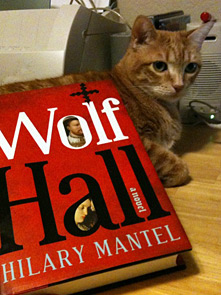
Since my cat keeps insisting that she must be on my desk while I’m working, I put her to work as a book stand.

I say “finally” since I actually finished reading the book last fall and mentioned a few months ago that I was working on a review. I’ve had some notes sitting around for a while but I’m just now getting around to trying to put those notes into a coherent commentary (albeit a short one). I’ve purposely not read any other reviews of the book beyond the headlines and snippet that show up in my Google news alerts, but even from the little bit I’ve seen I don’t think I will be adding much to the discussion that hasn’t already been said.

When I first heard about “Wolf Hall” and the author’s choice of Thomas Cromwell as the central figure my first reaction was surprise. But, after I thought about it for a while, I decided it was a refreshing choice. I don’t read a whole lot of Tudor history fiction any more for a variety of reasons, so a book that takes a person who is often portrayed as a two-dimensional villain and gives him a humanizing third dimension was a welcome change. Cromwell received a similar treatment in “The Tudors” television series.

I’m sure other reviewers have remarked on Mantel’s decision to write the book in the present tense, something I thought at first would bother me. But, between the tense (which reads as almost stream-of-consciousness at times) and the atmospheric descriptions, I found myself quickly sucked in to the story. I have never read much on Cromwell’s life outside of his role at court, so the backstory of his youth and the inclusion of his family life was all new ground for me. I know that there are some gaps in our knowledge of Cromwell’s life, so now I’m curious as to what is history and what was filled in by the author’s imagination.

Perhaps the biggest surprise of the book though was the wry humor throughout, the running joke of Thomas “Call Me” Wriothesley being just one example. When Thomas first comes in to the story he introduces himself: “My name is Wri-oth-es-ley, but wish to spare you the effort, you can call me Risley.” And pretty much every time after this he is referred to as “Call Me” or “Call Me Risley” (and I admit, I chuckled just about every time.)

If there is a negative to the book, I would say that it is not a “beginner” Tudor novel. A familiarity with the people and events of the period is helpful. (The book includes a five page cast of characters at the beginning, which is a good reference for those who don’t know the court of Henry VIII as well as most readers of this site probably do.) The only other negative that comes to mind – having to wait for the sequel!

Picture of the Week #70

Stained glass window in St. Gredifael’s Church, near Penmynydd, Wales. Photo May 2000.

Penmynydd is on the Isle of Anglesey, off the northwest coast of Wales. The area is ancenstral land of the Tudors and the great-great aunt and uncle of Henry VII are buried at the church.

The lettering around the window translates from the Welsh to “Unity is like a rose on a river bank, and like a House of Steel on the top of a mountain”. The Welsh of “House of Steel” is Ty Dur, or Tudor.

The top part of the window are parts of the royal regalia of England, the middle is a cluster of Tudor roses and the bottom part is a portcullis, which was the symbol of the Beaufort family.

This was the window that I mentioned back in 2007 had been smashed by vandals. If I remember correctly, it has since been restored, and I think they were able to incorporate some fragments of the original back in to the new window.

Sunday short takes

* The dig at Shakespeare’s New Place that I’ve mentioned previously has a website where you can follow the excavation and see what they’ve been finding: http://www.digforshakespeare.com/

* Little Miss Sunnydale has posted photos from a visit to Ludlow Castle, along with information on Princess Mary’s time there.

* Gareth Russell has been blogging the fall of Anne Boleyn as it happened in 1536.
The posts so far:
May 1st, 1536: May Day and May 2nd, 1536: The Queen’s Arrest